OAuth2 스코프
🌐 AI와 사람이 함께한 번역
이 번역은 사람의 안내를 받아 AI가 만들었습니다. 🤝
원문의 의미를 오해하거나 부자연스러워 보이는 등 오류가 있을 수 있습니다. 🤖
FastAPI에서 OAuth2 스코프를 직접 사용할 수 있으며, 자연스럽게 동작하도록 통합되어 있습니다.
이를 통해 OAuth2 표준을 따르는 더 세밀한 권한 시스템을 OpenAPI 애플리케이션(및 API 문서)에 통합할 수 있습니다.
스코프를 사용하는 OAuth2는 Facebook, Google, GitHub, Microsoft, X (Twitter) 등 많은 대형 인증 제공자가 사용하는 메커니즘입니다. 이들은 이를 통해 사용자와 애플리케이션에 특정 권한을 제공합니다.
Facebook, Google, GitHub, Microsoft, X (Twitter)로 “로그인”할 때마다, 해당 애플리케이션은 스코프가 있는 OAuth2를 사용하고 있습니다.
이 섹션에서는 FastAPI 애플리케이션에서 동일한 “스코프가 있는 OAuth2”로 인증(Authentication)과 인가(Authorization)를 관리하는 방법을 확인합니다.
경고
이 섹션은 다소 고급 내용입니다. 이제 막 시작했다면 건너뛰어도 됩니다.
OAuth2 스코프가 반드시 필요한 것은 아니며, 인증과 인가는 원하는 방식으로 처리할 수 있습니다.
하지만 스코프가 있는 OAuth2는 (OpenAPI와 함께) API 및 API 문서에 깔끔하게 통합될 수 있습니다.
그럼에도 불구하고, 해당 스코프(또는 그 밖의 어떤 보안/인가 요구사항이든)는 코드에서 필요에 맞게 직접 강제해야 합니다.
많은 경우 스코프가 있는 OAuth2는 과한 선택일 수 있습니다.
하지만 필요하다고 알고 있거나 궁금하다면 계속 읽어보세요.
OAuth2 스코프와 OpenAPI
OAuth2 사양은 “스코프(scopes)”를 공백으로 구분된 문자열 목록으로 정의합니다.
각 문자열의 내용은 어떤 형식이든 될 수 있지만, 공백을 포함하면 안 됩니다.
이 스코프들은 “권한”을 나타냅니다.
OpenAPI(예: API 문서)에서는 “security schemes”를 정의할 수 있습니다.
이 security scheme 중 하나가 OAuth2를 사용한다면, 스코프도 선언하고 사용할 수 있습니다.
각 “스코프”는 (공백 없는) 문자열일 뿐입니다.
보통 다음과 같이 특정 보안 권한을 선언하는 데 사용합니다:
users:read또는users:write는 흔한 예시입니다.instagram_basic는 Facebook/Instagram에서 사용합니다.https://www.googleapis.com/auth/drive는 Google에서 사용합니다.
참고
OAuth2에서 “스코프”는 필요한 특정 권한을 선언하는 문자열일 뿐입니다.
: 같은 다른 문자가 있거나 URL이어도 상관없습니다.
그런 세부사항은 구현에 따라 달라집니다.
OAuth2 입장에서는 그저 문자열입니다.
전체 개요
먼저, 메인 튜토리얼 - 사용자 가이드의 비밀번호(및 해싱)를 사용하는 OAuth2, JWT 토큰을 사용하는 Bearer 예제에서 어떤 부분이 바뀌는지 빠르게 살펴보겠습니다. 이제 OAuth2 스코프를 사용합니다:
from datetime import datetime, timedelta, timezone
from typing import Annotated

import jwt
from fastapi import Depends, FastAPI, HTTPException, Security, status
from fastapi.security import (
    OAuth2PasswordBearer,
    OAuth2PasswordRequestForm,
    SecurityScopes,
)
from jwt.exceptions import InvalidTokenError
from pwdlib import PasswordHash
from pydantic import BaseModel, ValidationError

# to get a string like this run:
# openssl rand -hex 32
SECRET_KEY = "09d25e094faa6ca2556c818166b7a9563b93f7099f6f0f4caa6cf63b88e8d3e7"
ALGORITHM = "HS256"
ACCESS_TOKEN_EXPIRE_MINUTES = 30


fake_users_db = {
    "johndoe": {
        "username": "johndoe",
        "full_name": "John Doe",
        "email": "johndoe@example.com",
        "hashed_password": "$argon2id$v=19$m=65536,t=3,p=4$wagCPXjifgvUFBzq4hqe3w$CYaIb8sB+wtD+Vu/P4uod1+Qof8h+1g7bbDlBID48Rc",
        "disabled": False,
    },
    "alice": {
        "username": "alice",
        "full_name": "Alice Chains",
        "email": "alicechains@example.com",
        "hashed_password": "$argon2id$v=19$m=65536,t=3,p=4$g2/AV1zwopqUntPKJavBFw$BwpRGDCyUHLvHICnwijyX8ROGoiUPwNKZ7915MeYfCE",
        "disabled": True,
    },
}


class Token(BaseModel):
    access_token: str
    token_type: str


class TokenData(BaseModel):
    username: str | None = None
    scopes: list[str] = []


class User(BaseModel):
    username: str
    email: str | None = None
    full_name: str | None = None
    disabled: bool | None = None


class UserInDB(User):
    hashed_password: str


password_hash = PasswordHash.recommended()

DUMMY_HASH = password_hash.hash("dummypassword")

oauth2_scheme = OAuth2PasswordBearer(
    tokenUrl="token",
    scopes={"me": "Read information about the current user.", "items": "Read items."},
)

app = FastAPI()


def verify_password(plain_password, hashed_password):
    return password_hash.verify(plain_password, hashed_password)


def get_password_hash(password):
    return password_hash.hash(password)


def get_user(db, username: str):
    if username in db:
        user_dict = db[username]
        return UserInDB(**user_dict)


def authenticate_user(fake_db, username: str, password: str):
    user = get_user(fake_db, username)
    if not user:
        verify_password(password, DUMMY_HASH)
        return False
    if not verify_password(password, user.hashed_password):
        return False
    return user


def create_access_token(data: dict, expires_delta: timedelta | None = None):
    to_encode = data.copy()
    if expires_delta:
        expire = datetime.now(timezone.utc) + expires_delta
    else:
        expire = datetime.now(timezone.utc) + timedelta(minutes=15)
    to_encode.update({"exp": expire})
    encoded_jwt = jwt.encode(to_encode, SECRET_KEY, algorithm=ALGORITHM)
    return encoded_jwt


async def get_current_user(
    security_scopes: SecurityScopes, token: Annotated[str, Depends(oauth2_scheme)]
):
    if security_scopes.scopes:
        authenticate_value = f'Bearer scope="{security_scopes.scope_str}"'
    else:
        authenticate_value = "Bearer"
    credentials_exception = HTTPException(
        status_code=status.HTTP_401_UNAUTHORIZED,
        detail="Could not validate credentials",
        headers={"WWW-Authenticate": authenticate_value},
    )
    try:
        payload = jwt.decode(token, SECRET_KEY, algorithms=[ALGORITHM])
        username = payload.get("sub")
        if username is None:
            raise credentials_exception
        scope: str = payload.get("scope", "")
        token_scopes = scope.split(" ")
        token_data = TokenData(scopes=token_scopes, username=username)
    except (InvalidTokenError, ValidationError):
        raise credentials_exception
    user = get_user(fake_users_db, username=token_data.username)
    if user is None:
        raise credentials_exception
    for scope in security_scopes.scopes:
        if scope not in token_data.scopes:
            raise HTTPException(
                status_code=status.HTTP_401_UNAUTHORIZED,
                detail="Not enough permissions",
                headers={"WWW-Authenticate": authenticate_value},
            )
    return user


async def get_current_active_user(
    current_user: Annotated[User, Security(get_current_user, scopes=["me"])],
):
    if current_user.disabled:
        raise HTTPException(status_code=400, detail="Inactive user")
    return current_user


@app.post("/token")
async def login_for_access_token(
    form_data: Annotated[OAuth2PasswordRequestForm, Depends()],
) -> Token:
    user = authenticate_user(fake_users_db, form_data.username, form_data.password)
    if not user:
        raise HTTPException(status_code=400, detail="Incorrect username or password")
    access_token_expires = timedelta(minutes=ACCESS_TOKEN_EXPIRE_MINUTES)
    access_token = create_access_token(
        data={"sub": user.username, "scope": " ".join(form_data.scopes)},
        expires_delta=access_token_expires,
    )
    return Token(access_token=access_token, token_type="bearer")


@app.get("/users/me/")
async def read_users_me(
    current_user: Annotated[User, Depends(get_current_active_user)],
) -> User:
    return current_user


@app.get("/users/me/items/")
async def read_own_items(
    current_user: Annotated[User, Security(get_current_active_user, scopes=["items"])],
):
    return [{"item_id": "Foo", "owner": current_user.username}]


@app.get("/status/")
async def read_system_status(current_user: Annotated[User, Depends(get_current_user)]):
    return {"status": "ok"}
🤓 Other versions and variants
Tip
Prefer to use the Annotated version if possible.
from datetime import datetime, timedelta, timezone

import jwt
from fastapi import Depends, FastAPI, HTTPException, Security, status
from fastapi.security import (
    OAuth2PasswordBearer,
    OAuth2PasswordRequestForm,
    SecurityScopes,
)
from jwt.exceptions import InvalidTokenError
from pwdlib import PasswordHash
from pydantic import BaseModel, ValidationError

# to get a string like this run:
# openssl rand -hex 32
SECRET_KEY = "09d25e094faa6ca2556c818166b7a9563b93f7099f6f0f4caa6cf63b88e8d3e7"
ALGORITHM = "HS256"
ACCESS_TOKEN_EXPIRE_MINUTES = 30


fake_users_db = {
    "johndoe": {
        "username": "johndoe",
        "full_name": "John Doe",
        "email": "johndoe@example.com",
        "hashed_password": "$argon2id$v=19$m=65536,t=3,p=4$wagCPXjifgvUFBzq4hqe3w$CYaIb8sB+wtD+Vu/P4uod1+Qof8h+1g7bbDlBID48Rc",
        "disabled": False,
    },
    "alice": {
        "username": "alice",
        "full_name": "Alice Chains",
        "email": "alicechains@example.com",
        "hashed_password": "$argon2id$v=19$m=65536,t=3,p=4$g2/AV1zwopqUntPKJavBFw$BwpRGDCyUHLvHICnwijyX8ROGoiUPwNKZ7915MeYfCE",
        "disabled": True,
    },
}


class Token(BaseModel):
    access_token: str
    token_type: str


class TokenData(BaseModel):
    username: str | None = None
    scopes: list[str] = []


class User(BaseModel):
    username: str
    email: str | None = None
    full_name: str | None = None
    disabled: bool | None = None


class UserInDB(User):
    hashed_password: str


password_hash = PasswordHash.recommended()

DUMMY_HASH = password_hash.hash("dummypassword")

oauth2_scheme = OAuth2PasswordBearer(
    tokenUrl="token",
    scopes={"me": "Read information about the current user.", "items": "Read items."},
)

app = FastAPI()


def verify_password(plain_password, hashed_password):
    return password_hash.verify(plain_password, hashed_password)


def get_password_hash(password):
    return password_hash.hash(password)


def get_user(db, username: str):
    if username in db:
        user_dict = db[username]
        return UserInDB(**user_dict)


def authenticate_user(fake_db, username: str, password: str):
    user = get_user(fake_db, username)
    if not user:
        verify_password(password, DUMMY_HASH)
        return False
    if not verify_password(password, user.hashed_password):
        return False
    return user


def create_access_token(data: dict, expires_delta: timedelta | None = None):
    to_encode = data.copy()
    if expires_delta:
        expire = datetime.now(timezone.utc) + expires_delta
    else:
        expire = datetime.now(timezone.utc) + timedelta(minutes=15)
    to_encode.update({"exp": expire})
    encoded_jwt = jwt.encode(to_encode, SECRET_KEY, algorithm=ALGORITHM)
    return encoded_jwt


async def get_current_user(
    security_scopes: SecurityScopes, token: str = Depends(oauth2_scheme)
):
    if security_scopes.scopes:
        authenticate_value = f'Bearer scope="{security_scopes.scope_str}"'
    else:
        authenticate_value = "Bearer"
    credentials_exception = HTTPException(
        status_code=status.HTTP_401_UNAUTHORIZED,
        detail="Could not validate credentials",
        headers={"WWW-Authenticate": authenticate_value},
    )
    try:
        payload = jwt.decode(token, SECRET_KEY, algorithms=[ALGORITHM])
        username: str = payload.get("sub")
        if username is None:
            raise credentials_exception
        scope: str = payload.get("scope", "")
        token_scopes = scope.split(" ")
        token_data = TokenData(scopes=token_scopes, username=username)
    except (InvalidTokenError, ValidationError):
        raise credentials_exception
    user = get_user(fake_users_db, username=token_data.username)
    if user is None:
        raise credentials_exception
    for scope in security_scopes.scopes:
        if scope not in token_data.scopes:
            raise HTTPException(
                status_code=status.HTTP_401_UNAUTHORIZED,
                detail="Not enough permissions",
                headers={"WWW-Authenticate": authenticate_value},
            )
    return user


async def get_current_active_user(
    current_user: User = Security(get_current_user, scopes=["me"]),
):
    if current_user.disabled:
        raise HTTPException(status_code=400, detail="Inactive user")
    return current_user


@app.post("/token")
async def login_for_access_token(
    form_data: OAuth2PasswordRequestForm = Depends(),
) -> Token:
    user = authenticate_user(fake_users_db, form_data.username, form_data.password)
    if not user:
        raise HTTPException(status_code=400, detail="Incorrect username or password")
    access_token_expires = timedelta(minutes=ACCESS_TOKEN_EXPIRE_MINUTES)
    access_token = create_access_token(
        data={"sub": user.username, "scope": " ".join(form_data.scopes)},
        expires_delta=access_token_expires,
    )
    return Token(access_token=access_token, token_type="bearer")


@app.get("/users/me/")
async def read_users_me(current_user: User = Depends(get_current_active_user)) -> User:
    return current_user


@app.get("/users/me/items/")
async def read_own_items(
    current_user: User = Security(get_current_active_user, scopes=["items"]),
):
    return [{"item_id": "Foo", "owner": current_user.username}]


@app.get("/status/")
async def read_system_status(current_user: User = Depends(get_current_user)):
    return {"status": "ok"}
이제 변경 사항을 단계별로 살펴보겠습니다.
OAuth2 보안 스킴
첫 번째 변경 사항은 이제 사용 가능한 스코프 2개(me, items)로 OAuth2 보안 스킴을 선언한다는 점입니다.
scopes 매개변수는 각 스코프를 키로 하고, 설명을 값으로 하는 dict를 받습니다:
from datetime import datetime, timedelta, timezone
from typing import Annotated

import jwt
from fastapi import Depends, FastAPI, HTTPException, Security, status
from fastapi.security import (
    OAuth2PasswordBearer,
    OAuth2PasswordRequestForm,
    SecurityScopes,
)
from jwt.exceptions import InvalidTokenError
from pwdlib import PasswordHash
from pydantic import BaseModel, ValidationError

# to get a string like this run:
# openssl rand -hex 32
SECRET_KEY = "09d25e094faa6ca2556c818166b7a9563b93f7099f6f0f4caa6cf63b88e8d3e7"
ALGORITHM = "HS256"
ACCESS_TOKEN_EXPIRE_MINUTES = 30


fake_users_db = {
    "johndoe": {
        "username": "johndoe",
        "full_name": "John Doe",
        "email": "johndoe@example.com",
        "hashed_password": "$argon2id$v=19$m=65536,t=3,p=4$wagCPXjifgvUFBzq4hqe3w$CYaIb8sB+wtD+Vu/P4uod1+Qof8h+1g7bbDlBID48Rc",
        "disabled": False,
    },
    "alice": {
        "username": "alice",
        "full_name": "Alice Chains",
        "email": "alicechains@example.com",
        "hashed_password": "$argon2id$v=19$m=65536,t=3,p=4$g2/AV1zwopqUntPKJavBFw$BwpRGDCyUHLvHICnwijyX8ROGoiUPwNKZ7915MeYfCE",
        "disabled": True,
    },
}


class Token(BaseModel):
    access_token: str
    token_type: str


class TokenData(BaseModel):
    username: str | None = None
    scopes: list[str] = []


class User(BaseModel):
    username: str
    email: str | None = None
    full_name: str | None = None
    disabled: bool | None = None


class UserInDB(User):
    hashed_password: str


password_hash = PasswordHash.recommended()

DUMMY_HASH = password_hash.hash("dummypassword")

oauth2_scheme = OAuth2PasswordBearer(
    tokenUrl="token",
    scopes={"me": "Read information about the current user.", "items": "Read items."},
)

app = FastAPI()


def verify_password(plain_password, hashed_password):
    return password_hash.verify(plain_password, hashed_password)


def get_password_hash(password):
    return password_hash.hash(password)


def get_user(db, username: str):
    if username in db:
        user_dict = db[username]
        return UserInDB(**user_dict)


def authenticate_user(fake_db, username: str, password: str):
    user = get_user(fake_db, username)
    if not user:
        verify_password(password, DUMMY_HASH)
        return False
    if not verify_password(password, user.hashed_password):
        return False
    return user


def create_access_token(data: dict, expires_delta: timedelta | None = None):
    to_encode = data.copy()
    if expires_delta:
        expire = datetime.now(timezone.utc) + expires_delta
    else:
        expire = datetime.now(timezone.utc) + timedelta(minutes=15)
    to_encode.update({"exp": expire})
    encoded_jwt = jwt.encode(to_encode, SECRET_KEY, algorithm=ALGORITHM)
    return encoded_jwt


async def get_current_user(
    security_scopes: SecurityScopes, token: Annotated[str, Depends(oauth2_scheme)]
):
    if security_scopes.scopes:
        authenticate_value = f'Bearer scope="{security_scopes.scope_str}"'
    else:
        authenticate_value = "Bearer"
    credentials_exception = HTTPException(
        status_code=status.HTTP_401_UNAUTHORIZED,
        detail="Could not validate credentials",
        headers={"WWW-Authenticate": authenticate_value},
    )
    try:
        payload = jwt.decode(token, SECRET_KEY, algorithms=[ALGORITHM])
        username = payload.get("sub")
        if username is None:
            raise credentials_exception
        scope: str = payload.get("scope", "")
        token_scopes = scope.split(" ")
        token_data = TokenData(scopes=token_scopes, username=username)
    except (InvalidTokenError, ValidationError):
        raise credentials_exception
    user = get_user(fake_users_db, username=token_data.username)
    if user is None:
        raise credentials_exception
    for scope in security_scopes.scopes:
        if scope not in token_data.scopes:
            raise HTTPException(
                status_code=status.HTTP_401_UNAUTHORIZED,
                detail="Not enough permissions",
                headers={"WWW-Authenticate": authenticate_value},
            )
    return user


async def get_current_active_user(
    current_user: Annotated[User, Security(get_current_user, scopes=["me"])],
):
    if current_user.disabled:
        raise HTTPException(status_code=400, detail="Inactive user")
    return current_user


@app.post("/token")
async def login_for_access_token(
    form_data: Annotated[OAuth2PasswordRequestForm, Depends()],
) -> Token:
    user = authenticate_user(fake_users_db, form_data.username, form_data.password)
    if not user:
        raise HTTPException(status_code=400, detail="Incorrect username or password")
    access_token_expires = timedelta(minutes=ACCESS_TOKEN_EXPIRE_MINUTES)
    access_token = create_access_token(
        data={"sub": user.username, "scope": " ".join(form_data.scopes)},
        expires_delta=access_token_expires,
    )
    return Token(access_token=access_token, token_type="bearer")


@app.get("/users/me/")
async def read_users_me(
    current_user: Annotated[User, Depends(get_current_active_user)],
) -> User:
    return current_user


@app.get("/users/me/items/")
async def read_own_items(
    current_user: Annotated[User, Security(get_current_active_user, scopes=["items"])],
):
    return [{"item_id": "Foo", "owner": current_user.username}]


@app.get("/status/")
async def read_system_status(current_user: Annotated[User, Depends(get_current_user)]):
    return {"status": "ok"}
🤓 Other versions and variants
Tip
Prefer to use the Annotated version if possible.
from datetime import datetime, timedelta, timezone

import jwt
from fastapi import Depends, FastAPI, HTTPException, Security, status
from fastapi.security import (
    OAuth2PasswordBearer,
    OAuth2PasswordRequestForm,
    SecurityScopes,
)
from jwt.exceptions import InvalidTokenError
from pwdlib import PasswordHash
from pydantic import BaseModel, ValidationError

# to get a string like this run:
# openssl rand -hex 32
SECRET_KEY = "09d25e094faa6ca2556c818166b7a9563b93f7099f6f0f4caa6cf63b88e8d3e7"
ALGORITHM = "HS256"
ACCESS_TOKEN_EXPIRE_MINUTES = 30


fake_users_db = {
    "johndoe": {
        "username": "johndoe",
        "full_name": "John Doe",
        "email": "johndoe@example.com",
        "hashed_password": "$argon2id$v=19$m=65536,t=3,p=4$wagCPXjifgvUFBzq4hqe3w$CYaIb8sB+wtD+Vu/P4uod1+Qof8h+1g7bbDlBID48Rc",
        "disabled": False,
    },
    "alice": {
        "username": "alice",
        "full_name": "Alice Chains",
        "email": "alicechains@example.com",
        "hashed_password": "$argon2id$v=19$m=65536,t=3,p=4$g2/AV1zwopqUntPKJavBFw$BwpRGDCyUHLvHICnwijyX8ROGoiUPwNKZ7915MeYfCE",
        "disabled": True,
    },
}


class Token(BaseModel):
    access_token: str
    token_type: str


class TokenData(BaseModel):
    username: str | None = None
    scopes: list[str] = []


class User(BaseModel):
    username: str
    email: str | None = None
    full_name: str | None = None
    disabled: bool | None = None


class UserInDB(User):
    hashed_password: str


password_hash = PasswordHash.recommended()

DUMMY_HASH = password_hash.hash("dummypassword")

oauth2_scheme = OAuth2PasswordBearer(
    tokenUrl="token",
    scopes={"me": "Read information about the current user.", "items": "Read items."},
)

app = FastAPI()


def verify_password(plain_password, hashed_password):
    return password_hash.verify(plain_password, hashed_password)


def get_password_hash(password):
    return password_hash.hash(password)


def get_user(db, username: str):
    if username in db:
        user_dict = db[username]
        return UserInDB(**user_dict)


def authenticate_user(fake_db, username: str, password: str):
    user = get_user(fake_db, username)
    if not user:
        verify_password(password, DUMMY_HASH)
        return False
    if not verify_password(password, user.hashed_password):
        return False
    return user


def create_access_token(data: dict, expires_delta: timedelta | None = None):
    to_encode = data.copy()
    if expires_delta:
        expire = datetime.now(timezone.utc) + expires_delta
    else:
        expire = datetime.now(timezone.utc) + timedelta(minutes=15)
    to_encode.update({"exp": expire})
    encoded_jwt = jwt.encode(to_encode, SECRET_KEY, algorithm=ALGORITHM)
    return encoded_jwt


async def get_current_user(
    security_scopes: SecurityScopes, token: str = Depends(oauth2_scheme)
):
    if security_scopes.scopes:
        authenticate_value = f'Bearer scope="{security_scopes.scope_str}"'
    else:
        authenticate_value = "Bearer"
    credentials_exception = HTTPException(
        status_code=status.HTTP_401_UNAUTHORIZED,
        detail="Could not validate credentials",
        headers={"WWW-Authenticate": authenticate_value},
    )
    try:
        payload = jwt.decode(token, SECRET_KEY, algorithms=[ALGORITHM])
        username: str = payload.get("sub")
        if username is None:
            raise credentials_exception
        scope: str = payload.get("scope", "")
        token_scopes = scope.split(" ")
        token_data = TokenData(scopes=token_scopes, username=username)
    except (InvalidTokenError, ValidationError):
        raise credentials_exception
    user = get_user(fake_users_db, username=token_data.username)
    if user is None:
        raise credentials_exception
    for scope in security_scopes.scopes:
        if scope not in token_data.scopes:
            raise HTTPException(
                status_code=status.HTTP_401_UNAUTHORIZED,
                detail="Not enough permissions",
                headers={"WWW-Authenticate": authenticate_value},
            )
    return user


async def get_current_active_user(
    current_user: User = Security(get_current_user, scopes=["me"]),
):
    if current_user.disabled:
        raise HTTPException(status_code=400, detail="Inactive user")
    return current_user


@app.post("/token")
async def login_for_access_token(
    form_data: OAuth2PasswordRequestForm = Depends(),
) -> Token:
    user = authenticate_user(fake_users_db, form_data.username, form_data.password)
    if not user:
        raise HTTPException(status_code=400, detail="Incorrect username or password")
    access_token_expires = timedelta(minutes=ACCESS_TOKEN_EXPIRE_MINUTES)
    access_token = create_access_token(
        data={"sub": user.username, "scope": " ".join(form_data.scopes)},
        expires_delta=access_token_expires,
    )
    return Token(access_token=access_token, token_type="bearer")


@app.get("/users/me/")
async def read_users_me(current_user: User = Depends(get_current_active_user)) -> User:
    return current_user


@app.get("/users/me/items/")
async def read_own_items(
    current_user: User = Security(get_current_active_user, scopes=["items"]),
):
    return [{"item_id": "Foo", "owner": current_user.username}]


@app.get("/status/")
async def read_system_status(current_user: User = Depends(get_current_user)):
    return {"status": "ok"}
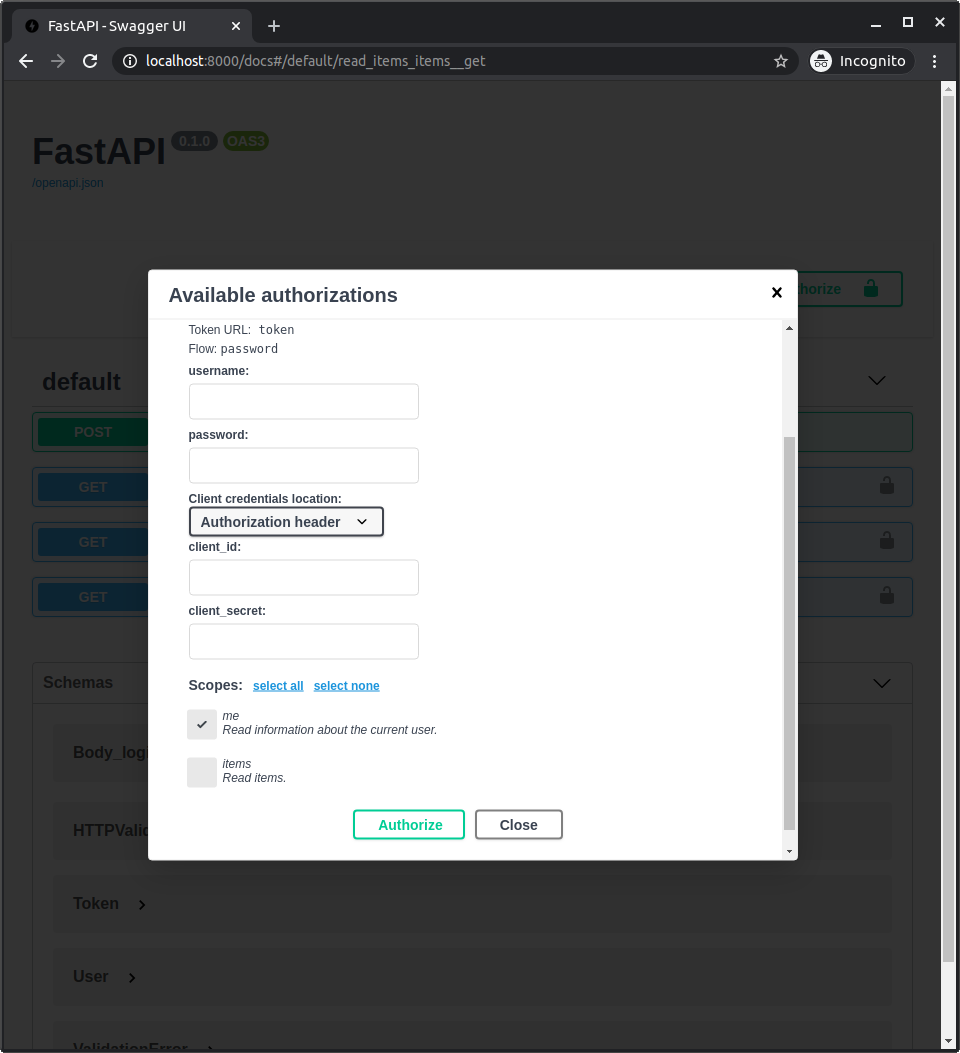
이제 스코프를 선언했기 때문에, 로그인/인가할 때 API 문서에 스코프가 표시됩니다.
그리고 접근을 허용할 스코프를 선택할 수 있게 됩니다: me와 items.
이는 Facebook, Google, GitHub 등으로 로그인하면서 권한을 부여할 때 사용되는 것과 동일한 메커니즘입니다:
스코프를 포함한 JWT 토큰
이제 토큰 경로 처리를 수정해, 요청된 스코프를 반환하도록 합니다.
여전히 동일한 OAuth2PasswordRequestForm을 사용합니다. 여기에는 요청에서 받은 각 스코프를 담는 scopes 속성이 있으며, 타입은 str의 list입니다.
그리고 JWT 토큰의 일부로 스코프를 반환합니다.
위험
단순화를 위해, 여기서는 요청으로 받은 스코프를 그대로 토큰에 추가하고 있습니다.
하지만 실제 애플리케이션에서는 보안을 위해, 사용자가 실제로 가질 수 있는 스코프만(또는 미리 정의한 것만) 추가하도록 반드시 확인해야 합니다.
from datetime import datetime, timedelta, timezone
from typing import Annotated

import jwt
from fastapi import Depends, FastAPI, HTTPException, Security, status
from fastapi.security import (
    OAuth2PasswordBearer,
    OAuth2PasswordRequestForm,
    SecurityScopes,
)
from jwt.exceptions import InvalidTokenError
from pwdlib import PasswordHash
from pydantic import BaseModel, ValidationError

# to get a string like this run:
# openssl rand -hex 32
SECRET_KEY = "09d25e094faa6ca2556c818166b7a9563b93f7099f6f0f4caa6cf63b88e8d3e7"
ALGORITHM = "HS256"
ACCESS_TOKEN_EXPIRE_MINUTES = 30


fake_users_db = {
    "johndoe": {
        "username": "johndoe",
        "full_name": "John Doe",
        "email": "johndoe@example.com",
        "hashed_password": "$argon2id$v=19$m=65536,t=3,p=4$wagCPXjifgvUFBzq4hqe3w$CYaIb8sB+wtD+Vu/P4uod1+Qof8h+1g7bbDlBID48Rc",
        "disabled": False,
    },
    "alice": {
        "username": "alice",
        "full_name": "Alice Chains",
        "email": "alicechains@example.com",
        "hashed_password": "$argon2id$v=19$m=65536,t=3,p=4$g2/AV1zwopqUntPKJavBFw$BwpRGDCyUHLvHICnwijyX8ROGoiUPwNKZ7915MeYfCE",
        "disabled": True,
    },
}


class Token(BaseModel):
    access_token: str
    token_type: str


class TokenData(BaseModel):
    username: str | None = None
    scopes: list[str] = []


class User(BaseModel):
    username: str
    email: str | None = None
    full_name: str | None = None
    disabled: bool | None = None


class UserInDB(User):
    hashed_password: str


password_hash = PasswordHash.recommended()

DUMMY_HASH = password_hash.hash("dummypassword")

oauth2_scheme = OAuth2PasswordBearer(
    tokenUrl="token",
    scopes={"me": "Read information about the current user.", "items": "Read items."},
)

app = FastAPI()


def verify_password(plain_password, hashed_password):
    return password_hash.verify(plain_password, hashed_password)


def get_password_hash(password):
    return password_hash.hash(password)


def get_user(db, username: str):
    if username in db:
        user_dict = db[username]
        return UserInDB(**user_dict)


def authenticate_user(fake_db, username: str, password: str):
    user = get_user(fake_db, username)
    if not user:
        verify_password(password, DUMMY_HASH)
        return False
    if not verify_password(password, user.hashed_password):
        return False
    return user


def create_access_token(data: dict, expires_delta: timedelta | None = None):
    to_encode = data.copy()
    if expires_delta:
        expire = datetime.now(timezone.utc) + expires_delta
    else:
        expire = datetime.now(timezone.utc) + timedelta(minutes=15)
    to_encode.update({"exp": expire})
    encoded_jwt = jwt.encode(to_encode, SECRET_KEY, algorithm=ALGORITHM)
    return encoded_jwt


async def get_current_user(
    security_scopes: SecurityScopes, token: Annotated[str, Depends(oauth2_scheme)]
):
    if security_scopes.scopes:
        authenticate_value = f'Bearer scope="{security_scopes.scope_str}"'
    else:
        authenticate_value = "Bearer"
    credentials_exception = HTTPException(
        status_code=status.HTTP_401_UNAUTHORIZED,
        detail="Could not validate credentials",
        headers={"WWW-Authenticate": authenticate_value},
    )
    try:
        payload = jwt.decode(token, SECRET_KEY, algorithms=[ALGORITHM])
        username = payload.get("sub")
        if username is None:
            raise credentials_exception
        scope: str = payload.get("scope", "")
        token_scopes = scope.split(" ")
        token_data = TokenData(scopes=token_scopes, username=username)
    except (InvalidTokenError, ValidationError):
        raise credentials_exception
    user = get_user(fake_users_db, username=token_data.username)
    if user is None:
        raise credentials_exception
    for scope in security_scopes.scopes:
        if scope not in token_data.scopes:
            raise HTTPException(
                status_code=status.HTTP_401_UNAUTHORIZED,
                detail="Not enough permissions",
                headers={"WWW-Authenticate": authenticate_value},
            )
    return user


async def get_current_active_user(
    current_user: Annotated[User, Security(get_current_user, scopes=["me"])],
):
    if current_user.disabled:
        raise HTTPException(status_code=400, detail="Inactive user")
    return current_user


@app.post("/token")
async def login_for_access_token(
    form_data: Annotated[OAuth2PasswordRequestForm, Depends()],
) -> Token:
    user = authenticate_user(fake_users_db, form_data.username, form_data.password)
    if not user:
        raise HTTPException(status_code=400, detail="Incorrect username or password")
    access_token_expires = timedelta(minutes=ACCESS_TOKEN_EXPIRE_MINUTES)
    access_token = create_access_token(
        data={"sub": user.username, "scope": " ".join(form_data.scopes)},
        expires_delta=access_token_expires,
    )
    return Token(access_token=access_token, token_type="bearer")


@app.get("/users/me/")
async def read_users_me(
    current_user: Annotated[User, Depends(get_current_active_user)],
) -> User:
    return current_user


@app.get("/users/me/items/")
async def read_own_items(
    current_user: Annotated[User, Security(get_current_active_user, scopes=["items"])],
):
    return [{"item_id": "Foo", "owner": current_user.username}]


@app.get("/status/")
async def read_system_status(current_user: Annotated[User, Depends(get_current_user)]):
    return {"status": "ok"}
🤓 Other versions and variants
Tip
Prefer to use the Annotated version if possible.
from datetime import datetime, timedelta, timezone

import jwt
from fastapi import Depends, FastAPI, HTTPException, Security, status
from fastapi.security import (
    OAuth2PasswordBearer,
    OAuth2PasswordRequestForm,
    SecurityScopes,
)
from jwt.exceptions import InvalidTokenError
from pwdlib import PasswordHash
from pydantic import BaseModel, ValidationError

# to get a string like this run:
# openssl rand -hex 32
SECRET_KEY = "09d25e094faa6ca2556c818166b7a9563b93f7099f6f0f4caa6cf63b88e8d3e7"
ALGORITHM = "HS256"
ACCESS_TOKEN_EXPIRE_MINUTES = 30


fake_users_db = {
    "johndoe": {
        "username": "johndoe",
        "full_name": "John Doe",
        "email": "johndoe@example.com",
        "hashed_password": "$argon2id$v=19$m=65536,t=3,p=4$wagCPXjifgvUFBzq4hqe3w$CYaIb8sB+wtD+Vu/P4uod1+Qof8h+1g7bbDlBID48Rc",
        "disabled": False,
    },
    "alice": {
        "username": "alice",
        "full_name": "Alice Chains",
        "email": "alicechains@example.com",
        "hashed_password": "$argon2id$v=19$m=65536,t=3,p=4$g2/AV1zwopqUntPKJavBFw$BwpRGDCyUHLvHICnwijyX8ROGoiUPwNKZ7915MeYfCE",
        "disabled": True,
    },
}


class Token(BaseModel):
    access_token: str
    token_type: str


class TokenData(BaseModel):
    username: str | None = None
    scopes: list[str] = []


class User(BaseModel):
    username: str
    email: str | None = None
    full_name: str | None = None
    disabled: bool | None = None


class UserInDB(User):
    hashed_password: str


password_hash = PasswordHash.recommended()

DUMMY_HASH = password_hash.hash("dummypassword")

oauth2_scheme = OAuth2PasswordBearer(
    tokenUrl="token",
    scopes={"me": "Read information about the current user.", "items": "Read items."},
)

app = FastAPI()


def verify_password(plain_password, hashed_password):
    return password_hash.verify(plain_password, hashed_password)


def get_password_hash(password):
    return password_hash.hash(password)


def get_user(db, username: str):
    if username in db:
        user_dict = db[username]
        return UserInDB(**user_dict)


def authenticate_user(fake_db, username: str, password: str):
    user = get_user(fake_db, username)
    if not user:
        verify_password(password, DUMMY_HASH)
        return False
    if not verify_password(password, user.hashed_password):
        return False
    return user


def create_access_token(data: dict, expires_delta: timedelta | None = None):
    to_encode = data.copy()
    if expires_delta:
        expire = datetime.now(timezone.utc) + expires_delta
    else:
        expire = datetime.now(timezone.utc) + timedelta(minutes=15)
    to_encode.update({"exp": expire})
    encoded_jwt = jwt.encode(to_encode, SECRET_KEY, algorithm=ALGORITHM)
    return encoded_jwt


async def get_current_user(
    security_scopes: SecurityScopes, token: str = Depends(oauth2_scheme)
):
    if security_scopes.scopes:
        authenticate_value = f'Bearer scope="{security_scopes.scope_str}"'
    else:
        authenticate_value = "Bearer"
    credentials_exception = HTTPException(
        status_code=status.HTTP_401_UNAUTHORIZED,
        detail="Could not validate credentials",
        headers={"WWW-Authenticate": authenticate_value},
    )
    try:
        payload = jwt.decode(token, SECRET_KEY, algorithms=[ALGORITHM])
        username: str = payload.get("sub")
        if username is None:
            raise credentials_exception
        scope: str = payload.get("scope", "")
        token_scopes = scope.split(" ")
        token_data = TokenData(scopes=token_scopes, username=username)
    except (InvalidTokenError, ValidationError):
        raise credentials_exception
    user = get_user(fake_users_db, username=token_data.username)
    if user is None:
        raise credentials_exception
    for scope in security_scopes.scopes:
        if scope not in token_data.scopes:
            raise HTTPException(
                status_code=status.HTTP_401_UNAUTHORIZED,
                detail="Not enough permissions",
                headers={"WWW-Authenticate": authenticate_value},
            )
    return user


async def get_current_active_user(
    current_user: User = Security(get_current_user, scopes=["me"]),
):
    if current_user.disabled:
        raise HTTPException(status_code=400, detail="Inactive user")
    return current_user


@app.post("/token")
async def login_for_access_token(
    form_data: OAuth2PasswordRequestForm = Depends(),
) -> Token:
    user = authenticate_user(fake_users_db, form_data.username, form_data.password)
    if not user:
        raise HTTPException(status_code=400, detail="Incorrect username or password")
    access_token_expires = timedelta(minutes=ACCESS_TOKEN_EXPIRE_MINUTES)
    access_token = create_access_token(
        data={"sub": user.username, "scope": " ".join(form_data.scopes)},
        expires_delta=access_token_expires,
    )
    return Token(access_token=access_token, token_type="bearer")


@app.get("/users/me/")
async def read_users_me(current_user: User = Depends(get_current_active_user)) -> User:
    return current_user


@app.get("/users/me/items/")
async def read_own_items(
    current_user: User = Security(get_current_active_user, scopes=["items"]),
):
    return [{"item_id": "Foo", "owner": current_user.username}]


@app.get("/status/")
async def read_system_status(current_user: User = Depends(get_current_user)):
    return {"status": "ok"}
경로 처리와 의존성에서 스코프 선언하기
이제 /users/me/items/에 대한 경로 처리가 스코프 items를 요구한다고 선언합니다.
이를 위해 fastapi에서 Security를 import하여 사용합니다.
Security는 (Depends처럼) 의존성을 선언하는 데 사용할 수 있지만, Security는 스코프(문자열) 목록을 받는 scopes 매개변수도 받습니다.
이 경우, 의존성 함수 get_current_active_user를 Security에 전달합니다(Depends로 할 때와 같은 방식).
하지만 스코프 list도 함께 전달합니다. 여기서는 스코프 하나만: items(더 많을 수도 있습니다).
또한 의존성 함수 get_current_active_user는 Depends뿐 아니라 Security로도 하위 의존성을 선언할 수 있습니다. 자체 하위 의존성 함수(get_current_user)와 추가 스코프 요구사항을 선언합니다.
이 경우에는 스코프 me를 요구합니다(여러 스코프를 요구할 수도 있습니다).
참고
반드시 서로 다른 곳에 서로 다른 스코프를 추가해야 하는 것은 아닙니다.
여기서는 FastAPI가 서로 다른 레벨에서 선언된 스코프를 어떻게 처리하는지 보여주기 위해 이렇게 합니다.
from datetime import datetime, timedelta, timezone
from typing import Annotated

import jwt
from fastapi import Depends, FastAPI, HTTPException, Security, status
from fastapi.security import (
    OAuth2PasswordBearer,
    OAuth2PasswordRequestForm,
    SecurityScopes,
)
from jwt.exceptions import InvalidTokenError
from pwdlib import PasswordHash
from pydantic import BaseModel, ValidationError

# to get a string like this run:
# openssl rand -hex 32
SECRET_KEY = "09d25e094faa6ca2556c818166b7a9563b93f7099f6f0f4caa6cf63b88e8d3e7"
ALGORITHM = "HS256"
ACCESS_TOKEN_EXPIRE_MINUTES = 30


fake_users_db = {
    "johndoe": {
        "username": "johndoe",
        "full_name": "John Doe",
        "email": "johndoe@example.com",
        "hashed_password": "$argon2id$v=19$m=65536,t=3,p=4$wagCPXjifgvUFBzq4hqe3w$CYaIb8sB+wtD+Vu/P4uod1+Qof8h+1g7bbDlBID48Rc",
        "disabled": False,
    },
    "alice": {
        "username": "alice",
        "full_name": "Alice Chains",
        "email": "alicechains@example.com",
        "hashed_password": "$argon2id$v=19$m=65536,t=3,p=4$g2/AV1zwopqUntPKJavBFw$BwpRGDCyUHLvHICnwijyX8ROGoiUPwNKZ7915MeYfCE",
        "disabled": True,
    },
}


class Token(BaseModel):
    access_token: str
    token_type: str


class TokenData(BaseModel):
    username: str | None = None
    scopes: list[str] = []


class User(BaseModel):
    username: str
    email: str | None = None
    full_name: str | None = None
    disabled: bool | None = None


class UserInDB(User):
    hashed_password: str


password_hash = PasswordHash.recommended()

DUMMY_HASH = password_hash.hash("dummypassword")

oauth2_scheme = OAuth2PasswordBearer(
    tokenUrl="token",
    scopes={"me": "Read information about the current user.", "items": "Read items."},
)

app = FastAPI()


def verify_password(plain_password, hashed_password):
    return password_hash.verify(plain_password, hashed_password)


def get_password_hash(password):
    return password_hash.hash(password)


def get_user(db, username: str):
    if username in db:
        user_dict = db[username]
        return UserInDB(**user_dict)


def authenticate_user(fake_db, username: str, password: str):
    user = get_user(fake_db, username)
    if not user:
        verify_password(password, DUMMY_HASH)
        return False
    if not verify_password(password, user.hashed_password):
        return False
    return user


def create_access_token(data: dict, expires_delta: timedelta | None = None):
    to_encode = data.copy()
    if expires_delta:
        expire = datetime.now(timezone.utc) + expires_delta
    else:
        expire = datetime.now(timezone.utc) + timedelta(minutes=15)
    to_encode.update({"exp": expire})
    encoded_jwt = jwt.encode(to_encode, SECRET_KEY, algorithm=ALGORITHM)
    return encoded_jwt


async def get_current_user(
    security_scopes: SecurityScopes, token: Annotated[str, Depends(oauth2_scheme)]
):
    if security_scopes.scopes:
        authenticate_value = f'Bearer scope="{security_scopes.scope_str}"'
    else:
        authenticate_value = "Bearer"
    credentials_exception = HTTPException(
        status_code=status.HTTP_401_UNAUTHORIZED,
        detail="Could not validate credentials",
        headers={"WWW-Authenticate": authenticate_value},
    )
    try:
        payload = jwt.decode(token, SECRET_KEY, algorithms=[ALGORITHM])
        username = payload.get("sub")
        if username is None:
            raise credentials_exception
        scope: str = payload.get("scope", "")
        token_scopes = scope.split(" ")
        token_data = TokenData(scopes=token_scopes, username=username)
    except (InvalidTokenError, ValidationError):
        raise credentials_exception
    user = get_user(fake_users_db, username=token_data.username)
    if user is None:
        raise credentials_exception
    for scope in security_scopes.scopes:
        if scope not in token_data.scopes:
            raise HTTPException(
                status_code=status.HTTP_401_UNAUTHORIZED,
                detail="Not enough permissions",
                headers={"WWW-Authenticate": authenticate_value},
            )
    return user


async def get_current_active_user(
    current_user: Annotated[User, Security(get_current_user, scopes=["me"])],
):
    if current_user.disabled:
        raise HTTPException(status_code=400, detail="Inactive user")
    return current_user


@app.post("/token")
async def login_for_access_token(
    form_data: Annotated[OAuth2PasswordRequestForm, Depends()],
) -> Token:
    user = authenticate_user(fake_users_db, form_data.username, form_data.password)
    if not user:
        raise HTTPException(status_code=400, detail="Incorrect username or password")
    access_token_expires = timedelta(minutes=ACCESS_TOKEN_EXPIRE_MINUTES)
    access_token = create_access_token(
        data={"sub": user.username, "scope": " ".join(form_data.scopes)},
        expires_delta=access_token_expires,
    )
    return Token(access_token=access_token, token_type="bearer")


@app.get("/users/me/")
async def read_users_me(
    current_user: Annotated[User, Depends(get_current_active_user)],
) -> User:
    return current_user


@app.get("/users/me/items/")
async def read_own_items(
    current_user: Annotated[User, Security(get_current_active_user, scopes=["items"])],
):
    return [{"item_id": "Foo", "owner": current_user.username}]


@app.get("/status/")
async def read_system_status(current_user: Annotated[User, Depends(get_current_user)]):
    return {"status": "ok"}
🤓 Other versions and variants
Tip
Prefer to use the Annotated version if possible.
from datetime import datetime, timedelta, timezone

import jwt
from fastapi import Depends, FastAPI, HTTPException, Security, status
from fastapi.security import (
    OAuth2PasswordBearer,
    OAuth2PasswordRequestForm,
    SecurityScopes,
)
from jwt.exceptions import InvalidTokenError
from pwdlib import PasswordHash
from pydantic import BaseModel, ValidationError

# to get a string like this run:
# openssl rand -hex 32
SECRET_KEY = "09d25e094faa6ca2556c818166b7a9563b93f7099f6f0f4caa6cf63b88e8d3e7"
ALGORITHM = "HS256"
ACCESS_TOKEN_EXPIRE_MINUTES = 30


fake_users_db = {
    "johndoe": {
        "username": "johndoe",
        "full_name": "John Doe",
        "email": "johndoe@example.com",
        "hashed_password": "$argon2id$v=19$m=65536,t=3,p=4$wagCPXjifgvUFBzq4hqe3w$CYaIb8sB+wtD+Vu/P4uod1+Qof8h+1g7bbDlBID48Rc",
        "disabled": False,
    },
    "alice": {
        "username": "alice",
        "full_name": "Alice Chains",
        "email": "alicechains@example.com",
        "hashed_password": "$argon2id$v=19$m=65536,t=3,p=4$g2/AV1zwopqUntPKJavBFw$BwpRGDCyUHLvHICnwijyX8ROGoiUPwNKZ7915MeYfCE",
        "disabled": True,
    },
}


class Token(BaseModel):
    access_token: str
    token_type: str


class TokenData(BaseModel):
    username: str | None = None
    scopes: list[str] = []


class User(BaseModel):
    username: str
    email: str | None = None
    full_name: str | None = None
    disabled: bool | None = None


class UserInDB(User):
    hashed_password: str


password_hash = PasswordHash.recommended()

DUMMY_HASH = password_hash.hash("dummypassword")

oauth2_scheme = OAuth2PasswordBearer(
    tokenUrl="token",
    scopes={"me": "Read information about the current user.", "items": "Read items."},
)

app = FastAPI()


def verify_password(plain_password, hashed_password):
    return password_hash.verify(plain_password, hashed_password)


def get_password_hash(password):
    return password_hash.hash(password)


def get_user(db, username: str):
    if username in db:
        user_dict = db[username]
        return UserInDB(**user_dict)


def authenticate_user(fake_db, username: str, password: str):
    user = get_user(fake_db, username)
    if not user:
        verify_password(password, DUMMY_HASH)
        return False
    if not verify_password(password, user.hashed_password):
        return False
    return user


def create_access_token(data: dict, expires_delta: timedelta | None = None):
    to_encode = data.copy()
    if expires_delta:
        expire = datetime.now(timezone.utc) + expires_delta
    else:
        expire = datetime.now(timezone.utc) + timedelta(minutes=15)
    to_encode.update({"exp": expire})
    encoded_jwt = jwt.encode(to_encode, SECRET_KEY, algorithm=ALGORITHM)
    return encoded_jwt


async def get_current_user(
    security_scopes: SecurityScopes, token: str = Depends(oauth2_scheme)
):
    if security_scopes.scopes:
        authenticate_value = f'Bearer scope="{security_scopes.scope_str}"'
    else:
        authenticate_value = "Bearer"
    credentials_exception = HTTPException(
        status_code=status.HTTP_401_UNAUTHORIZED,
        detail="Could not validate credentials",
        headers={"WWW-Authenticate": authenticate_value},
    )
    try:
        payload = jwt.decode(token, SECRET_KEY, algorithms=[ALGORITHM])
        username: str = payload.get("sub")
        if username is None:
            raise credentials_exception
        scope: str = payload.get("scope", "")
        token_scopes = scope.split(" ")
        token_data = TokenData(scopes=token_scopes, username=username)
    except (InvalidTokenError, ValidationError):
        raise credentials_exception
    user = get_user(fake_users_db, username=token_data.username)
    if user is None:
        raise credentials_exception
    for scope in security_scopes.scopes:
        if scope not in token_data.scopes:
            raise HTTPException(
                status_code=status.HTTP_401_UNAUTHORIZED,
                detail="Not enough permissions",
                headers={"WWW-Authenticate": authenticate_value},
            )
    return user


async def get_current_active_user(
    current_user: User = Security(get_current_user, scopes=["me"]),
):
    if current_user.disabled:
        raise HTTPException(status_code=400, detail="Inactive user")
    return current_user


@app.post("/token")
async def login_for_access_token(
    form_data: OAuth2PasswordRequestForm = Depends(),
) -> Token:
    user = authenticate_user(fake_users_db, form_data.username, form_data.password)
    if not user:
        raise HTTPException(status_code=400, detail="Incorrect username or password")
    access_token_expires = timedelta(minutes=ACCESS_TOKEN_EXPIRE_MINUTES)
    access_token = create_access_token(
        data={"sub": user.username, "scope": " ".join(form_data.scopes)},
        expires_delta=access_token_expires,
    )
    return Token(access_token=access_token, token_type="bearer")


@app.get("/users/me/")
async def read_users_me(current_user: User = Depends(get_current_active_user)) -> User:
    return current_user


@app.get("/users/me/items/")
async def read_own_items(
    current_user: User = Security(get_current_active_user, scopes=["items"]),
):
    return [{"item_id": "Foo", "owner": current_user.username}]


@app.get("/status/")
async def read_system_status(current_user: User = Depends(get_current_user)):
    return {"status": "ok"}
기술 세부사항
Security는 실제로 Depends의 서브클래스이며, 나중에 보게 될 추가 매개변수 하나만 더 있습니다.
하지만 Depends 대신 Security를 사용하면, FastAPI는 보안 스코프를 선언할 수 있음을 알고 내부적으로 이를 사용하며, OpenAPI로 API를 문서화할 수 있습니다.
하지만 fastapi에서 Query, Path, Depends, Security 등을 import할 때, 이것들은 실제로 특수한 클래스를 반환하는 함수입니다.
SecurityScopes 사용하기
이제 의존성 get_current_user를 업데이트합니다.
이는 위의 의존성들이 사용하는 것입니다.
여기에서 앞서 만든 동일한 OAuth2 스킴을 의존성으로 선언하여 사용합니다: oauth2_scheme.
이 의존성 함수 자체에는 스코프 요구사항이 없기 때문에, oauth2_scheme와 함께 Depends를 사용할 수 있습니다. 보안 스코프를 지정할 필요가 없을 때는 Security를 쓸 필요가 없습니다.
또한 fastapi.security에서 import한 SecurityScopes 타입의 특별한 매개변수를 선언합니다.
이 SecurityScopes 클래스는 Request와 비슷합니다(Request는 요청 객체를 직접 얻기 위해 사용했습니다).
from datetime import datetime, timedelta, timezone
from typing import Annotated

import jwt
from fastapi import Depends, FastAPI, HTTPException, Security, status
from fastapi.security import (
    OAuth2PasswordBearer,
    OAuth2PasswordRequestForm,
    SecurityScopes,
)
from jwt.exceptions import InvalidTokenError
from pwdlib import PasswordHash
from pydantic import BaseModel, ValidationError

# to get a string like this run:
# openssl rand -hex 32
SECRET_KEY = "09d25e094faa6ca2556c818166b7a9563b93f7099f6f0f4caa6cf63b88e8d3e7"
ALGORITHM = "HS256"
ACCESS_TOKEN_EXPIRE_MINUTES = 30


fake_users_db = {
    "johndoe": {
        "username": "johndoe",
        "full_name": "John Doe",
        "email": "johndoe@example.com",
        "hashed_password": "$argon2id$v=19$m=65536,t=3,p=4$wagCPXjifgvUFBzq4hqe3w$CYaIb8sB+wtD+Vu/P4uod1+Qof8h+1g7bbDlBID48Rc",
        "disabled": False,
    },
    "alice": {
        "username": "alice",
        "full_name": "Alice Chains",
        "email": "alicechains@example.com",
        "hashed_password": "$argon2id$v=19$m=65536,t=3,p=4$g2/AV1zwopqUntPKJavBFw$BwpRGDCyUHLvHICnwijyX8ROGoiUPwNKZ7915MeYfCE",
        "disabled": True,
    },
}


class Token(BaseModel):
    access_token: str
    token_type: str


class TokenData(BaseModel):
    username: str | None = None
    scopes: list[str] = []


class User(BaseModel):
    username: str
    email: str | None = None
    full_name: str | None = None
    disabled: bool | None = None


class UserInDB(User):
    hashed_password: str


password_hash = PasswordHash.recommended()

DUMMY_HASH = password_hash.hash("dummypassword")

oauth2_scheme = OAuth2PasswordBearer(
    tokenUrl="token",
    scopes={"me": "Read information about the current user.", "items": "Read items."},
)

app = FastAPI()


def verify_password(plain_password, hashed_password):
    return password_hash.verify(plain_password, hashed_password)


def get_password_hash(password):
    return password_hash.hash(password)


def get_user(db, username: str):
    if username in db:
        user_dict = db[username]
        return UserInDB(**user_dict)


def authenticate_user(fake_db, username: str, password: str):
    user = get_user(fake_db, username)
    if not user:
        verify_password(password, DUMMY_HASH)
        return False
    if not verify_password(password, user.hashed_password):
        return False
    return user


def create_access_token(data: dict, expires_delta: timedelta | None = None):
    to_encode = data.copy()
    if expires_delta:
        expire = datetime.now(timezone.utc) + expires_delta
    else:
        expire = datetime.now(timezone.utc) + timedelta(minutes=15)
    to_encode.update({"exp": expire})
    encoded_jwt = jwt.encode(to_encode, SECRET_KEY, algorithm=ALGORITHM)
    return encoded_jwt


async def get_current_user(
    security_scopes: SecurityScopes, token: Annotated[str, Depends(oauth2_scheme)]
):
    if security_scopes.scopes:
        authenticate_value = f'Bearer scope="{security_scopes.scope_str}"'
    else:
        authenticate_value = "Bearer"
    credentials_exception = HTTPException(
        status_code=status.HTTP_401_UNAUTHORIZED,
        detail="Could not validate credentials",
        headers={"WWW-Authenticate": authenticate_value},
    )
    try:
        payload = jwt.decode(token, SECRET_KEY, algorithms=[ALGORITHM])
        username = payload.get("sub")
        if username is None:
            raise credentials_exception
        scope: str = payload.get("scope", "")
        token_scopes = scope.split(" ")
        token_data = TokenData(scopes=token_scopes, username=username)
    except (InvalidTokenError, ValidationError):
        raise credentials_exception
    user = get_user(fake_users_db, username=token_data.username)
    if user is None:
        raise credentials_exception
    for scope in security_scopes.scopes:
        if scope not in token_data.scopes:
            raise HTTPException(
                status_code=status.HTTP_401_UNAUTHORIZED,
                detail="Not enough permissions",
                headers={"WWW-Authenticate": authenticate_value},
            )
    return user


async def get_current_active_user(
    current_user: Annotated[User, Security(get_current_user, scopes=["me"])],
):
    if current_user.disabled:
        raise HTTPException(status_code=400, detail="Inactive user")
    return current_user


@app.post("/token")
async def login_for_access_token(
    form_data: Annotated[OAuth2PasswordRequestForm, Depends()],
) -> Token:
    user = authenticate_user(fake_users_db, form_data.username, form_data.password)
    if not user:
        raise HTTPException(status_code=400, detail="Incorrect username or password")
    access_token_expires = timedelta(minutes=ACCESS_TOKEN_EXPIRE_MINUTES)
    access_token = create_access_token(
        data={"sub": user.username, "scope": " ".join(form_data.scopes)},
        expires_delta=access_token_expires,
    )
    return Token(access_token=access_token, token_type="bearer")


@app.get("/users/me/")
async def read_users_me(
    current_user: Annotated[User, Depends(get_current_active_user)],
) -> User:
    return current_user


@app.get("/users/me/items/")
async def read_own_items(
    current_user: Annotated[User, Security(get_current_active_user, scopes=["items"])],
):
    return [{"item_id": "Foo", "owner": current_user.username}]


@app.get("/status/")
async def read_system_status(current_user: Annotated[User, Depends(get_current_user)]):
    return {"status": "ok"}
🤓 Other versions and variants
Tip
Prefer to use the Annotated version if possible.
from datetime import datetime, timedelta, timezone

import jwt
from fastapi import Depends, FastAPI, HTTPException, Security, status
from fastapi.security import (
    OAuth2PasswordBearer,
    OAuth2PasswordRequestForm,
    SecurityScopes,
)
from jwt.exceptions import InvalidTokenError
from pwdlib import PasswordHash
from pydantic import BaseModel, ValidationError

# to get a string like this run:
# openssl rand -hex 32
SECRET_KEY = "09d25e094faa6ca2556c818166b7a9563b93f7099f6f0f4caa6cf63b88e8d3e7"
ALGORITHM = "HS256"
ACCESS_TOKEN_EXPIRE_MINUTES = 30


fake_users_db = {
    "johndoe": {
        "username": "johndoe",
        "full_name": "John Doe",
        "email": "johndoe@example.com",
        "hashed_password": "$argon2id$v=19$m=65536,t=3,p=4$wagCPXjifgvUFBzq4hqe3w$CYaIb8sB+wtD+Vu/P4uod1+Qof8h+1g7bbDlBID48Rc",
        "disabled": False,
    },
    "alice": {
        "username": "alice",
        "full_name": "Alice Chains",
        "email": "alicechains@example.com",
        "hashed_password": "$argon2id$v=19$m=65536,t=3,p=4$g2/AV1zwopqUntPKJavBFw$BwpRGDCyUHLvHICnwijyX8ROGoiUPwNKZ7915MeYfCE",
        "disabled": True,
    },
}


class Token(BaseModel):
    access_token: str
    token_type: str


class TokenData(BaseModel):
    username: str | None = None
    scopes: list[str] = []


class User(BaseModel):
    username: str
    email: str | None = None
    full_name: str | None = None
    disabled: bool | None = None


class UserInDB(User):
    hashed_password: str


password_hash = PasswordHash.recommended()

DUMMY_HASH = password_hash.hash("dummypassword")

oauth2_scheme = OAuth2PasswordBearer(
    tokenUrl="token",
    scopes={"me": "Read information about the current user.", "items": "Read items."},
)

app = FastAPI()


def verify_password(plain_password, hashed_password):
    return password_hash.verify(plain_password, hashed_password)


def get_password_hash(password):
    return password_hash.hash(password)


def get_user(db, username: str):
    if username in db:
        user_dict = db[username]
        return UserInDB(**user_dict)


def authenticate_user(fake_db, username: str, password: str):
    user = get_user(fake_db, username)
    if not user:
        verify_password(password, DUMMY_HASH)
        return False
    if not verify_password(password, user.hashed_password):
        return False
    return user


def create_access_token(data: dict, expires_delta: timedelta | None = None):
    to_encode = data.copy()
    if expires_delta:
        expire = datetime.now(timezone.utc) + expires_delta
    else:
        expire = datetime.now(timezone.utc) + timedelta(minutes=15)
    to_encode.update({"exp": expire})
    encoded_jwt = jwt.encode(to_encode, SECRET_KEY, algorithm=ALGORITHM)
    return encoded_jwt


async def get_current_user(
    security_scopes: SecurityScopes, token: str = Depends(oauth2_scheme)
):
    if security_scopes.scopes:
        authenticate_value = f'Bearer scope="{security_scopes.scope_str}"'
    else:
        authenticate_value = "Bearer"
    credentials_exception = HTTPException(
        status_code=status.HTTP_401_UNAUTHORIZED,
        detail="Could not validate credentials",
        headers={"WWW-Authenticate": authenticate_value},
    )
    try:
        payload = jwt.decode(token, SECRET_KEY, algorithms=[ALGORITHM])
        username: str = payload.get("sub")
        if username is None:
            raise credentials_exception
        scope: str = payload.get("scope", "")
        token_scopes = scope.split(" ")
        token_data = TokenData(scopes=token_scopes, username=username)
    except (InvalidTokenError, ValidationError):
        raise credentials_exception
    user = get_user(fake_users_db, username=token_data.username)
    if user is None:
        raise credentials_exception
    for scope in security_scopes.scopes:
        if scope not in token_data.scopes:
            raise HTTPException(
                status_code=status.HTTP_401_UNAUTHORIZED,
                detail="Not enough permissions",
                headers={"WWW-Authenticate": authenticate_value},
            )
    return user


async def get_current_active_user(
    current_user: User = Security(get_current_user, scopes=["me"]),
):
    if current_user.disabled:
        raise HTTPException(status_code=400, detail="Inactive user")
    return current_user


@app.post("/token")
async def login_for_access_token(
    form_data: OAuth2PasswordRequestForm = Depends(),
) -> Token:
    user = authenticate_user(fake_users_db, form_data.username, form_data.password)
    if not user:
        raise HTTPException(status_code=400, detail="Incorrect username or password")
    access_token_expires = timedelta(minutes=ACCESS_TOKEN_EXPIRE_MINUTES)
    access_token = create_access_token(
        data={"sub": user.username, "scope": " ".join(form_data.scopes)},
        expires_delta=access_token_expires,
    )
    return Token(access_token=access_token, token_type="bearer")


@app.get("/users/me/")
async def read_users_me(current_user: User = Depends(get_current_active_user)) -> User:
    return current_user


@app.get("/users/me/items/")
async def read_own_items(
    current_user: User = Security(get_current_active_user, scopes=["items"]),
):
    return [{"item_id": "Foo", "owner": current_user.username}]


@app.get("/status/")
async def read_system_status(current_user: User = Depends(get_current_user)):
    return {"status": "ok"}
scopes 사용하기
매개변수 security_scopes의 타입은 SecurityScopes입니다.
여기에는 scopes 속성이 있으며, 자기 자신과 이 함수를 하위 의존성으로 사용하는 모든 의존성이 요구하는 스코프 전체를 담은 list를 가집니다. 즉, 모든 “dependants”... 다소 헷갈릴 수 있는데, 아래에서 다시 설명합니다.
security_scopes 객체(SecurityScopes 클래스)에는 또한 scope_str 속성이 있는데, 공백으로 구분된 단일 문자열로 스코프들을 담고 있습니다(이를 사용할 것입니다).
나중에 여러 지점에서 재사용(raise)할 수 있는 HTTPException을 생성합니다.
이 예외에는 필요한 스코프(있다면)를 공백으로 구분된 문자열(scope_str)로 포함합니다. 그리고 그 스코프 문자열을 WWW-Authenticate 헤더에 넣습니다(이는 사양의 일부입니다).
from datetime import datetime, timedelta, timezone
from typing import Annotated

import jwt
from fastapi import Depends, FastAPI, HTTPException, Security, status
from fastapi.security import (
    OAuth2PasswordBearer,
    OAuth2PasswordRequestForm,
    SecurityScopes,
)
from jwt.exceptions import InvalidTokenError
from pwdlib import PasswordHash
from pydantic import BaseModel, ValidationError

# to get a string like this run:
# openssl rand -hex 32
SECRET_KEY = "09d25e094faa6ca2556c818166b7a9563b93f7099f6f0f4caa6cf63b88e8d3e7"
ALGORITHM = "HS256"
ACCESS_TOKEN_EXPIRE_MINUTES = 30


fake_users_db = {
    "johndoe": {
        "username": "johndoe",
        "full_name": "John Doe",
        "email": "johndoe@example.com",
        "hashed_password": "$argon2id$v=19$m=65536,t=3,p=4$wagCPXjifgvUFBzq4hqe3w$CYaIb8sB+wtD+Vu/P4uod1+Qof8h+1g7bbDlBID48Rc",
        "disabled": False,
    },
    "alice": {
        "username": "alice",
        "full_name": "Alice Chains",
        "email": "alicechains@example.com",
        "hashed_password": "$argon2id$v=19$m=65536,t=3,p=4$g2/AV1zwopqUntPKJavBFw$BwpRGDCyUHLvHICnwijyX8ROGoiUPwNKZ7915MeYfCE",
        "disabled": True,
    },
}


class Token(BaseModel):
    access_token: str
    token_type: str


class TokenData(BaseModel):
    username: str | None = None
    scopes: list[str] = []


class User(BaseModel):
    username: str
    email: str | None = None
    full_name: str | None = None
    disabled: bool | None = None


class UserInDB(User):
    hashed_password: str


password_hash = PasswordHash.recommended()

DUMMY_HASH = password_hash.hash("dummypassword")

oauth2_scheme = OAuth2PasswordBearer(
    tokenUrl="token",
    scopes={"me": "Read information about the current user.", "items": "Read items."},
)

app = FastAPI()


def verify_password(plain_password, hashed_password):
    return password_hash.verify(plain_password, hashed_password)


def get_password_hash(password):
    return password_hash.hash(password)


def get_user(db, username: str):
    if username in db:
        user_dict = db[username]
        return UserInDB(**user_dict)


def authenticate_user(fake_db, username: str, password: str):
    user = get_user(fake_db, username)
    if not user:
        verify_password(password, DUMMY_HASH)
        return False
    if not verify_password(password, user.hashed_password):
        return False
    return user


def create_access_token(data: dict, expires_delta: timedelta | None = None):
    to_encode = data.copy()
    if expires_delta:
        expire = datetime.now(timezone.utc) + expires_delta
    else:
        expire = datetime.now(timezone.utc) + timedelta(minutes=15)
    to_encode.update({"exp": expire})
    encoded_jwt = jwt.encode(to_encode, SECRET_KEY, algorithm=ALGORITHM)
    return encoded_jwt


async def get_current_user(
    security_scopes: SecurityScopes, token: Annotated[str, Depends(oauth2_scheme)]
):
    if security_scopes.scopes:
        authenticate_value = f'Bearer scope="{security_scopes.scope_str}"'
    else:
        authenticate_value = "Bearer"
    credentials_exception = HTTPException(
        status_code=status.HTTP_401_UNAUTHORIZED,
        detail="Could not validate credentials",
        headers={"WWW-Authenticate": authenticate_value},
    )
    try:
        payload = jwt.decode(token, SECRET_KEY, algorithms=[ALGORITHM])
        username = payload.get("sub")
        if username is None:
            raise credentials_exception
        scope: str = payload.get("scope", "")
        token_scopes = scope.split(" ")
        token_data = TokenData(scopes=token_scopes, username=username)
    except (InvalidTokenError, ValidationError):
        raise credentials_exception
    user = get_user(fake_users_db, username=token_data.username)
    if user is None:
        raise credentials_exception
    for scope in security_scopes.scopes:
        if scope not in token_data.scopes:
            raise HTTPException(
                status_code=status.HTTP_401_UNAUTHORIZED,
                detail="Not enough permissions",
                headers={"WWW-Authenticate": authenticate_value},
            )
    return user


async def get_current_active_user(
    current_user: Annotated[User, Security(get_current_user, scopes=["me"])],
):
    if current_user.disabled:
        raise HTTPException(status_code=400, detail="Inactive user")
    return current_user


@app.post("/token")
async def login_for_access_token(
    form_data: Annotated[OAuth2PasswordRequestForm, Depends()],
) -> Token:
    user = authenticate_user(fake_users_db, form_data.username, form_data.password)
    if not user:
        raise HTTPException(status_code=400, detail="Incorrect username or password")
    access_token_expires = timedelta(minutes=ACCESS_TOKEN_EXPIRE_MINUTES)
    access_token = create_access_token(
        data={"sub": user.username, "scope": " ".join(form_data.scopes)},
        expires_delta=access_token_expires,
    )
    return Token(access_token=access_token, token_type="bearer")


@app.get("/users/me/")
async def read_users_me(
    current_user: Annotated[User, Depends(get_current_active_user)],
) -> User:
    return current_user


@app.get("/users/me/items/")
async def read_own_items(
    current_user: Annotated[User, Security(get_current_active_user, scopes=["items"])],
):
    return [{"item_id": "Foo", "owner": current_user.username}]


@app.get("/status/")
async def read_system_status(current_user: Annotated[User, Depends(get_current_user)]):
    return {"status": "ok"}
🤓 Other versions and variants
Tip
Prefer to use the Annotated version if possible.
from datetime import datetime, timedelta, timezone

import jwt
from fastapi import Depends, FastAPI, HTTPException, Security, status
from fastapi.security import (
    OAuth2PasswordBearer,
    OAuth2PasswordRequestForm,
    SecurityScopes,
)
from jwt.exceptions import InvalidTokenError
from pwdlib import PasswordHash
from pydantic import BaseModel, ValidationError

# to get a string like this run:
# openssl rand -hex 32
SECRET_KEY = "09d25e094faa6ca2556c818166b7a9563b93f7099f6f0f4caa6cf63b88e8d3e7"
ALGORITHM = "HS256"
ACCESS_TOKEN_EXPIRE_MINUTES = 30


fake_users_db = {
    "johndoe": {
        "username": "johndoe",
        "full_name": "John Doe",
        "email": "johndoe@example.com",
        "hashed_password": "$argon2id$v=19$m=65536,t=3,p=4$wagCPXjifgvUFBzq4hqe3w$CYaIb8sB+wtD+Vu/P4uod1+Qof8h+1g7bbDlBID48Rc",
        "disabled": False,
    },
    "alice": {
        "username": "alice",
        "full_name": "Alice Chains",
        "email": "alicechains@example.com",
        "hashed_password": "$argon2id$v=19$m=65536,t=3,p=4$g2/AV1zwopqUntPKJavBFw$BwpRGDCyUHLvHICnwijyX8ROGoiUPwNKZ7915MeYfCE",
        "disabled": True,
    },
}


class Token(BaseModel):
    access_token: str
    token_type: str


class TokenData(BaseModel):
    username: str | None = None
    scopes: list[str] = []


class User(BaseModel):
    username: str
    email: str | None = None
    full_name: str | None = None
    disabled: bool | None = None


class UserInDB(User):
    hashed_password: str


password_hash = PasswordHash.recommended()

DUMMY_HASH = password_hash.hash("dummypassword")

oauth2_scheme = OAuth2PasswordBearer(
    tokenUrl="token",
    scopes={"me": "Read information about the current user.", "items": "Read items."},
)

app = FastAPI()


def verify_password(plain_password, hashed_password):
    return password_hash.verify(plain_password, hashed_password)


def get_password_hash(password):
    return password_hash.hash(password)


def get_user(db, username: str):
    if username in db:
        user_dict = db[username]
        return UserInDB(**user_dict)


def authenticate_user(fake_db, username: str, password: str):
    user = get_user(fake_db, username)
    if not user:
        verify_password(password, DUMMY_HASH)
        return False
    if not verify_password(password, user.hashed_password):
        return False
    return user


def create_access_token(data: dict, expires_delta: timedelta | None = None):
    to_encode = data.copy()
    if expires_delta:
        expire = datetime.now(timezone.utc) + expires_delta
    else:
        expire = datetime.now(timezone.utc) + timedelta(minutes=15)
    to_encode.update({"exp": expire})
    encoded_jwt = jwt.encode(to_encode, SECRET_KEY, algorithm=ALGORITHM)
    return encoded_jwt


async def get_current_user(
    security_scopes: SecurityScopes, token: str = Depends(oauth2_scheme)
):
    if security_scopes.scopes:
        authenticate_value = f'Bearer scope="{security_scopes.scope_str}"'
    else:
        authenticate_value = "Bearer"
    credentials_exception = HTTPException(
        status_code=status.HTTP_401_UNAUTHORIZED,
        detail="Could not validate credentials",
        headers={"WWW-Authenticate": authenticate_value},
    )
    try:
        payload = jwt.decode(token, SECRET_KEY, algorithms=[ALGORITHM])
        username: str = payload.get("sub")
        if username is None:
            raise credentials_exception
        scope: str = payload.get("scope", "")
        token_scopes = scope.split(" ")
        token_data = TokenData(scopes=token_scopes, username=username)
    except (InvalidTokenError, ValidationError):
        raise credentials_exception
    user = get_user(fake_users_db, username=token_data.username)
    if user is None:
        raise credentials_exception
    for scope in security_scopes.scopes:
        if scope not in token_data.scopes:
            raise HTTPException(
                status_code=status.HTTP_401_UNAUTHORIZED,
                detail="Not enough permissions",
                headers={"WWW-Authenticate": authenticate_value},
            )
    return user


async def get_current_active_user(
    current_user: User = Security(get_current_user, scopes=["me"]),
):
    if current_user.disabled:
        raise HTTPException(status_code=400, detail="Inactive user")
    return current_user


@app.post("/token")
async def login_for_access_token(
    form_data: OAuth2PasswordRequestForm = Depends(),
) -> Token:
    user = authenticate_user(fake_users_db, form_data.username, form_data.password)
    if not user:
        raise HTTPException(status_code=400, detail="Incorrect username or password")
    access_token_expires = timedelta(minutes=ACCESS_TOKEN_EXPIRE_MINUTES)
    access_token = create_access_token(
        data={"sub": user.username, "scope": " ".join(form_data.scopes)},
        expires_delta=access_token_expires,
    )
    return Token(access_token=access_token, token_type="bearer")


@app.get("/users/me/")
async def read_users_me(current_user: User = Depends(get_current_active_user)) -> User:
    return current_user


@app.get("/users/me/items/")
async def read_own_items(
    current_user: User = Security(get_current_active_user, scopes=["items"]),
):
    return [{"item_id": "Foo", "owner": current_user.username}]


@app.get("/status/")
async def read_system_status(current_user: User = Depends(get_current_user)):
    return {"status": "ok"}
username과 데이터 형태 검증하기
username을 얻었는지 확인하고, 스코프를 추출합니다.
그런 다음 Pydantic 모델로 데이터를 검증합니다(ValidationError 예외를 잡습니다). JWT 토큰을 읽거나 Pydantic으로 데이터를 검증하는 과정에서 오류가 나면, 앞에서 만든 HTTPException을 raise합니다.
이를 위해 Pydantic 모델 TokenData에 새 속성 scopes를 추가합니다.
Pydantic으로 데이터를 검증하면, 예를 들어 스코프가 정확히 str의 list이고 username이 str인지 등을 보장할 수 있습니다.
예를 들어 dict나 다른 형태라면, 나중에 애플리케이션이 어느 시점에 깨지면서 보안 위험이 될 수 있습니다.
또한 해당 username을 가진 사용자가 있는지 확인하고, 없다면 앞에서 만든 동일한 예외를 raise합니다.
from datetime import datetime, timedelta, timezone
from typing import Annotated

import jwt
from fastapi import Depends, FastAPI, HTTPException, Security, status
from fastapi.security import (
    OAuth2PasswordBearer,
    OAuth2PasswordRequestForm,
    SecurityScopes,
)
from jwt.exceptions import InvalidTokenError
from pwdlib import PasswordHash
from pydantic import BaseModel, ValidationError

# to get a string like this run:
# openssl rand -hex 32
SECRET_KEY = "09d25e094faa6ca2556c818166b7a9563b93f7099f6f0f4caa6cf63b88e8d3e7"
ALGORITHM = "HS256"
ACCESS_TOKEN_EXPIRE_MINUTES = 30


fake_users_db = {
    "johndoe": {
        "username": "johndoe",
        "full_name": "John Doe",
        "email": "johndoe@example.com",
        "hashed_password": "$argon2id$v=19$m=65536,t=3,p=4$wagCPXjifgvUFBzq4hqe3w$CYaIb8sB+wtD+Vu/P4uod1+Qof8h+1g7bbDlBID48Rc",
        "disabled": False,
    },
    "alice": {
        "username": "alice",
        "full_name": "Alice Chains",
        "email": "alicechains@example.com",
        "hashed_password": "$argon2id$v=19$m=65536,t=3,p=4$g2/AV1zwopqUntPKJavBFw$BwpRGDCyUHLvHICnwijyX8ROGoiUPwNKZ7915MeYfCE",
        "disabled": True,
    },
}


class Token(BaseModel):
    access_token: str
    token_type: str


class TokenData(BaseModel):
    username: str | None = None
    scopes: list[str] = []


class User(BaseModel):
    username: str
    email: str | None = None
    full_name: str | None = None
    disabled: bool | None = None


class UserInDB(User):
    hashed_password: str


password_hash = PasswordHash.recommended()

DUMMY_HASH = password_hash.hash("dummypassword")

oauth2_scheme = OAuth2PasswordBearer(
    tokenUrl="token",
    scopes={"me": "Read information about the current user.", "items": "Read items."},
)

app = FastAPI()


def verify_password(plain_password, hashed_password):
    return password_hash.verify(plain_password, hashed_password)


def get_password_hash(password):
    return password_hash.hash(password)


def get_user(db, username: str):
    if username in db:
        user_dict = db[username]
        return UserInDB(**user_dict)


def authenticate_user(fake_db, username: str, password: str):
    user = get_user(fake_db, username)
    if not user:
        verify_password(password, DUMMY_HASH)
        return False
    if not verify_password(password, user.hashed_password):
        return False
    return user


def create_access_token(data: dict, expires_delta: timedelta | None = None):
    to_encode = data.copy()
    if expires_delta:
        expire = datetime.now(timezone.utc) + expires_delta
    else:
        expire = datetime.now(timezone.utc) + timedelta(minutes=15)
    to_encode.update({"exp": expire})
    encoded_jwt = jwt.encode(to_encode, SECRET_KEY, algorithm=ALGORITHM)
    return encoded_jwt


async def get_current_user(
    security_scopes: SecurityScopes, token: Annotated[str, Depends(oauth2_scheme)]
):
    if security_scopes.scopes:
        authenticate_value = f'Bearer scope="{security_scopes.scope_str}"'
    else:
        authenticate_value = "Bearer"
    credentials_exception = HTTPException(
        status_code=status.HTTP_401_UNAUTHORIZED,
        detail="Could not validate credentials",
        headers={"WWW-Authenticate": authenticate_value},
    )
    try:
        payload = jwt.decode(token, SECRET_KEY, algorithms=[ALGORITHM])
        username = payload.get("sub")
        if username is None:
            raise credentials_exception
        scope: str = payload.get("scope", "")
        token_scopes = scope.split(" ")
        token_data = TokenData(scopes=token_scopes, username=username)
    except (InvalidTokenError, ValidationError):
        raise credentials_exception
    user = get_user(fake_users_db, username=token_data.username)
    if user is None:
        raise credentials_exception
    for scope in security_scopes.scopes:
        if scope not in token_data.scopes:
            raise HTTPException(
                status_code=status.HTTP_401_UNAUTHORIZED,
                detail="Not enough permissions",
                headers={"WWW-Authenticate": authenticate_value},
            )
    return user


async def get_current_active_user(
    current_user: Annotated[User, Security(get_current_user, scopes=["me"])],
):
    if current_user.disabled:
        raise HTTPException(status_code=400, detail="Inactive user")
    return current_user


@app.post("/token")
async def login_for_access_token(
    form_data: Annotated[OAuth2PasswordRequestForm, Depends()],
) -> Token:
    user = authenticate_user(fake_users_db, form_data.username, form_data.password)
    if not user:
        raise HTTPException(status_code=400, detail="Incorrect username or password")
    access_token_expires = timedelta(minutes=ACCESS_TOKEN_EXPIRE_MINUTES)
    access_token = create_access_token(
        data={"sub": user.username, "scope": " ".join(form_data.scopes)},
        expires_delta=access_token_expires,
    )
    return Token(access_token=access_token, token_type="bearer")


@app.get("/users/me/")
async def read_users_me(
    current_user: Annotated[User, Depends(get_current_active_user)],
) -> User:
    return current_user


@app.get("/users/me/items/")
async def read_own_items(
    current_user: Annotated[User, Security(get_current_active_user, scopes=["items"])],
):
    return [{"item_id": "Foo", "owner": current_user.username}]


@app.get("/status/")
async def read_system_status(current_user: Annotated[User, Depends(get_current_user)]):
    return {"status": "ok"}
🤓 Other versions and variants
Tip
Prefer to use the Annotated version if possible.
from datetime import datetime, timedelta, timezone

import jwt
from fastapi import Depends, FastAPI, HTTPException, Security, status
from fastapi.security import (
    OAuth2PasswordBearer,
    OAuth2PasswordRequestForm,
    SecurityScopes,
)
from jwt.exceptions import InvalidTokenError
from pwdlib import PasswordHash
from pydantic import BaseModel, ValidationError

# to get a string like this run:
# openssl rand -hex 32
SECRET_KEY = "09d25e094faa6ca2556c818166b7a9563b93f7099f6f0f4caa6cf63b88e8d3e7"
ALGORITHM = "HS256"
ACCESS_TOKEN_EXPIRE_MINUTES = 30


fake_users_db = {
    "johndoe": {
        "username": "johndoe",
        "full_name": "John Doe",
        "email": "johndoe@example.com",
        "hashed_password": "$argon2id$v=19$m=65536,t=3,p=4$wagCPXjifgvUFBzq4hqe3w$CYaIb8sB+wtD+Vu/P4uod1+Qof8h+1g7bbDlBID48Rc",
        "disabled": False,
    },
    "alice": {
        "username": "alice",
        "full_name": "Alice Chains",
        "email": "alicechains@example.com",
        "hashed_password": "$argon2id$v=19$m=65536,t=3,p=4$g2/AV1zwopqUntPKJavBFw$BwpRGDCyUHLvHICnwijyX8ROGoiUPwNKZ7915MeYfCE",
        "disabled": True,
    },
}


class Token(BaseModel):
    access_token: str
    token_type: str


class TokenData(BaseModel):
    username: str | None = None
    scopes: list[str] = []


class User(BaseModel):
    username: str
    email: str | None = None
    full_name: str | None = None
    disabled: bool | None = None


class UserInDB(User):
    hashed_password: str


password_hash = PasswordHash.recommended()

DUMMY_HASH = password_hash.hash("dummypassword")

oauth2_scheme = OAuth2PasswordBearer(
    tokenUrl="token",
    scopes={"me": "Read information about the current user.", "items": "Read items."},
)

app = FastAPI()


def verify_password(plain_password, hashed_password):
    return password_hash.verify(plain_password, hashed_password)


def get_password_hash(password):
    return password_hash.hash(password)


def get_user(db, username: str):
    if username in db:
        user_dict = db[username]
        return UserInDB(**user_dict)


def authenticate_user(fake_db, username: str, password: str):
    user = get_user(fake_db, username)
    if not user:
        verify_password(password, DUMMY_HASH)
        return False
    if not verify_password(password, user.hashed_password):
        return False
    return user


def create_access_token(data: dict, expires_delta: timedelta | None = None):
    to_encode = data.copy()
    if expires_delta:
        expire = datetime.now(timezone.utc) + expires_delta
    else:
        expire = datetime.now(timezone.utc) + timedelta(minutes=15)
    to_encode.update({"exp": expire})
    encoded_jwt = jwt.encode(to_encode, SECRET_KEY, algorithm=ALGORITHM)
    return encoded_jwt


async def get_current_user(
    security_scopes: SecurityScopes, token: str = Depends(oauth2_scheme)
):
    if security_scopes.scopes:
        authenticate_value = f'Bearer scope="{security_scopes.scope_str}"'
    else:
        authenticate_value = "Bearer"
    credentials_exception = HTTPException(
        status_code=status.HTTP_401_UNAUTHORIZED,
        detail="Could not validate credentials",
        headers={"WWW-Authenticate": authenticate_value},
    )
    try:
        payload = jwt.decode(token, SECRET_KEY, algorithms=[ALGORITHM])
        username: str = payload.get("sub")
        if username is None:
            raise credentials_exception
        scope: str = payload.get("scope", "")
        token_scopes = scope.split(" ")
        token_data = TokenData(scopes=token_scopes, username=username)
    except (InvalidTokenError, ValidationError):
        raise credentials_exception
    user = get_user(fake_users_db, username=token_data.username)
    if user is None:
        raise credentials_exception
    for scope in security_scopes.scopes:
        if scope not in token_data.scopes:
            raise HTTPException(
                status_code=status.HTTP_401_UNAUTHORIZED,
                detail="Not enough permissions",
                headers={"WWW-Authenticate": authenticate_value},
            )
    return user


async def get_current_active_user(
    current_user: User = Security(get_current_user, scopes=["me"]),
):
    if current_user.disabled:
        raise HTTPException(status_code=400, detail="Inactive user")
    return current_user


@app.post("/token")
async def login_for_access_token(
    form_data: OAuth2PasswordRequestForm = Depends(),
) -> Token:
    user = authenticate_user(fake_users_db, form_data.username, form_data.password)
    if not user:
        raise HTTPException(status_code=400, detail="Incorrect username or password")
    access_token_expires = timedelta(minutes=ACCESS_TOKEN_EXPIRE_MINUTES)
    access_token = create_access_token(
        data={"sub": user.username, "scope": " ".join(form_data.scopes)},
        expires_delta=access_token_expires,
    )
    return Token(access_token=access_token, token_type="bearer")


@app.get("/users/me/")
async def read_users_me(current_user: User = Depends(get_current_active_user)) -> User:
    return current_user


@app.get("/users/me/items/")
async def read_own_items(
    current_user: User = Security(get_current_active_user, scopes=["items"]),
):
    return [{"item_id": "Foo", "owner": current_user.username}]


@app.get("/status/")
async def read_system_status(current_user: User = Depends(get_current_user)):
    return {"status": "ok"}
scopes 검증하기
이제 이 의존성과 모든 dependant( 경로 처리 포함)가 요구하는 모든 스코프가, 받은 토큰의 스코프에 포함되어 있는지 확인합니다. 그렇지 않으면 HTTPException을 raise합니다.
이를 위해, 모든 스코프를 str로 담고 있는 security_scopes.scopes를 사용합니다.
from datetime import datetime, timedelta, timezone
from typing import Annotated

import jwt
from fastapi import Depends, FastAPI, HTTPException, Security, status
from fastapi.security import (
    OAuth2PasswordBearer,
    OAuth2PasswordRequestForm,
    SecurityScopes,
)
from jwt.exceptions import InvalidTokenError
from pwdlib import PasswordHash
from pydantic import BaseModel, ValidationError

# to get a string like this run:
# openssl rand -hex 32
SECRET_KEY = "09d25e094faa6ca2556c818166b7a9563b93f7099f6f0f4caa6cf63b88e8d3e7"
ALGORITHM = "HS256"
ACCESS_TOKEN_EXPIRE_MINUTES = 30


fake_users_db = {
    "johndoe": {
        "username": "johndoe",
        "full_name": "John Doe",
        "email": "johndoe@example.com",
        "hashed_password": "$argon2id$v=19$m=65536,t=3,p=4$wagCPXjifgvUFBzq4hqe3w$CYaIb8sB+wtD+Vu/P4uod1+Qof8h+1g7bbDlBID48Rc",
        "disabled": False,
    },
    "alice": {
        "username": "alice",
        "full_name": "Alice Chains",
        "email": "alicechains@example.com",
        "hashed_password": "$argon2id$v=19$m=65536,t=3,p=4$g2/AV1zwopqUntPKJavBFw$BwpRGDCyUHLvHICnwijyX8ROGoiUPwNKZ7915MeYfCE",
        "disabled": True,
    },
}


class Token(BaseModel):
    access_token: str
    token_type: str


class TokenData(BaseModel):
    username: str | None = None
    scopes: list[str] = []


class User(BaseModel):
    username: str
    email: str | None = None
    full_name: str | None = None
    disabled: bool | None = None


class UserInDB(User):
    hashed_password: str


password_hash = PasswordHash.recommended()

DUMMY_HASH = password_hash.hash("dummypassword")

oauth2_scheme = OAuth2PasswordBearer(
    tokenUrl="token",
    scopes={"me": "Read information about the current user.", "items": "Read items."},
)

app = FastAPI()


def verify_password(plain_password, hashed_password):
    return password_hash.verify(plain_password, hashed_password)


def get_password_hash(password):
    return password_hash.hash(password)


def get_user(db, username: str):
    if username in db:
        user_dict = db[username]
        return UserInDB(**user_dict)


def authenticate_user(fake_db, username: str, password: str):
    user = get_user(fake_db, username)
    if not user:
        verify_password(password, DUMMY_HASH)
        return False
    if not verify_password(password, user.hashed_password):
        return False
    return user


def create_access_token(data: dict, expires_delta: timedelta | None = None):
    to_encode = data.copy()
    if expires_delta:
        expire = datetime.now(timezone.utc) + expires_delta
    else:
        expire = datetime.now(timezone.utc) + timedelta(minutes=15)
    to_encode.update({"exp": expire})
    encoded_jwt = jwt.encode(to_encode, SECRET_KEY, algorithm=ALGORITHM)
    return encoded_jwt


async def get_current_user(
    security_scopes: SecurityScopes, token: Annotated[str, Depends(oauth2_scheme)]
):
    if security_scopes.scopes:
        authenticate_value = f'Bearer scope="{security_scopes.scope_str}"'
    else:
        authenticate_value = "Bearer"
    credentials_exception = HTTPException(
        status_code=status.HTTP_401_UNAUTHORIZED,
        detail="Could not validate credentials",
        headers={"WWW-Authenticate": authenticate_value},
    )
    try:
        payload = jwt.decode(token, SECRET_KEY, algorithms=[ALGORITHM])
        username = payload.get("sub")
        if username is None:
            raise credentials_exception
        scope: str = payload.get("scope", "")
        token_scopes = scope.split(" ")
        token_data = TokenData(scopes=token_scopes, username=username)
    except (InvalidTokenError, ValidationError):
        raise credentials_exception
    user = get_user(fake_users_db, username=token_data.username)
    if user is None:
        raise credentials_exception
    for scope in security_scopes.scopes:
        if scope not in token_data.scopes:
            raise HTTPException(
                status_code=status.HTTP_401_UNAUTHORIZED,
                detail="Not enough permissions",
                headers={"WWW-Authenticate": authenticate_value},
            )
    return user


async def get_current_active_user(
    current_user: Annotated[User, Security(get_current_user, scopes=["me"])],
):
    if current_user.disabled:
        raise HTTPException(status_code=400, detail="Inactive user")
    return current_user


@app.post("/token")
async def login_for_access_token(
    form_data: Annotated[OAuth2PasswordRequestForm, Depends()],
) -> Token:
    user = authenticate_user(fake_users_db, form_data.username, form_data.password)
    if not user:
        raise HTTPException(status_code=400, detail="Incorrect username or password")
    access_token_expires = timedelta(minutes=ACCESS_TOKEN_EXPIRE_MINUTES)
    access_token = create_access_token(
        data={"sub": user.username, "scope": " ".join(form_data.scopes)},
        expires_delta=access_token_expires,
    )
    return Token(access_token=access_token, token_type="bearer")


@app.get("/users/me/")
async def read_users_me(
    current_user: Annotated[User, Depends(get_current_active_user)],
) -> User:
    return current_user


@app.get("/users/me/items/")
async def read_own_items(
    current_user: Annotated[User, Security(get_current_active_user, scopes=["items"])],
):
    return [{"item_id": "Foo", "owner": current_user.username}]


@app.get("/status/")
async def read_system_status(current_user: Annotated[User, Depends(get_current_user)]):
    return {"status": "ok"}
🤓 Other versions and variants
Tip
Prefer to use the Annotated version if possible.
from datetime import datetime, timedelta, timezone

import jwt
from fastapi import Depends, FastAPI, HTTPException, Security, status
from fastapi.security import (
    OAuth2PasswordBearer,
    OAuth2PasswordRequestForm,
    SecurityScopes,
)
from jwt.exceptions import InvalidTokenError
from pwdlib import PasswordHash
from pydantic import BaseModel, ValidationError

# to get a string like this run:
# openssl rand -hex 32
SECRET_KEY = "09d25e094faa6ca2556c818166b7a9563b93f7099f6f0f4caa6cf63b88e8d3e7"
ALGORITHM = "HS256"
ACCESS_TOKEN_EXPIRE_MINUTES = 30


fake_users_db = {
    "johndoe": {
        "username": "johndoe",
        "full_name": "John Doe",
        "email": "johndoe@example.com",
        "hashed_password": "$argon2id$v=19$m=65536,t=3,p=4$wagCPXjifgvUFBzq4hqe3w$CYaIb8sB+wtD+Vu/P4uod1+Qof8h+1g7bbDlBID48Rc",
        "disabled": False,
    },
    "alice": {
        "username": "alice",
        "full_name": "Alice Chains",
        "email": "alicechains@example.com",
        "hashed_password": "$argon2id$v=19$m=65536,t=3,p=4$g2/AV1zwopqUntPKJavBFw$BwpRGDCyUHLvHICnwijyX8ROGoiUPwNKZ7915MeYfCE",
        "disabled": True,
    },
}


class Token(BaseModel):
    access_token: str
    token_type: str


class TokenData(BaseModel):
    username: str | None = None
    scopes: list[str] = []


class User(BaseModel):
    username: str
    email: str | None = None
    full_name: str | None = None
    disabled: bool | None = None


class UserInDB(User):
    hashed_password: str


password_hash = PasswordHash.recommended()

DUMMY_HASH = password_hash.hash("dummypassword")

oauth2_scheme = OAuth2PasswordBearer(
    tokenUrl="token",
    scopes={"me": "Read information about the current user.", "items": "Read items."},
)

app = FastAPI()


def verify_password(plain_password, hashed_password):
    return password_hash.verify(plain_password, hashed_password)


def get_password_hash(password):
    return password_hash.hash(password)


def get_user(db, username: str):
    if username in db:
        user_dict = db[username]
        return UserInDB(**user_dict)


def authenticate_user(fake_db, username: str, password: str):
    user = get_user(fake_db, username)
    if not user:
        verify_password(password, DUMMY_HASH)
        return False
    if not verify_password(password, user.hashed_password):
        return False
    return user


def create_access_token(data: dict, expires_delta: timedelta | None = None):
    to_encode = data.copy()
    if expires_delta:
        expire = datetime.now(timezone.utc) + expires_delta
    else:
        expire = datetime.now(timezone.utc) + timedelta(minutes=15)
    to_encode.update({"exp": expire})
    encoded_jwt = jwt.encode(to_encode, SECRET_KEY, algorithm=ALGORITHM)
    return encoded_jwt


async def get_current_user(
    security_scopes: SecurityScopes, token: str = Depends(oauth2_scheme)
):
    if security_scopes.scopes:
        authenticate_value = f'Bearer scope="{security_scopes.scope_str}"'
    else:
        authenticate_value = "Bearer"
    credentials_exception = HTTPException(
        status_code=status.HTTP_401_UNAUTHORIZED,
        detail="Could not validate credentials",
        headers={"WWW-Authenticate": authenticate_value},
    )
    try:
        payload = jwt.decode(token, SECRET_KEY, algorithms=[ALGORITHM])
        username: str = payload.get("sub")
        if username is None:
            raise credentials_exception
        scope: str = payload.get("scope", "")
        token_scopes = scope.split(" ")
        token_data = TokenData(scopes=token_scopes, username=username)
    except (InvalidTokenError, ValidationError):
        raise credentials_exception
    user = get_user(fake_users_db, username=token_data.username)
    if user is None:
        raise credentials_exception
    for scope in security_scopes.scopes:
        if scope not in token_data.scopes:
            raise HTTPException(
                status_code=status.HTTP_401_UNAUTHORIZED,
                detail="Not enough permissions",
                headers={"WWW-Authenticate": authenticate_value},
            )
    return user


async def get_current_active_user(
    current_user: User = Security(get_current_user, scopes=["me"]),
):
    if current_user.disabled:
        raise HTTPException(status_code=400, detail="Inactive user")
    return current_user


@app.post("/token")
async def login_for_access_token(
    form_data: OAuth2PasswordRequestForm = Depends(),
) -> Token:
    user = authenticate_user(fake_users_db, form_data.username, form_data.password)
    if not user:
        raise HTTPException(status_code=400, detail="Incorrect username or password")
    access_token_expires = timedelta(minutes=ACCESS_TOKEN_EXPIRE_MINUTES)
    access_token = create_access_token(
        data={"sub": user.username, "scope": " ".join(form_data.scopes)},
        expires_delta=access_token_expires,
    )
    return Token(access_token=access_token, token_type="bearer")


@app.get("/users/me/")
async def read_users_me(current_user: User = Depends(get_current_active_user)) -> User:
    return current_user


@app.get("/users/me/items/")
async def read_own_items(
    current_user: User = Security(get_current_active_user, scopes=["items"]),
):
    return [{"item_id": "Foo", "owner": current_user.username}]


@app.get("/status/")
async def read_system_status(current_user: User = Depends(get_current_user)):
    return {"status": "ok"}
의존성 트리와 스코프
이 의존성 트리와 스코프를 다시 살펴보겠습니다.
get_current_active_user 의존성은 get_current_user를 하위 의존성으로 가지므로, get_current_active_user에서 선언된 스코프 "me"는 get_current_user에 전달되는 security_scopes.scopes의 요구 스코프 목록에 포함됩니다.
경로 처리 자체도 스코프 "items"를 선언하므로, 이것 또한 get_current_user에 전달되는 security_scopes.scopes 목록에 포함됩니다.
의존성과 스코프의 계층 구조는 다음과 같습니다:
- 경로 처리
read_own_items는:- 의존성과 함께 요구 스코프
["items"]를 가집니다: get_current_active_user:- 의존성 함수
get_current_active_user는:- 의존성과 함께 요구 스코프
["me"]를 가집니다: get_current_user:- 의존성 함수
get_current_user는:- 자체적으로는 요구 스코프가 없습니다.
oauth2_scheme를 사용하는 의존성이 있습니다.SecurityScopes타입의security_scopes매개변수가 있습니다:- 이
security_scopes매개변수는 위에서 선언된 모든 스코프를 담은list인scopes속성을 가지므로:- 경로 처리
read_own_items의 경우security_scopes.scopes에는["me", "items"]가 들어갑니다. - 경로 처리
read_users_me의 경우security_scopes.scopes에는["me"]가 들어갑니다. 이는 의존성get_current_active_user에서 선언되기 때문입니다. - 경로 처리
read_system_status의 경우security_scopes.scopes에는[](없음)가 들어갑니다.scopes가 있는Security를 선언하지 않았고, 그 의존성인get_current_user도scopes를 선언하지 않았기 때문입니다.
- 경로 처리
- 이
- 의존성 함수
- 의존성과 함께 요구 스코프
- 의존성 함수
- 의존성과 함께 요구 스코프
팁
여기서 중요한 “마법 같은” 점은 get_current_user가 각 경로 처리마다 검사해야 하는 scopes 목록이 달라진다는 것입니다.
이는 특정 경로 처리에 대한 의존성 트리에서, 각 경로 처리와 각 의존성에 선언된 scopes에 따라 달라집니다.
SecurityScopes에 대한 추가 설명
SecurityScopes는 어느 지점에서든, 그리고 여러 곳에서 사용할 수 있으며, “루트” 의존성에만 있어야 하는 것은 아닙니다.
SecurityScopes는 해당 특정 경로 처리와 해당 특정 의존성 트리에 대해, 현재 Security 의존성과 모든 dependant에 선언된 보안 스코프를 항상 갖고 있습니다.
SecurityScopes에는 dependant가 선언한 모든 스코프가 포함되므로, 중앙의 의존성 함수에서 토큰이 필요한 스코프를 가지고 있는지 검증한 다음, 서로 다른 경로 처리에서 서로 다른 스코프 요구사항을 선언할 수 있습니다.
이들은 각 경로 처리마다 독립적으로 검사됩니다.
확인하기
API 문서를 열면, 인증하고 인가할 스코프를 지정할 수 있습니다.
어떤 스코프도 선택하지 않으면 “인증”은 되지만, /users/me/ 또는 /users/me/items/에 접근하려고 하면 권한이 충분하지 않다는 오류가 발생합니다. /status/에는 여전히 접근할 수 있습니다.
그리고 스코프 me는 선택했지만 스코프 items는 선택하지 않았다면, /users/me/에는 접근할 수 있지만 /users/me/items/에는 접근할 수 없습니다.
이는 사용자가 애플리케이션에 얼마나 많은 권한을 부여했는지에 따라, 제3자 애플리케이션이 사용자로부터 제공받은 토큰으로 이 경로 처리들 중 하나에 접근하려고 할 때 발생하는 상황과 같습니다.
제3자 통합에 대해
이 예제에서는 OAuth2 “password” 플로우를 사용하고 있습니다.
이는 보통 자체 프론트엔드가 있는 우리 애플리케이션에 로그인할 때 적합합니다.
우리가 이를 통제하므로 username과 password를 받는 것을 신뢰할 수 있기 때문입니다.
하지만 다른 사람들이 연결할 OAuth2 애플리케이션(즉, Facebook, Google, GitHub 등과 동등한 인증 제공자를 만들고 있다면)을 구축한다면, 다른 플로우 중 하나를 사용해야 합니다.
가장 흔한 것은 implicit 플로우입니다.
가장 안전한 것은 code 플로우이지만, 더 많은 단계가 필요해 구현이 더 복잡합니다. 복잡하기 때문에 많은 제공자는 implicit 플로우를 권장하게 됩니다.
참고
인증 제공자마다 자신들의 브랜드의 일부로 만들기 위해, 각 플로우를 서로 다른 방식으로 이름 붙이는 경우가 흔합니다.
하지만 결국, 동일한 OAuth2 표준을 구현하고 있는 것입니다.
FastAPI는 fastapi.security.oauth2에 이러한 모든 OAuth2 인증 플로우를 위한 유틸리티를 포함합니다.
데코레이터 dependencies에서의 Security
경로 처리 데코레이터의 의존성에서 설명한 것처럼 데코레이터의 dependencies 매개변수에 Depends의 list를 정의할 수 있는 것과 같은 방식으로, 거기에서 scopes와 함께 Security를 사용할 수도 있습니다.