OpenAPI에서 추가 응답
🌐 AI와 사람이 함께한 번역
이 번역은 사람의 안내를 받아 AI가 만들었습니다. 🤝
원문의 의미를 오해하거나 부자연스러워 보이는 등 오류가 있을 수 있습니다. 🤖
경고
이는 꽤 고급 주제입니다.
FastAPI를 막 시작했다면, 이 내용이 필요 없을 수도 있습니다.
추가 상태 코드, 미디어 타입, 설명 등을 포함한 추가 응답을 선언할 수 있습니다.
이러한 추가 응답은 OpenAPI 스키마에 포함되므로 API 문서에도 표시됩니다.
하지만 이러한 추가 응답의 경우, 상태 코드와 콘텐츠를 포함하여 JSONResponse 같은 Response를 직접 반환하도록 반드시 처리해야 합니다.
model을 사용한 추가 응답
경로 처리 데코레이터에 responses 파라미터를 전달할 수 있습니다.
이는 dict를 받습니다. 키는 각 응답의 상태 코드(예: 200)이고, 값은 각 응답에 대한 정보를 담은 다른 dict입니다.
각 응답 dict에는 response_model처럼 Pydantic 모델을 담는 model 키가 있을 수 있습니다.
FastAPI는 그 모델을 사용해 JSON Schema를 생성하고, OpenAPI의 올바른 위치에 포함합니다.
예를 들어, 상태 코드 404와 Pydantic 모델 Message를 사용하는 다른 응답을 선언하려면 다음과 같이 작성할 수 있습니다:
from fastapi import FastAPI
from fastapi.responses import JSONResponse
from pydantic import BaseModel


class Item(BaseModel):
    id: str
    value: str


class Message(BaseModel):
    message: str


app = FastAPI()


@app.get("/items/{item_id}", response_model=Item, responses={404: {"model": Message}})
async def read_item(item_id: str):
    if item_id == "foo":
        return {"id": "foo", "value": "there goes my hero"}
    return JSONResponse(status_code=404, content={"message": "Item not found"})
참고
JSONResponse를 직접 반환해야 한다는 점을 기억하세요.
정보
model 키는 OpenAPI의 일부가 아닙니다.
FastAPI는 여기에서 Pydantic 모델을 가져와 JSON Schema를 생성하고 올바른 위치에 넣습니다.
올바른 위치는 다음과 같습니다:
- 값으로 또 다른 JSON 객체(
dict)를 가지는content키 안에:- 미디어 타입(예:
application/json)을 키로 가지며, 값으로 또 다른 JSON 객체를 포함하고:schema키가 있고, 그 값이 모델에서 생성된 JSON Schema입니다. 이것이 올바른 위치입니다.- FastAPI는 이를 직접 포함하는 대신, OpenAPI의 다른 위치에 있는 전역 JSON Schemas를 참조하도록 여기에서 reference를 추가합니다. 이렇게 하면 다른 애플리케이션과 클라이언트가 그 JSON Schema를 직접 사용할 수 있고, 더 나은 코드 생성 도구 등을 제공할 수 있습니다.
- 미디어 타입(예:
이 경로 처리에 대해 OpenAPI에 생성되는 응답은 다음과 같습니다:
{
    "responses": {
        "404": {
            "description": "Additional Response",
            "content": {
                "application/json": {
                    "schema": {
                        "$ref": "#/components/schemas/Message"
                    }
                }
            }
        },
        "200": {
            "description": "Successful Response",
            "content": {
                "application/json": {
                    "schema": {
                        "$ref": "#/components/schemas/Item"
                    }
                }
            }
        },
        "422": {
            "description": "Validation Error",
            "content": {
                "application/json": {
                    "schema": {
                        "$ref": "#/components/schemas/HTTPValidationError"
                    }
                }
            }
        }
    }
}
스키마는 OpenAPI 스키마 내부의 다른 위치를 참조합니다:
{
    "components": {
        "schemas": {
            "Message": {
                "title": "Message",
                "required": [
                    "message"
                ],
                "type": "object",
                "properties": {
                    "message": {
                        "title": "Message",
                        "type": "string"
                    }
                }
            },
            "Item": {
                "title": "Item",
                "required": [
                    "id",
                    "value"
                ],
                "type": "object",
                "properties": {
                    "id": {
                        "title": "Id",
                        "type": "string"
                    },
                    "value": {
                        "title": "Value",
                        "type": "string"
                    }
                }
            },
            "ValidationError": {
                "title": "ValidationError",
                "required": [
                    "loc",
                    "msg",
                    "type"
                ],
                "type": "object",
                "properties": {
                    "loc": {
                        "title": "Location",
                        "type": "array",
                        "items": {
                            "type": "string"
                        }
                    },
                    "msg": {
                        "title": "Message",
                        "type": "string"
                    },
                    "type": {
                        "title": "Error Type",
                        "type": "string"
                    }
                }
            },
            "HTTPValidationError": {
                "title": "HTTPValidationError",
                "type": "object",
                "properties": {
                    "detail": {
                        "title": "Detail",
                        "type": "array",
                        "items": {
                            "$ref": "#/components/schemas/ValidationError"
                        }
                    }
                }
            }
        }
    }
}
주요 응답에 대한 추가 미디어 타입
같은 responses 파라미터를 사용해 동일한 주요 응답에 대해 다른 미디어 타입을 추가할 수도 있습니다.
예를 들어, 경로 처리가 JSON 객체(미디어 타입 application/json) 또는 PNG 이미지(미디어 타입 image/png)를 반환할 수 있다고 선언하기 위해 image/png라는 추가 미디어 타입을 추가할 수 있습니다:
from fastapi import FastAPI
from fastapi.responses import FileResponse
from pydantic import BaseModel


class Item(BaseModel):
    id: str
    value: str


app = FastAPI()


@app.get(
    "/items/{item_id}",
    response_model=Item,
    responses={
        200: {
            "content": {"image/png": {}},
            "description": "Return the JSON item or an image.",
        }
    },
)
async def read_item(item_id: str, img: bool | None = None):
    if img:
        return FileResponse("image.png", media_type="image/png")
    else:
        return {"id": "foo", "value": "there goes my hero"}
참고
이미지는 FileResponse를 사용해 직접 반환해야 한다는 점에 유의하세요.
정보
responses 파라미터에서 다른 미디어 타입을 명시적으로 지정하지 않는 한, FastAPI는 응답이 주요 응답 클래스와 동일한 미디어 타입(기본값 application/json)을 가진다고 가정합니다.
하지만 커스텀 응답 클래스를 지정하면서 미디어 타입을 None으로 설정했다면, FastAPI는 연결된 모델이 있는 모든 추가 응답에 대해 application/json을 사용합니다.
정보 결합하기
response_model, status_code, responses 파라미터를 포함해 여러 위치의 응답 정보를 결합할 수도 있습니다.
기본 상태 코드 200(또는 필요하다면 커스텀 코드)을 사용하여 response_model을 선언하고, 그와 동일한 응답에 대한 추가 정보를 responses에서 OpenAPI 스키마에 직접 선언할 수 있습니다.
FastAPI는 responses의 추가 정보를 유지하고, 모델의 JSON Schema와 결합합니다.
예를 들어, Pydantic 모델을 사용하고 커스텀 description을 가진 상태 코드 404 응답을 선언할 수 있습니다.
또한 response_model을 사용하는 상태 코드 200 응답을 선언하되, 커스텀 example을 포함할 수도 있습니다:
from fastapi import FastAPI
from fastapi.responses import JSONResponse
from pydantic import BaseModel


class Item(BaseModel):
    id: str
    value: str


class Message(BaseModel):
    message: str


app = FastAPI()


@app.get(
    "/items/{item_id}",
    response_model=Item,
    responses={
        404: {"model": Message, "description": "The item was not found"},
        200: {
            "description": "Item requested by ID",
            "content": {
                "application/json": {
                    "example": {"id": "bar", "value": "The bar tenders"}
                }
            },
        },
    },
)
async def read_item(item_id: str):
    if item_id == "foo":
        return {"id": "foo", "value": "there goes my hero"}
    else:
        return JSONResponse(status_code=404, content={"message": "Item not found"})
이 모든 내용은 OpenAPI에 결합되어 포함되고, API 문서에 표시됩니다:
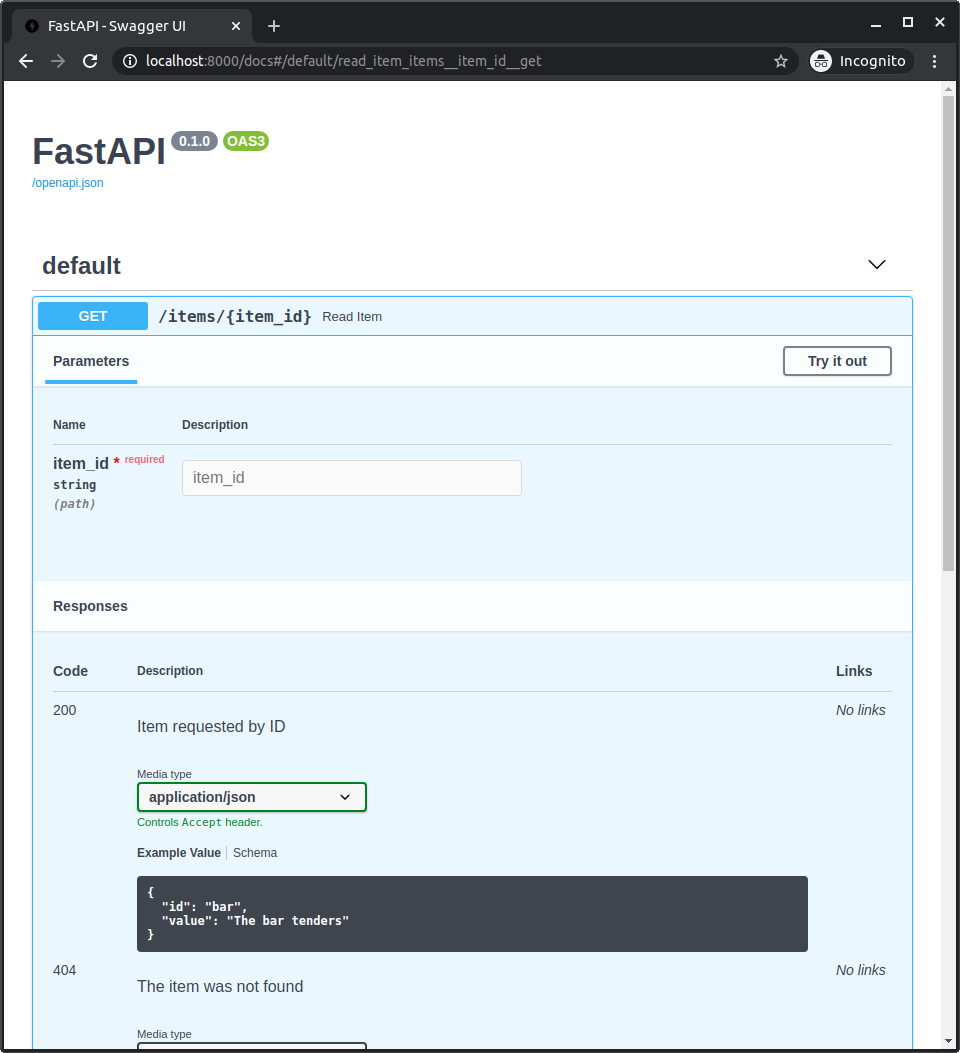
미리 정의된 응답과 커스텀 응답 결합하기
여러 경로 처리에 적용되는 미리 정의된 응답이 필요할 수도 있지만, 각 경로 처리마다 필요한 커스텀 응답과 결합하고 싶을 수도 있습니다.
그런 경우 Python의 dict “unpacking” 기법인 **dict_to_unpack을 사용할 수 있습니다:
old_dict = {
    "old key": "old value",
    "second old key": "second old value",
}
new_dict = {**old_dict, "new key": "new value"}
여기서 new_dict는 old_dict의 모든 키-값 쌍에 더해 새 키-값 쌍까지 포함합니다:
{
    "old key": "old value",
    "second old key": "second old value",
    "new key": "new value",
}
이 기법을 사용해 경로 처리에서 일부 미리 정의된 응답을 재사용하고, 추가 커스텀 응답과 결합할 수 있습니다.
예를 들어:
from fastapi import FastAPI
from fastapi.responses import FileResponse
from pydantic import BaseModel


class Item(BaseModel):
    id: str
    value: str


responses = {
    404: {"description": "Item not found"},
    302: {"description": "The item was moved"},
    403: {"description": "Not enough privileges"},
}


app = FastAPI()


@app.get(
    "/items/{item_id}",
    response_model=Item,
    responses={**responses, 200: {"content": {"image/png": {}}}},
)
async def read_item(item_id: str, img: bool | None = None):
    if img:
        return FileResponse("image.png", media_type="image/png")
    else:
        return {"id": "foo", "value": "there goes my hero"}
OpenAPI 응답에 대한 추가 정보
응답에 정확히 무엇을 포함할 수 있는지 보려면, OpenAPI 사양의 다음 섹션을 확인하세요:
- OpenAPI Responses Object:
Response Object를 포함합니다. - OpenAPI Response Object:
responses파라미터 안의 각 응답에 이것의 어떤 항목이든 직접 포함할 수 있습니다.description,headers,content(여기에서 서로 다른 미디어 타입과 JSON Schema를 선언합니다),links등을 포함할 수 있습니다.