OAuth2 のスコープ
🌐 AI と人間による翻訳
この翻訳は、人間のガイドに基づいて AI によって作成されました。🤝
原文の意図を取り違えていたり、不自然な表現になっている可能性があります。🤖
AI LLM をより適切に誘導するのを手伝う ことで、この翻訳を改善できます。
OAuth2 のスコープは FastAPI で直接利用でき、シームレスに統合されています。
これにより、OAuth2 標準に従った、よりきめ細かな権限システムを、OpenAPI 対応アプリケーション(および API ドキュメント)に統合できます。
スコープ付きの OAuth2 は、Facebook、Google、GitHub、Microsoft、X (Twitter) など、多くの大手認証プロバイダで使われている仕組みです。ユーザーやアプリケーションに特定の権限を付与するために利用されます。
「Facebook でログイン」「Google でログイン」「GitHub でログイン」「Microsoft でログイン」「X (Twitter) でログイン」するたびに、そのアプリケーションはスコープ付きの OAuth2 を使っています。
この節では、同じスコープ付き OAuth2 を使って、FastAPI アプリケーションで認証と認可を管理する方法を見ていきます。
注意
これはやや高度な内容です。はじめたばかりであれば読み飛ばしても構いません。
OAuth2 のスコープは必ずしも必要ではなく、認証と認可は好きなやり方で実装できます。
ただし、スコープ付きの OAuth2 は、API(OpenAPI)や API ドキュメントにきれいに統合できます。
とはいえ、これらのスコープやその他のセキュリティ/認可要件の適用は、必要に応じてコードの中で行う必要があります。
多くの場合、スコープ付き OAuth2 はオーバースペックになりえます。
それでも必要だと分かっている場合や、興味がある場合は、このまま読み進めてください。
OAuth2 のスコープと OpenAPI
OAuth2 仕様では、「スコープ」は空白で区切られた文字列の一覧として定義されています。
各文字列の内容は任意ですが、空白は含められません。
これらのスコープは「権限」を表します。
OpenAPI(例: API ドキュメント)では、「セキュリティスキーム」を定義できます。
これらのセキュリティスキームの一つが OAuth2 を使う場合、スコープを宣言して利用できます。
各「スコープ」は、ただの文字列(空白なし)です。
通常、特定のセキュリティ権限を宣言するために使われます。例えば:
users:readやusers:writeは一般的な例です。instagram_basicは Facebook / Instagram で使われています。https://www.googleapis.com/auth/driveは Google で使われています。
備考
OAuth2 において「スコープ」は、必要な特定の権限を宣言する単なる文字列です。
: のような他の文字が含まれていても、URL であっても問題ありません。
それらの詳細は実装依存です。
OAuth2 にとっては、単に文字列に過ぎません。
全体像
まず、メインのチュートリアル - ユーザーガイドにある OAuth2(パスワード[ハッシュ化あり])、Bearer と JWT トークン の例から変更される部分を、スコープ付き OAuth2 を使って手早く見てみましょう。
from datetime import datetime, timedelta, timezone
from typing import Annotated

import jwt
from fastapi import Depends, FastAPI, HTTPException, Security, status
from fastapi.security import (
    OAuth2PasswordBearer,
    OAuth2PasswordRequestForm,
    SecurityScopes,
)
from jwt.exceptions import InvalidTokenError
from pwdlib import PasswordHash
from pydantic import BaseModel, ValidationError

# to get a string like this run:
# openssl rand -hex 32
SECRET_KEY = "09d25e094faa6ca2556c818166b7a9563b93f7099f6f0f4caa6cf63b88e8d3e7"
ALGORITHM = "HS256"
ACCESS_TOKEN_EXPIRE_MINUTES = 30


fake_users_db = {
    "johndoe": {
        "username": "johndoe",
        "full_name": "John Doe",
        "email": "johndoe@example.com",
        "hashed_password": "$argon2id$v=19$m=65536,t=3,p=4$wagCPXjifgvUFBzq4hqe3w$CYaIb8sB+wtD+Vu/P4uod1+Qof8h+1g7bbDlBID48Rc",
        "disabled": False,
    },
    "alice": {
        "username": "alice",
        "full_name": "Alice Chains",
        "email": "alicechains@example.com",
        "hashed_password": "$argon2id$v=19$m=65536,t=3,p=4$g2/AV1zwopqUntPKJavBFw$BwpRGDCyUHLvHICnwijyX8ROGoiUPwNKZ7915MeYfCE",
        "disabled": True,
    },
}


class Token(BaseModel):
    access_token: str
    token_type: str


class TokenData(BaseModel):
    username: str | None = None
    scopes: list[str] = []


class User(BaseModel):
    username: str
    email: str | None = None
    full_name: str | None = None
    disabled: bool | None = None


class UserInDB(User):
    hashed_password: str


password_hash = PasswordHash.recommended()

DUMMY_HASH = password_hash.hash("dummypassword")

oauth2_scheme = OAuth2PasswordBearer(
    tokenUrl="token",
    scopes={"me": "Read information about the current user.", "items": "Read items."},
)

app = FastAPI()


def verify_password(plain_password, hashed_password):
    return password_hash.verify(plain_password, hashed_password)


def get_password_hash(password):
    return password_hash.hash(password)


def get_user(db, username: str):
    if username in db:
        user_dict = db[username]
        return UserInDB(**user_dict)


def authenticate_user(fake_db, username: str, password: str):
    user = get_user(fake_db, username)
    if not user:
        verify_password(password, DUMMY_HASH)
        return False
    if not verify_password(password, user.hashed_password):
        return False
    return user


def create_access_token(data: dict, expires_delta: timedelta | None = None):
    to_encode = data.copy()
    if expires_delta:
        expire = datetime.now(timezone.utc) + expires_delta
    else:
        expire = datetime.now(timezone.utc) + timedelta(minutes=15)
    to_encode.update({"exp": expire})
    encoded_jwt = jwt.encode(to_encode, SECRET_KEY, algorithm=ALGORITHM)
    return encoded_jwt


async def get_current_user(
    security_scopes: SecurityScopes, token: Annotated[str, Depends(oauth2_scheme)]
):
    if security_scopes.scopes:
        authenticate_value = f'Bearer scope="{security_scopes.scope_str}"'
    else:
        authenticate_value = "Bearer"
    credentials_exception = HTTPException(
        status_code=status.HTTP_401_UNAUTHORIZED,
        detail="Could not validate credentials",
        headers={"WWW-Authenticate": authenticate_value},
    )
    try:
        payload = jwt.decode(token, SECRET_KEY, algorithms=[ALGORITHM])
        username = payload.get("sub")
        if username is None:
            raise credentials_exception
        scope: str = payload.get("scope", "")
        token_scopes = scope.split(" ")
        token_data = TokenData(scopes=token_scopes, username=username)
    except (InvalidTokenError, ValidationError):
        raise credentials_exception
    user = get_user(fake_users_db, username=token_data.username)
    if user is None:
        raise credentials_exception
    for scope in security_scopes.scopes:
        if scope not in token_data.scopes:
            raise HTTPException(
                status_code=status.HTTP_401_UNAUTHORIZED,
                detail="Not enough permissions",
                headers={"WWW-Authenticate": authenticate_value},
            )
    return user


async def get_current_active_user(
    current_user: Annotated[User, Security(get_current_user, scopes=["me"])],
):
    if current_user.disabled:
        raise HTTPException(status_code=400, detail="Inactive user")
    return current_user


@app.post("/token")
async def login_for_access_token(
    form_data: Annotated[OAuth2PasswordRequestForm, Depends()],
) -> Token:
    user = authenticate_user(fake_users_db, form_data.username, form_data.password)
    if not user:
        raise HTTPException(status_code=400, detail="Incorrect username or password")
    access_token_expires = timedelta(minutes=ACCESS_TOKEN_EXPIRE_MINUTES)
    access_token = create_access_token(
        data={"sub": user.username, "scope": " ".join(form_data.scopes)},
        expires_delta=access_token_expires,
    )
    return Token(access_token=access_token, token_type="bearer")


@app.get("/users/me/")
async def read_users_me(
    current_user: Annotated[User, Depends(get_current_active_user)],
) -> User:
    return current_user


@app.get("/users/me/items/")
async def read_own_items(
    current_user: Annotated[User, Security(get_current_active_user, scopes=["items"])],
):
    return [{"item_id": "Foo", "owner": current_user.username}]


@app.get("/status/")
async def read_system_status(current_user: Annotated[User, Depends(get_current_user)]):
    return {"status": "ok"}
🤓 Other versions and variants
Tip
Prefer to use the Annotated version if possible.
from datetime import datetime, timedelta, timezone

import jwt
from fastapi import Depends, FastAPI, HTTPException, Security, status
from fastapi.security import (
    OAuth2PasswordBearer,
    OAuth2PasswordRequestForm,
    SecurityScopes,
)
from jwt.exceptions import InvalidTokenError
from pwdlib import PasswordHash
from pydantic import BaseModel, ValidationError

# to get a string like this run:
# openssl rand -hex 32
SECRET_KEY = "09d25e094faa6ca2556c818166b7a9563b93f7099f6f0f4caa6cf63b88e8d3e7"
ALGORITHM = "HS256"
ACCESS_TOKEN_EXPIRE_MINUTES = 30


fake_users_db = {
    "johndoe": {
        "username": "johndoe",
        "full_name": "John Doe",
        "email": "johndoe@example.com",
        "hashed_password": "$argon2id$v=19$m=65536,t=3,p=4$wagCPXjifgvUFBzq4hqe3w$CYaIb8sB+wtD+Vu/P4uod1+Qof8h+1g7bbDlBID48Rc",
        "disabled": False,
    },
    "alice": {
        "username": "alice",
        "full_name": "Alice Chains",
        "email": "alicechains@example.com",
        "hashed_password": "$argon2id$v=19$m=65536,t=3,p=4$g2/AV1zwopqUntPKJavBFw$BwpRGDCyUHLvHICnwijyX8ROGoiUPwNKZ7915MeYfCE",
        "disabled": True,
    },
}


class Token(BaseModel):
    access_token: str
    token_type: str


class TokenData(BaseModel):
    username: str | None = None
    scopes: list[str] = []


class User(BaseModel):
    username: str
    email: str | None = None
    full_name: str | None = None
    disabled: bool | None = None


class UserInDB(User):
    hashed_password: str


password_hash = PasswordHash.recommended()

DUMMY_HASH = password_hash.hash("dummypassword")

oauth2_scheme = OAuth2PasswordBearer(
    tokenUrl="token",
    scopes={"me": "Read information about the current user.", "items": "Read items."},
)

app = FastAPI()


def verify_password(plain_password, hashed_password):
    return password_hash.verify(plain_password, hashed_password)


def get_password_hash(password):
    return password_hash.hash(password)


def get_user(db, username: str):
    if username in db:
        user_dict = db[username]
        return UserInDB(**user_dict)


def authenticate_user(fake_db, username: str, password: str):
    user = get_user(fake_db, username)
    if not user:
        verify_password(password, DUMMY_HASH)
        return False
    if not verify_password(password, user.hashed_password):
        return False
    return user


def create_access_token(data: dict, expires_delta: timedelta | None = None):
    to_encode = data.copy()
    if expires_delta:
        expire = datetime.now(timezone.utc) + expires_delta
    else:
        expire = datetime.now(timezone.utc) + timedelta(minutes=15)
    to_encode.update({"exp": expire})
    encoded_jwt = jwt.encode(to_encode, SECRET_KEY, algorithm=ALGORITHM)
    return encoded_jwt


async def get_current_user(
    security_scopes: SecurityScopes, token: str = Depends(oauth2_scheme)
):
    if security_scopes.scopes:
        authenticate_value = f'Bearer scope="{security_scopes.scope_str}"'
    else:
        authenticate_value = "Bearer"
    credentials_exception = HTTPException(
        status_code=status.HTTP_401_UNAUTHORIZED,
        detail="Could not validate credentials",
        headers={"WWW-Authenticate": authenticate_value},
    )
    try:
        payload = jwt.decode(token, SECRET_KEY, algorithms=[ALGORITHM])
        username: str = payload.get("sub")
        if username is None:
            raise credentials_exception
        scope: str = payload.get("scope", "")
        token_scopes = scope.split(" ")
        token_data = TokenData(scopes=token_scopes, username=username)
    except (InvalidTokenError, ValidationError):
        raise credentials_exception
    user = get_user(fake_users_db, username=token_data.username)
    if user is None:
        raise credentials_exception
    for scope in security_scopes.scopes:
        if scope not in token_data.scopes:
            raise HTTPException(
                status_code=status.HTTP_401_UNAUTHORIZED,
                detail="Not enough permissions",
                headers={"WWW-Authenticate": authenticate_value},
            )
    return user


async def get_current_active_user(
    current_user: User = Security(get_current_user, scopes=["me"]),
):
    if current_user.disabled:
        raise HTTPException(status_code=400, detail="Inactive user")
    return current_user


@app.post("/token")
async def login_for_access_token(
    form_data: OAuth2PasswordRequestForm = Depends(),
) -> Token:
    user = authenticate_user(fake_users_db, form_data.username, form_data.password)
    if not user:
        raise HTTPException(status_code=400, detail="Incorrect username or password")
    access_token_expires = timedelta(minutes=ACCESS_TOKEN_EXPIRE_MINUTES)
    access_token = create_access_token(
        data={"sub": user.username, "scope": " ".join(form_data.scopes)},
        expires_delta=access_token_expires,
    )
    return Token(access_token=access_token, token_type="bearer")


@app.get("/users/me/")
async def read_users_me(current_user: User = Depends(get_current_active_user)) -> User:
    return current_user


@app.get("/users/me/items/")
async def read_own_items(
    current_user: User = Security(get_current_active_user, scopes=["items"]),
):
    return [{"item_id": "Foo", "owner": current_user.username}]


@app.get("/status/")
async def read_system_status(current_user: User = Depends(get_current_user)):
    return {"status": "ok"}
では、これらの変更を一つずつ確認していきます。
OAuth2 のセキュリティスキーム
最初の変更点は、me と items の 2 つのスコープを持つ OAuth2 セキュリティスキームを宣言していることです。
scopes パラメータは、各スコープをキー、その説明を値とする dict を受け取ります:
from datetime import datetime, timedelta, timezone
from typing import Annotated

import jwt
from fastapi import Depends, FastAPI, HTTPException, Security, status
from fastapi.security import (
    OAuth2PasswordBearer,
    OAuth2PasswordRequestForm,
    SecurityScopes,
)
from jwt.exceptions import InvalidTokenError
from pwdlib import PasswordHash
from pydantic import BaseModel, ValidationError

# to get a string like this run:
# openssl rand -hex 32
SECRET_KEY = "09d25e094faa6ca2556c818166b7a9563b93f7099f6f0f4caa6cf63b88e8d3e7"
ALGORITHM = "HS256"
ACCESS_TOKEN_EXPIRE_MINUTES = 30


fake_users_db = {
    "johndoe": {
        "username": "johndoe",
        "full_name": "John Doe",
        "email": "johndoe@example.com",
        "hashed_password": "$argon2id$v=19$m=65536,t=3,p=4$wagCPXjifgvUFBzq4hqe3w$CYaIb8sB+wtD+Vu/P4uod1+Qof8h+1g7bbDlBID48Rc",
        "disabled": False,
    },
    "alice": {
        "username": "alice",
        "full_name": "Alice Chains",
        "email": "alicechains@example.com",
        "hashed_password": "$argon2id$v=19$m=65536,t=3,p=4$g2/AV1zwopqUntPKJavBFw$BwpRGDCyUHLvHICnwijyX8ROGoiUPwNKZ7915MeYfCE",
        "disabled": True,
    },
}


class Token(BaseModel):
    access_token: str
    token_type: str


class TokenData(BaseModel):
    username: str | None = None
    scopes: list[str] = []


class User(BaseModel):
    username: str
    email: str | None = None
    full_name: str | None = None
    disabled: bool | None = None


class UserInDB(User):
    hashed_password: str


password_hash = PasswordHash.recommended()

DUMMY_HASH = password_hash.hash("dummypassword")

oauth2_scheme = OAuth2PasswordBearer(
    tokenUrl="token",
    scopes={"me": "Read information about the current user.", "items": "Read items."},
)

app = FastAPI()


def verify_password(plain_password, hashed_password):
    return password_hash.verify(plain_password, hashed_password)


def get_password_hash(password):
    return password_hash.hash(password)


def get_user(db, username: str):
    if username in db:
        user_dict = db[username]
        return UserInDB(**user_dict)


def authenticate_user(fake_db, username: str, password: str):
    user = get_user(fake_db, username)
    if not user:
        verify_password(password, DUMMY_HASH)
        return False
    if not verify_password(password, user.hashed_password):
        return False
    return user


def create_access_token(data: dict, expires_delta: timedelta | None = None):
    to_encode = data.copy()
    if expires_delta:
        expire = datetime.now(timezone.utc) + expires_delta
    else:
        expire = datetime.now(timezone.utc) + timedelta(minutes=15)
    to_encode.update({"exp": expire})
    encoded_jwt = jwt.encode(to_encode, SECRET_KEY, algorithm=ALGORITHM)
    return encoded_jwt


async def get_current_user(
    security_scopes: SecurityScopes, token: Annotated[str, Depends(oauth2_scheme)]
):
    if security_scopes.scopes:
        authenticate_value = f'Bearer scope="{security_scopes.scope_str}"'
    else:
        authenticate_value = "Bearer"
    credentials_exception = HTTPException(
        status_code=status.HTTP_401_UNAUTHORIZED,
        detail="Could not validate credentials",
        headers={"WWW-Authenticate": authenticate_value},
    )
    try:
        payload = jwt.decode(token, SECRET_KEY, algorithms=[ALGORITHM])
        username = payload.get("sub")
        if username is None:
            raise credentials_exception
        scope: str = payload.get("scope", "")
        token_scopes = scope.split(" ")
        token_data = TokenData(scopes=token_scopes, username=username)
    except (InvalidTokenError, ValidationError):
        raise credentials_exception
    user = get_user(fake_users_db, username=token_data.username)
    if user is None:
        raise credentials_exception
    for scope in security_scopes.scopes:
        if scope not in token_data.scopes:
            raise HTTPException(
                status_code=status.HTTP_401_UNAUTHORIZED,
                detail="Not enough permissions",
                headers={"WWW-Authenticate": authenticate_value},
            )
    return user


async def get_current_active_user(
    current_user: Annotated[User, Security(get_current_user, scopes=["me"])],
):
    if current_user.disabled:
        raise HTTPException(status_code=400, detail="Inactive user")
    return current_user


@app.post("/token")
async def login_for_access_token(
    form_data: Annotated[OAuth2PasswordRequestForm, Depends()],
) -> Token:
    user = authenticate_user(fake_users_db, form_data.username, form_data.password)
    if not user:
        raise HTTPException(status_code=400, detail="Incorrect username or password")
    access_token_expires = timedelta(minutes=ACCESS_TOKEN_EXPIRE_MINUTES)
    access_token = create_access_token(
        data={"sub": user.username, "scope": " ".join(form_data.scopes)},
        expires_delta=access_token_expires,
    )
    return Token(access_token=access_token, token_type="bearer")


@app.get("/users/me/")
async def read_users_me(
    current_user: Annotated[User, Depends(get_current_active_user)],
) -> User:
    return current_user


@app.get("/users/me/items/")
async def read_own_items(
    current_user: Annotated[User, Security(get_current_active_user, scopes=["items"])],
):
    return [{"item_id": "Foo", "owner": current_user.username}]


@app.get("/status/")
async def read_system_status(current_user: Annotated[User, Depends(get_current_user)]):
    return {"status": "ok"}
🤓 Other versions and variants
Tip
Prefer to use the Annotated version if possible.
from datetime import datetime, timedelta, timezone

import jwt
from fastapi import Depends, FastAPI, HTTPException, Security, status
from fastapi.security import (
    OAuth2PasswordBearer,
    OAuth2PasswordRequestForm,
    SecurityScopes,
)
from jwt.exceptions import InvalidTokenError
from pwdlib import PasswordHash
from pydantic import BaseModel, ValidationError

# to get a string like this run:
# openssl rand -hex 32
SECRET_KEY = "09d25e094faa6ca2556c818166b7a9563b93f7099f6f0f4caa6cf63b88e8d3e7"
ALGORITHM = "HS256"
ACCESS_TOKEN_EXPIRE_MINUTES = 30


fake_users_db = {
    "johndoe": {
        "username": "johndoe",
        "full_name": "John Doe",
        "email": "johndoe@example.com",
        "hashed_password": "$argon2id$v=19$m=65536,t=3,p=4$wagCPXjifgvUFBzq4hqe3w$CYaIb8sB+wtD+Vu/P4uod1+Qof8h+1g7bbDlBID48Rc",
        "disabled": False,
    },
    "alice": {
        "username": "alice",
        "full_name": "Alice Chains",
        "email": "alicechains@example.com",
        "hashed_password": "$argon2id$v=19$m=65536,t=3,p=4$g2/AV1zwopqUntPKJavBFw$BwpRGDCyUHLvHICnwijyX8ROGoiUPwNKZ7915MeYfCE",
        "disabled": True,
    },
}


class Token(BaseModel):
    access_token: str
    token_type: str


class TokenData(BaseModel):
    username: str | None = None
    scopes: list[str] = []


class User(BaseModel):
    username: str
    email: str | None = None
    full_name: str | None = None
    disabled: bool | None = None


class UserInDB(User):
    hashed_password: str


password_hash = PasswordHash.recommended()

DUMMY_HASH = password_hash.hash("dummypassword")

oauth2_scheme = OAuth2PasswordBearer(
    tokenUrl="token",
    scopes={"me": "Read information about the current user.", "items": "Read items."},
)

app = FastAPI()


def verify_password(plain_password, hashed_password):
    return password_hash.verify(plain_password, hashed_password)


def get_password_hash(password):
    return password_hash.hash(password)


def get_user(db, username: str):
    if username in db:
        user_dict = db[username]
        return UserInDB(**user_dict)


def authenticate_user(fake_db, username: str, password: str):
    user = get_user(fake_db, username)
    if not user:
        verify_password(password, DUMMY_HASH)
        return False
    if not verify_password(password, user.hashed_password):
        return False
    return user


def create_access_token(data: dict, expires_delta: timedelta | None = None):
    to_encode = data.copy()
    if expires_delta:
        expire = datetime.now(timezone.utc) + expires_delta
    else:
        expire = datetime.now(timezone.utc) + timedelta(minutes=15)
    to_encode.update({"exp": expire})
    encoded_jwt = jwt.encode(to_encode, SECRET_KEY, algorithm=ALGORITHM)
    return encoded_jwt


async def get_current_user(
    security_scopes: SecurityScopes, token: str = Depends(oauth2_scheme)
):
    if security_scopes.scopes:
        authenticate_value = f'Bearer scope="{security_scopes.scope_str}"'
    else:
        authenticate_value = "Bearer"
    credentials_exception = HTTPException(
        status_code=status.HTTP_401_UNAUTHORIZED,
        detail="Could not validate credentials",
        headers={"WWW-Authenticate": authenticate_value},
    )
    try:
        payload = jwt.decode(token, SECRET_KEY, algorithms=[ALGORITHM])
        username: str = payload.get("sub")
        if username is None:
            raise credentials_exception
        scope: str = payload.get("scope", "")
        token_scopes = scope.split(" ")
        token_data = TokenData(scopes=token_scopes, username=username)
    except (InvalidTokenError, ValidationError):
        raise credentials_exception
    user = get_user(fake_users_db, username=token_data.username)
    if user is None:
        raise credentials_exception
    for scope in security_scopes.scopes:
        if scope not in token_data.scopes:
            raise HTTPException(
                status_code=status.HTTP_401_UNAUTHORIZED,
                detail="Not enough permissions",
                headers={"WWW-Authenticate": authenticate_value},
            )
    return user


async def get_current_active_user(
    current_user: User = Security(get_current_user, scopes=["me"]),
):
    if current_user.disabled:
        raise HTTPException(status_code=400, detail="Inactive user")
    return current_user


@app.post("/token")
async def login_for_access_token(
    form_data: OAuth2PasswordRequestForm = Depends(),
) -> Token:
    user = authenticate_user(fake_users_db, form_data.username, form_data.password)
    if not user:
        raise HTTPException(status_code=400, detail="Incorrect username or password")
    access_token_expires = timedelta(minutes=ACCESS_TOKEN_EXPIRE_MINUTES)
    access_token = create_access_token(
        data={"sub": user.username, "scope": " ".join(form_data.scopes)},
        expires_delta=access_token_expires,
    )
    return Token(access_token=access_token, token_type="bearer")


@app.get("/users/me/")
async def read_users_me(current_user: User = Depends(get_current_active_user)) -> User:
    return current_user


@app.get("/users/me/items/")
async def read_own_items(
    current_user: User = Security(get_current_active_user, scopes=["items"]),
):
    return [{"item_id": "Foo", "owner": current_user.username}]


@app.get("/status/")
async def read_system_status(current_user: User = Depends(get_current_user)):
    return {"status": "ok"}
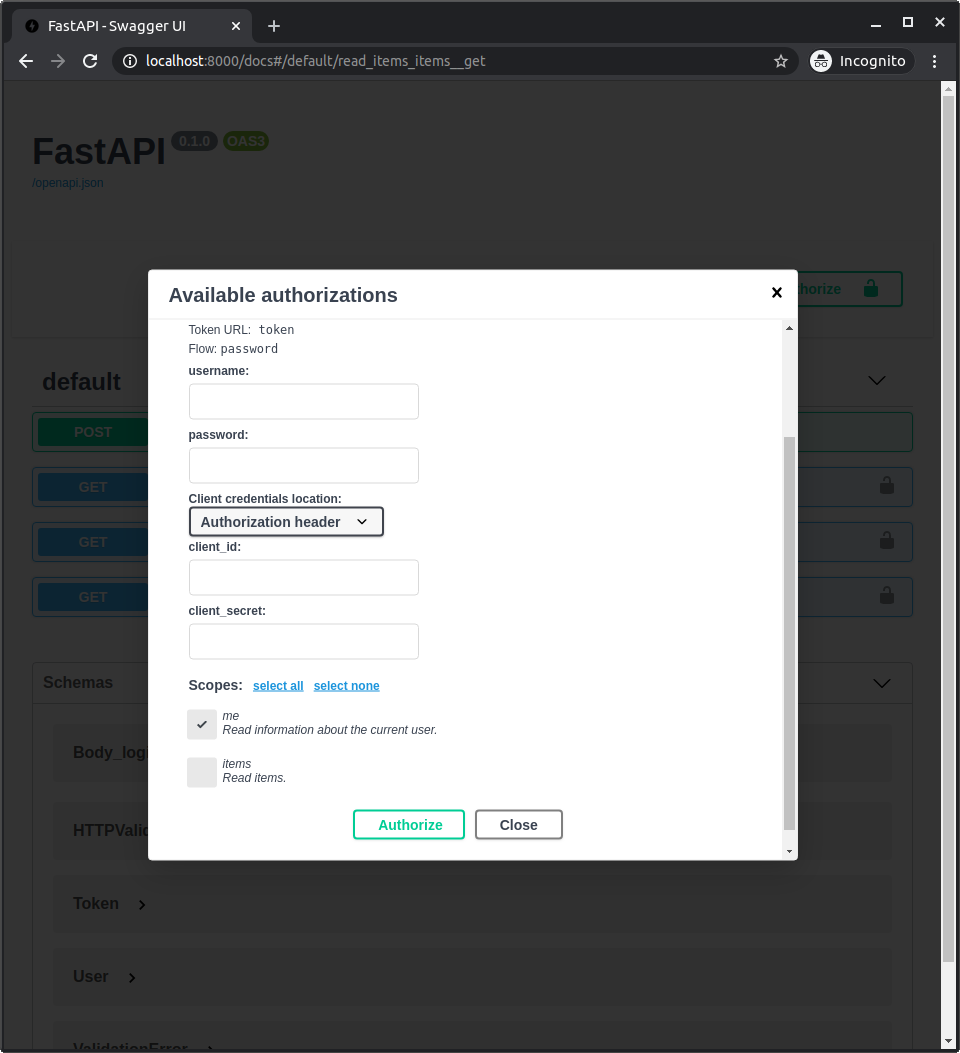
これらのスコープを宣言しているため、ログイン/認可時に API ドキュメントに表示されます。
そして、付与するスコープ(me、items)を選択できます。
これは、Facebook、Google、GitHub などでログイン時に権限を付与する際と同じ仕組みです:
スコープ付きの JWT トークン
次に、トークンの path operation を修正して、要求されたスコープを返すようにします。
引き続き同じ OAuth2PasswordRequestForm を使用します。これには、リクエストで受け取った各スコープを含む、str の list である scopes プロパティが含まれます。
そして、そのスコープを JWT トークンの一部として返します。
警告
簡単のため、ここでは受け取ったスコープをそのままトークンに追加しています。
しかし、本番アプリケーションではセキュリティのため、ユーザーが実際に持つことができるスコープ、または事前に定義したスコープだけを追加するようにしてください。
from datetime import datetime, timedelta, timezone
from typing import Annotated

import jwt
from fastapi import Depends, FastAPI, HTTPException, Security, status
from fastapi.security import (
    OAuth2PasswordBearer,
    OAuth2PasswordRequestForm,
    SecurityScopes,
)
from jwt.exceptions import InvalidTokenError
from pwdlib import PasswordHash
from pydantic import BaseModel, ValidationError

# to get a string like this run:
# openssl rand -hex 32
SECRET_KEY = "09d25e094faa6ca2556c818166b7a9563b93f7099f6f0f4caa6cf63b88e8d3e7"
ALGORITHM = "HS256"
ACCESS_TOKEN_EXPIRE_MINUTES = 30


fake_users_db = {
    "johndoe": {
        "username": "johndoe",
        "full_name": "John Doe",
        "email": "johndoe@example.com",
        "hashed_password": "$argon2id$v=19$m=65536,t=3,p=4$wagCPXjifgvUFBzq4hqe3w$CYaIb8sB+wtD+Vu/P4uod1+Qof8h+1g7bbDlBID48Rc",
        "disabled": False,
    },
    "alice": {
        "username": "alice",
        "full_name": "Alice Chains",
        "email": "alicechains@example.com",
        "hashed_password": "$argon2id$v=19$m=65536,t=3,p=4$g2/AV1zwopqUntPKJavBFw$BwpRGDCyUHLvHICnwijyX8ROGoiUPwNKZ7915MeYfCE",
        "disabled": True,
    },
}


class Token(BaseModel):
    access_token: str
    token_type: str


class TokenData(BaseModel):
    username: str | None = None
    scopes: list[str] = []


class User(BaseModel):
    username: str
    email: str | None = None
    full_name: str | None = None
    disabled: bool | None = None


class UserInDB(User):
    hashed_password: str


password_hash = PasswordHash.recommended()

DUMMY_HASH = password_hash.hash("dummypassword")

oauth2_scheme = OAuth2PasswordBearer(
    tokenUrl="token",
    scopes={"me": "Read information about the current user.", "items": "Read items."},
)

app = FastAPI()


def verify_password(plain_password, hashed_password):
    return password_hash.verify(plain_password, hashed_password)


def get_password_hash(password):
    return password_hash.hash(password)


def get_user(db, username: str):
    if username in db:
        user_dict = db[username]
        return UserInDB(**user_dict)


def authenticate_user(fake_db, username: str, password: str):
    user = get_user(fake_db, username)
    if not user:
        verify_password(password, DUMMY_HASH)
        return False
    if not verify_password(password, user.hashed_password):
        return False
    return user


def create_access_token(data: dict, expires_delta: timedelta | None = None):
    to_encode = data.copy()
    if expires_delta:
        expire = datetime.now(timezone.utc) + expires_delta
    else:
        expire = datetime.now(timezone.utc) + timedelta(minutes=15)
    to_encode.update({"exp": expire})
    encoded_jwt = jwt.encode(to_encode, SECRET_KEY, algorithm=ALGORITHM)
    return encoded_jwt


async def get_current_user(
    security_scopes: SecurityScopes, token: Annotated[str, Depends(oauth2_scheme)]
):
    if security_scopes.scopes:
        authenticate_value = f'Bearer scope="{security_scopes.scope_str}"'
    else:
        authenticate_value = "Bearer"
    credentials_exception = HTTPException(
        status_code=status.HTTP_401_UNAUTHORIZED,
        detail="Could not validate credentials",
        headers={"WWW-Authenticate": authenticate_value},
    )
    try:
        payload = jwt.decode(token, SECRET_KEY, algorithms=[ALGORITHM])
        username = payload.get("sub")
        if username is None:
            raise credentials_exception
        scope: str = payload.get("scope", "")
        token_scopes = scope.split(" ")
        token_data = TokenData(scopes=token_scopes, username=username)
    except (InvalidTokenError, ValidationError):
        raise credentials_exception
    user = get_user(fake_users_db, username=token_data.username)
    if user is None:
        raise credentials_exception
    for scope in security_scopes.scopes:
        if scope not in token_data.scopes:
            raise HTTPException(
                status_code=status.HTTP_401_UNAUTHORIZED,
                detail="Not enough permissions",
                headers={"WWW-Authenticate": authenticate_value},
            )
    return user


async def get_current_active_user(
    current_user: Annotated[User, Security(get_current_user, scopes=["me"])],
):
    if current_user.disabled:
        raise HTTPException(status_code=400, detail="Inactive user")
    return current_user


@app.post("/token")
async def login_for_access_token(
    form_data: Annotated[OAuth2PasswordRequestForm, Depends()],
) -> Token:
    user = authenticate_user(fake_users_db, form_data.username, form_data.password)
    if not user:
        raise HTTPException(status_code=400, detail="Incorrect username or password")
    access_token_expires = timedelta(minutes=ACCESS_TOKEN_EXPIRE_MINUTES)
    access_token = create_access_token(
        data={"sub": user.username, "scope": " ".join(form_data.scopes)},
        expires_delta=access_token_expires,
    )
    return Token(access_token=access_token, token_type="bearer")


@app.get("/users/me/")
async def read_users_me(
    current_user: Annotated[User, Depends(get_current_active_user)],
) -> User:
    return current_user


@app.get("/users/me/items/")
async def read_own_items(
    current_user: Annotated[User, Security(get_current_active_user, scopes=["items"])],
):
    return [{"item_id": "Foo", "owner": current_user.username}]


@app.get("/status/")
async def read_system_status(current_user: Annotated[User, Depends(get_current_user)]):
    return {"status": "ok"}
🤓 Other versions and variants
Tip
Prefer to use the Annotated version if possible.
from datetime import datetime, timedelta, timezone

import jwt
from fastapi import Depends, FastAPI, HTTPException, Security, status
from fastapi.security import (
    OAuth2PasswordBearer,
    OAuth2PasswordRequestForm,
    SecurityScopes,
)
from jwt.exceptions import InvalidTokenError
from pwdlib import PasswordHash
from pydantic import BaseModel, ValidationError

# to get a string like this run:
# openssl rand -hex 32
SECRET_KEY = "09d25e094faa6ca2556c818166b7a9563b93f7099f6f0f4caa6cf63b88e8d3e7"
ALGORITHM = "HS256"
ACCESS_TOKEN_EXPIRE_MINUTES = 30


fake_users_db = {
    "johndoe": {
        "username": "johndoe",
        "full_name": "John Doe",
        "email": "johndoe@example.com",
        "hashed_password": "$argon2id$v=19$m=65536,t=3,p=4$wagCPXjifgvUFBzq4hqe3w$CYaIb8sB+wtD+Vu/P4uod1+Qof8h+1g7bbDlBID48Rc",
        "disabled": False,
    },
    "alice": {
        "username": "alice",
        "full_name": "Alice Chains",
        "email": "alicechains@example.com",
        "hashed_password": "$argon2id$v=19$m=65536,t=3,p=4$g2/AV1zwopqUntPKJavBFw$BwpRGDCyUHLvHICnwijyX8ROGoiUPwNKZ7915MeYfCE",
        "disabled": True,
    },
}


class Token(BaseModel):
    access_token: str
    token_type: str


class TokenData(BaseModel):
    username: str | None = None
    scopes: list[str] = []


class User(BaseModel):
    username: str
    email: str | None = None
    full_name: str | None = None
    disabled: bool | None = None


class UserInDB(User):
    hashed_password: str


password_hash = PasswordHash.recommended()

DUMMY_HASH = password_hash.hash("dummypassword")

oauth2_scheme = OAuth2PasswordBearer(
    tokenUrl="token",
    scopes={"me": "Read information about the current user.", "items": "Read items."},
)

app = FastAPI()


def verify_password(plain_password, hashed_password):
    return password_hash.verify(plain_password, hashed_password)


def get_password_hash(password):
    return password_hash.hash(password)


def get_user(db, username: str):
    if username in db:
        user_dict = db[username]
        return UserInDB(**user_dict)


def authenticate_user(fake_db, username: str, password: str):
    user = get_user(fake_db, username)
    if not user:
        verify_password(password, DUMMY_HASH)
        return False
    if not verify_password(password, user.hashed_password):
        return False
    return user


def create_access_token(data: dict, expires_delta: timedelta | None = None):
    to_encode = data.copy()
    if expires_delta:
        expire = datetime.now(timezone.utc) + expires_delta
    else:
        expire = datetime.now(timezone.utc) + timedelta(minutes=15)
    to_encode.update({"exp": expire})
    encoded_jwt = jwt.encode(to_encode, SECRET_KEY, algorithm=ALGORITHM)
    return encoded_jwt


async def get_current_user(
    security_scopes: SecurityScopes, token: str = Depends(oauth2_scheme)
):
    if security_scopes.scopes:
        authenticate_value = f'Bearer scope="{security_scopes.scope_str}"'
    else:
        authenticate_value = "Bearer"
    credentials_exception = HTTPException(
        status_code=status.HTTP_401_UNAUTHORIZED,
        detail="Could not validate credentials",
        headers={"WWW-Authenticate": authenticate_value},
    )
    try:
        payload = jwt.decode(token, SECRET_KEY, algorithms=[ALGORITHM])
        username: str = payload.get("sub")
        if username is None:
            raise credentials_exception
        scope: str = payload.get("scope", "")
        token_scopes = scope.split(" ")
        token_data = TokenData(scopes=token_scopes, username=username)
    except (InvalidTokenError, ValidationError):
        raise credentials_exception
    user = get_user(fake_users_db, username=token_data.username)
    if user is None:
        raise credentials_exception
    for scope in security_scopes.scopes:
        if scope not in token_data.scopes:
            raise HTTPException(
                status_code=status.HTTP_401_UNAUTHORIZED,
                detail="Not enough permissions",
                headers={"WWW-Authenticate": authenticate_value},
            )
    return user


async def get_current_active_user(
    current_user: User = Security(get_current_user, scopes=["me"]),
):
    if current_user.disabled:
        raise HTTPException(status_code=400, detail="Inactive user")
    return current_user


@app.post("/token")
async def login_for_access_token(
    form_data: OAuth2PasswordRequestForm = Depends(),
) -> Token:
    user = authenticate_user(fake_users_db, form_data.username, form_data.password)
    if not user:
        raise HTTPException(status_code=400, detail="Incorrect username or password")
    access_token_expires = timedelta(minutes=ACCESS_TOKEN_EXPIRE_MINUTES)
    access_token = create_access_token(
        data={"sub": user.username, "scope": " ".join(form_data.scopes)},
        expires_delta=access_token_expires,
    )
    return Token(access_token=access_token, token_type="bearer")


@app.get("/users/me/")
async def read_users_me(current_user: User = Depends(get_current_active_user)) -> User:
    return current_user


@app.get("/users/me/items/")
async def read_own_items(
    current_user: User = Security(get_current_active_user, scopes=["items"]),
):
    return [{"item_id": "Foo", "owner": current_user.username}]


@app.get("/status/")
async def read_system_status(current_user: User = Depends(get_current_user)):
    return {"status": "ok"}
path operation と依存関係でスコープを宣言
ここでは、/users/me/items/ の path operation が items スコープを必要とするように宣言します。
そのために、fastapi から Security をインポートして使います。
Security は(Depends と同様に)依存関係を宣言できますが、さらにスコープ(文字列)のリストを受け取る scopes パラメータも持ちます。
この場合、Security に依存関数 get_current_active_user を渡します(Depends と同様です)。
加えて、items という 1 つのスコープ(複数でも可)を含む list も渡します。
依存関数 get_current_active_user は、Depends だけでなく Security でもサブ依存関係を宣言できます。自身のサブ依存関数(get_current_user)を宣言し、さらにスコープ要件を追加します。
この場合、me スコープを要求します(複数のスコープも可)。
備考
異なる場所で異なるスコープを追加する必要は必ずしもありません。
ここでは、FastAPI が異なるレベルで宣言されたスコープをどのように扱うかを示すためにそうしています。
from datetime import datetime, timedelta, timezone
from typing import Annotated

import jwt
from fastapi import Depends, FastAPI, HTTPException, Security, status
from fastapi.security import (
    OAuth2PasswordBearer,
    OAuth2PasswordRequestForm,
    SecurityScopes,
)
from jwt.exceptions import InvalidTokenError
from pwdlib import PasswordHash
from pydantic import BaseModel, ValidationError

# to get a string like this run:
# openssl rand -hex 32
SECRET_KEY = "09d25e094faa6ca2556c818166b7a9563b93f7099f6f0f4caa6cf63b88e8d3e7"
ALGORITHM = "HS256"
ACCESS_TOKEN_EXPIRE_MINUTES = 30


fake_users_db = {
    "johndoe": {
        "username": "johndoe",
        "full_name": "John Doe",
        "email": "johndoe@example.com",
        "hashed_password": "$argon2id$v=19$m=65536,t=3,p=4$wagCPXjifgvUFBzq4hqe3w$CYaIb8sB+wtD+Vu/P4uod1+Qof8h+1g7bbDlBID48Rc",
        "disabled": False,
    },
    "alice": {
        "username": "alice",
        "full_name": "Alice Chains",
        "email": "alicechains@example.com",
        "hashed_password": "$argon2id$v=19$m=65536,t=3,p=4$g2/AV1zwopqUntPKJavBFw$BwpRGDCyUHLvHICnwijyX8ROGoiUPwNKZ7915MeYfCE",
        "disabled": True,
    },
}


class Token(BaseModel):
    access_token: str
    token_type: str


class TokenData(BaseModel):
    username: str | None = None
    scopes: list[str] = []


class User(BaseModel):
    username: str
    email: str | None = None
    full_name: str | None = None
    disabled: bool | None = None


class UserInDB(User):
    hashed_password: str


password_hash = PasswordHash.recommended()

DUMMY_HASH = password_hash.hash("dummypassword")

oauth2_scheme = OAuth2PasswordBearer(
    tokenUrl="token",
    scopes={"me": "Read information about the current user.", "items": "Read items."},
)

app = FastAPI()


def verify_password(plain_password, hashed_password):
    return password_hash.verify(plain_password, hashed_password)


def get_password_hash(password):
    return password_hash.hash(password)


def get_user(db, username: str):
    if username in db:
        user_dict = db[username]
        return UserInDB(**user_dict)


def authenticate_user(fake_db, username: str, password: str):
    user = get_user(fake_db, username)
    if not user:
        verify_password(password, DUMMY_HASH)
        return False
    if not verify_password(password, user.hashed_password):
        return False
    return user


def create_access_token(data: dict, expires_delta: timedelta | None = None):
    to_encode = data.copy()
    if expires_delta:
        expire = datetime.now(timezone.utc) + expires_delta
    else:
        expire = datetime.now(timezone.utc) + timedelta(minutes=15)
    to_encode.update({"exp": expire})
    encoded_jwt = jwt.encode(to_encode, SECRET_KEY, algorithm=ALGORITHM)
    return encoded_jwt


async def get_current_user(
    security_scopes: SecurityScopes, token: Annotated[str, Depends(oauth2_scheme)]
):
    if security_scopes.scopes:
        authenticate_value = f'Bearer scope="{security_scopes.scope_str}"'
    else:
        authenticate_value = "Bearer"
    credentials_exception = HTTPException(
        status_code=status.HTTP_401_UNAUTHORIZED,
        detail="Could not validate credentials",
        headers={"WWW-Authenticate": authenticate_value},
    )
    try:
        payload = jwt.decode(token, SECRET_KEY, algorithms=[ALGORITHM])
        username = payload.get("sub")
        if username is None:
            raise credentials_exception
        scope: str = payload.get("scope", "")
        token_scopes = scope.split(" ")
        token_data = TokenData(scopes=token_scopes, username=username)
    except (InvalidTokenError, ValidationError):
        raise credentials_exception
    user = get_user(fake_users_db, username=token_data.username)
    if user is None:
        raise credentials_exception
    for scope in security_scopes.scopes:
        if scope not in token_data.scopes:
            raise HTTPException(
                status_code=status.HTTP_401_UNAUTHORIZED,
                detail="Not enough permissions",
                headers={"WWW-Authenticate": authenticate_value},
            )
    return user


async def get_current_active_user(
    current_user: Annotated[User, Security(get_current_user, scopes=["me"])],
):
    if current_user.disabled:
        raise HTTPException(status_code=400, detail="Inactive user")
    return current_user


@app.post("/token")
async def login_for_access_token(
    form_data: Annotated[OAuth2PasswordRequestForm, Depends()],
) -> Token:
    user = authenticate_user(fake_users_db, form_data.username, form_data.password)
    if not user:
        raise HTTPException(status_code=400, detail="Incorrect username or password")
    access_token_expires = timedelta(minutes=ACCESS_TOKEN_EXPIRE_MINUTES)
    access_token = create_access_token(
        data={"sub": user.username, "scope": " ".join(form_data.scopes)},
        expires_delta=access_token_expires,
    )
    return Token(access_token=access_token, token_type="bearer")


@app.get("/users/me/")
async def read_users_me(
    current_user: Annotated[User, Depends(get_current_active_user)],
) -> User:
    return current_user


@app.get("/users/me/items/")
async def read_own_items(
    current_user: Annotated[User, Security(get_current_active_user, scopes=["items"])],
):
    return [{"item_id": "Foo", "owner": current_user.username}]


@app.get("/status/")
async def read_system_status(current_user: Annotated[User, Depends(get_current_user)]):
    return {"status": "ok"}
🤓 Other versions and variants
Tip
Prefer to use the Annotated version if possible.
from datetime import datetime, timedelta, timezone

import jwt
from fastapi import Depends, FastAPI, HTTPException, Security, status
from fastapi.security import (
    OAuth2PasswordBearer,
    OAuth2PasswordRequestForm,
    SecurityScopes,
)
from jwt.exceptions import InvalidTokenError
from pwdlib import PasswordHash
from pydantic import BaseModel, ValidationError

# to get a string like this run:
# openssl rand -hex 32
SECRET_KEY = "09d25e094faa6ca2556c818166b7a9563b93f7099f6f0f4caa6cf63b88e8d3e7"
ALGORITHM = "HS256"
ACCESS_TOKEN_EXPIRE_MINUTES = 30


fake_users_db = {
    "johndoe": {
        "username": "johndoe",
        "full_name": "John Doe",
        "email": "johndoe@example.com",
        "hashed_password": "$argon2id$v=19$m=65536,t=3,p=4$wagCPXjifgvUFBzq4hqe3w$CYaIb8sB+wtD+Vu/P4uod1+Qof8h+1g7bbDlBID48Rc",
        "disabled": False,
    },
    "alice": {
        "username": "alice",
        "full_name": "Alice Chains",
        "email": "alicechains@example.com",
        "hashed_password": "$argon2id$v=19$m=65536,t=3,p=4$g2/AV1zwopqUntPKJavBFw$BwpRGDCyUHLvHICnwijyX8ROGoiUPwNKZ7915MeYfCE",
        "disabled": True,
    },
}


class Token(BaseModel):
    access_token: str
    token_type: str


class TokenData(BaseModel):
    username: str | None = None
    scopes: list[str] = []


class User(BaseModel):
    username: str
    email: str | None = None
    full_name: str | None = None
    disabled: bool | None = None


class UserInDB(User):
    hashed_password: str


password_hash = PasswordHash.recommended()

DUMMY_HASH = password_hash.hash("dummypassword")

oauth2_scheme = OAuth2PasswordBearer(
    tokenUrl="token",
    scopes={"me": "Read information about the current user.", "items": "Read items."},
)

app = FastAPI()


def verify_password(plain_password, hashed_password):
    return password_hash.verify(plain_password, hashed_password)


def get_password_hash(password):
    return password_hash.hash(password)


def get_user(db, username: str):
    if username in db:
        user_dict = db[username]
        return UserInDB(**user_dict)


def authenticate_user(fake_db, username: str, password: str):
    user = get_user(fake_db, username)
    if not user:
        verify_password(password, DUMMY_HASH)
        return False
    if not verify_password(password, user.hashed_password):
        return False
    return user


def create_access_token(data: dict, expires_delta: timedelta | None = None):
    to_encode = data.copy()
    if expires_delta:
        expire = datetime.now(timezone.utc) + expires_delta
    else:
        expire = datetime.now(timezone.utc) + timedelta(minutes=15)
    to_encode.update({"exp": expire})
    encoded_jwt = jwt.encode(to_encode, SECRET_KEY, algorithm=ALGORITHM)
    return encoded_jwt


async def get_current_user(
    security_scopes: SecurityScopes, token: str = Depends(oauth2_scheme)
):
    if security_scopes.scopes:
        authenticate_value = f'Bearer scope="{security_scopes.scope_str}"'
    else:
        authenticate_value = "Bearer"
    credentials_exception = HTTPException(
        status_code=status.HTTP_401_UNAUTHORIZED,
        detail="Could not validate credentials",
        headers={"WWW-Authenticate": authenticate_value},
    )
    try:
        payload = jwt.decode(token, SECRET_KEY, algorithms=[ALGORITHM])
        username: str = payload.get("sub")
        if username is None:
            raise credentials_exception
        scope: str = payload.get("scope", "")
        token_scopes = scope.split(" ")
        token_data = TokenData(scopes=token_scopes, username=username)
    except (InvalidTokenError, ValidationError):
        raise credentials_exception
    user = get_user(fake_users_db, username=token_data.username)
    if user is None:
        raise credentials_exception
    for scope in security_scopes.scopes:
        if scope not in token_data.scopes:
            raise HTTPException(
                status_code=status.HTTP_401_UNAUTHORIZED,
                detail="Not enough permissions",
                headers={"WWW-Authenticate": authenticate_value},
            )
    return user


async def get_current_active_user(
    current_user: User = Security(get_current_user, scopes=["me"]),
):
    if current_user.disabled:
        raise HTTPException(status_code=400, detail="Inactive user")
    return current_user


@app.post("/token")
async def login_for_access_token(
    form_data: OAuth2PasswordRequestForm = Depends(),
) -> Token:
    user = authenticate_user(fake_users_db, form_data.username, form_data.password)
    if not user:
        raise HTTPException(status_code=400, detail="Incorrect username or password")
    access_token_expires = timedelta(minutes=ACCESS_TOKEN_EXPIRE_MINUTES)
    access_token = create_access_token(
        data={"sub": user.username, "scope": " ".join(form_data.scopes)},
        expires_delta=access_token_expires,
    )
    return Token(access_token=access_token, token_type="bearer")


@app.get("/users/me/")
async def read_users_me(current_user: User = Depends(get_current_active_user)) -> User:
    return current_user


@app.get("/users/me/items/")
async def read_own_items(
    current_user: User = Security(get_current_active_user, scopes=["items"]),
):
    return [{"item_id": "Foo", "owner": current_user.username}]


@app.get("/status/")
async def read_system_status(current_user: User = Depends(get_current_user)):
    return {"status": "ok"}
技術詳細
Security は実際には Depends のサブクラスで、後述する追加パラメータが 1 つあるだけです。
しかし Depends の代わりに Security を使うことで、FastAPI はセキュリティスコープを宣言・内部利用でき、OpenAPI で API をドキュメント化できると判断します。
なお、fastapi から Query、Path、Depends、Security などをインポートする際、それらは実際には特殊なクラスを返す関数です。
SecurityScopes を使う
次に、依存関数 get_current_user を更新します。
これは上記の依存関係から使用されます。
ここで、先ほど作成した同じ OAuth2 スキームを依存関係(oauth2_scheme)として宣言して使います。
この依存関数自体はスコープ要件を持たないため、oauth2_scheme には Depends を使えます。セキュリティスコープを指定する必要がない場合は Security を使う必要はありません。
さらに、fastapi.security からインポートする特別な型 SecurityScopes のパラメータを宣言します。
この SecurityScopes クラスは Request に似ています(Request はリクエストオブジェクトを直接取得するために使いました)。
from datetime import datetime, timedelta, timezone
from typing import Annotated

import jwt
from fastapi import Depends, FastAPI, HTTPException, Security, status
from fastapi.security import (
    OAuth2PasswordBearer,
    OAuth2PasswordRequestForm,
    SecurityScopes,
)
from jwt.exceptions import InvalidTokenError
from pwdlib import PasswordHash
from pydantic import BaseModel, ValidationError

# to get a string like this run:
# openssl rand -hex 32
SECRET_KEY = "09d25e094faa6ca2556c818166b7a9563b93f7099f6f0f4caa6cf63b88e8d3e7"
ALGORITHM = "HS256"
ACCESS_TOKEN_EXPIRE_MINUTES = 30


fake_users_db = {
    "johndoe": {
        "username": "johndoe",
        "full_name": "John Doe",
        "email": "johndoe@example.com",
        "hashed_password": "$argon2id$v=19$m=65536,t=3,p=4$wagCPXjifgvUFBzq4hqe3w$CYaIb8sB+wtD+Vu/P4uod1+Qof8h+1g7bbDlBID48Rc",
        "disabled": False,
    },
    "alice": {
        "username": "alice",
        "full_name": "Alice Chains",
        "email": "alicechains@example.com",
        "hashed_password": "$argon2id$v=19$m=65536,t=3,p=4$g2/AV1zwopqUntPKJavBFw$BwpRGDCyUHLvHICnwijyX8ROGoiUPwNKZ7915MeYfCE",
        "disabled": True,
    },
}


class Token(BaseModel):
    access_token: str
    token_type: str


class TokenData(BaseModel):
    username: str | None = None
    scopes: list[str] = []


class User(BaseModel):
    username: str
    email: str | None = None
    full_name: str | None = None
    disabled: bool | None = None


class UserInDB(User):
    hashed_password: str


password_hash = PasswordHash.recommended()

DUMMY_HASH = password_hash.hash("dummypassword")

oauth2_scheme = OAuth2PasswordBearer(
    tokenUrl="token",
    scopes={"me": "Read information about the current user.", "items": "Read items."},
)

app = FastAPI()


def verify_password(plain_password, hashed_password):
    return password_hash.verify(plain_password, hashed_password)


def get_password_hash(password):
    return password_hash.hash(password)


def get_user(db, username: str):
    if username in db:
        user_dict = db[username]
        return UserInDB(**user_dict)


def authenticate_user(fake_db, username: str, password: str):
    user = get_user(fake_db, username)
    if not user:
        verify_password(password, DUMMY_HASH)
        return False
    if not verify_password(password, user.hashed_password):
        return False
    return user


def create_access_token(data: dict, expires_delta: timedelta | None = None):
    to_encode = data.copy()
    if expires_delta:
        expire = datetime.now(timezone.utc) + expires_delta
    else:
        expire = datetime.now(timezone.utc) + timedelta(minutes=15)
    to_encode.update({"exp": expire})
    encoded_jwt = jwt.encode(to_encode, SECRET_KEY, algorithm=ALGORITHM)
    return encoded_jwt


async def get_current_user(
    security_scopes: SecurityScopes, token: Annotated[str, Depends(oauth2_scheme)]
):
    if security_scopes.scopes:
        authenticate_value = f'Bearer scope="{security_scopes.scope_str}"'
    else:
        authenticate_value = "Bearer"
    credentials_exception = HTTPException(
        status_code=status.HTTP_401_UNAUTHORIZED,
        detail="Could not validate credentials",
        headers={"WWW-Authenticate": authenticate_value},
    )
    try:
        payload = jwt.decode(token, SECRET_KEY, algorithms=[ALGORITHM])
        username = payload.get("sub")
        if username is None:
            raise credentials_exception
        scope: str = payload.get("scope", "")
        token_scopes = scope.split(" ")
        token_data = TokenData(scopes=token_scopes, username=username)
    except (InvalidTokenError, ValidationError):
        raise credentials_exception
    user = get_user(fake_users_db, username=token_data.username)
    if user is None:
        raise credentials_exception
    for scope in security_scopes.scopes:
        if scope not in token_data.scopes:
            raise HTTPException(
                status_code=status.HTTP_401_UNAUTHORIZED,
                detail="Not enough permissions",
                headers={"WWW-Authenticate": authenticate_value},
            )
    return user


async def get_current_active_user(
    current_user: Annotated[User, Security(get_current_user, scopes=["me"])],
):
    if current_user.disabled:
        raise HTTPException(status_code=400, detail="Inactive user")
    return current_user


@app.post("/token")
async def login_for_access_token(
    form_data: Annotated[OAuth2PasswordRequestForm, Depends()],
) -> Token:
    user = authenticate_user(fake_users_db, form_data.username, form_data.password)
    if not user:
        raise HTTPException(status_code=400, detail="Incorrect username or password")
    access_token_expires = timedelta(minutes=ACCESS_TOKEN_EXPIRE_MINUTES)
    access_token = create_access_token(
        data={"sub": user.username, "scope": " ".join(form_data.scopes)},
        expires_delta=access_token_expires,
    )
    return Token(access_token=access_token, token_type="bearer")


@app.get("/users/me/")
async def read_users_me(
    current_user: Annotated[User, Depends(get_current_active_user)],
) -> User:
    return current_user


@app.get("/users/me/items/")
async def read_own_items(
    current_user: Annotated[User, Security(get_current_active_user, scopes=["items"])],
):
    return [{"item_id": "Foo", "owner": current_user.username}]


@app.get("/status/")
async def read_system_status(current_user: Annotated[User, Depends(get_current_user)]):
    return {"status": "ok"}
🤓 Other versions and variants
Tip
Prefer to use the Annotated version if possible.
from datetime import datetime, timedelta, timezone

import jwt
from fastapi import Depends, FastAPI, HTTPException, Security, status
from fastapi.security import (
    OAuth2PasswordBearer,
    OAuth2PasswordRequestForm,
    SecurityScopes,
)
from jwt.exceptions import InvalidTokenError
from pwdlib import PasswordHash
from pydantic import BaseModel, ValidationError

# to get a string like this run:
# openssl rand -hex 32
SECRET_KEY = "09d25e094faa6ca2556c818166b7a9563b93f7099f6f0f4caa6cf63b88e8d3e7"
ALGORITHM = "HS256"
ACCESS_TOKEN_EXPIRE_MINUTES = 30


fake_users_db = {
    "johndoe": {
        "username": "johndoe",
        "full_name": "John Doe",
        "email": "johndoe@example.com",
        "hashed_password": "$argon2id$v=19$m=65536,t=3,p=4$wagCPXjifgvUFBzq4hqe3w$CYaIb8sB+wtD+Vu/P4uod1+Qof8h+1g7bbDlBID48Rc",
        "disabled": False,
    },
    "alice": {
        "username": "alice",
        "full_name": "Alice Chains",
        "email": "alicechains@example.com",
        "hashed_password": "$argon2id$v=19$m=65536,t=3,p=4$g2/AV1zwopqUntPKJavBFw$BwpRGDCyUHLvHICnwijyX8ROGoiUPwNKZ7915MeYfCE",
        "disabled": True,
    },
}


class Token(BaseModel):
    access_token: str
    token_type: str


class TokenData(BaseModel):
    username: str | None = None
    scopes: list[str] = []


class User(BaseModel):
    username: str
    email: str | None = None
    full_name: str | None = None
    disabled: bool | None = None


class UserInDB(User):
    hashed_password: str


password_hash = PasswordHash.recommended()

DUMMY_HASH = password_hash.hash("dummypassword")

oauth2_scheme = OAuth2PasswordBearer(
    tokenUrl="token",
    scopes={"me": "Read information about the current user.", "items": "Read items."},
)

app = FastAPI()


def verify_password(plain_password, hashed_password):
    return password_hash.verify(plain_password, hashed_password)


def get_password_hash(password):
    return password_hash.hash(password)


def get_user(db, username: str):
    if username in db:
        user_dict = db[username]
        return UserInDB(**user_dict)


def authenticate_user(fake_db, username: str, password: str):
    user = get_user(fake_db, username)
    if not user:
        verify_password(password, DUMMY_HASH)
        return False
    if not verify_password(password, user.hashed_password):
        return False
    return user


def create_access_token(data: dict, expires_delta: timedelta | None = None):
    to_encode = data.copy()
    if expires_delta:
        expire = datetime.now(timezone.utc) + expires_delta
    else:
        expire = datetime.now(timezone.utc) + timedelta(minutes=15)
    to_encode.update({"exp": expire})
    encoded_jwt = jwt.encode(to_encode, SECRET_KEY, algorithm=ALGORITHM)
    return encoded_jwt


async def get_current_user(
    security_scopes: SecurityScopes, token: str = Depends(oauth2_scheme)
):
    if security_scopes.scopes:
        authenticate_value = f'Bearer scope="{security_scopes.scope_str}"'
    else:
        authenticate_value = "Bearer"
    credentials_exception = HTTPException(
        status_code=status.HTTP_401_UNAUTHORIZED,
        detail="Could not validate credentials",
        headers={"WWW-Authenticate": authenticate_value},
    )
    try:
        payload = jwt.decode(token, SECRET_KEY, algorithms=[ALGORITHM])
        username: str = payload.get("sub")
        if username is None:
            raise credentials_exception
        scope: str = payload.get("scope", "")
        token_scopes = scope.split(" ")
        token_data = TokenData(scopes=token_scopes, username=username)
    except (InvalidTokenError, ValidationError):
        raise credentials_exception
    user = get_user(fake_users_db, username=token_data.username)
    if user is None:
        raise credentials_exception
    for scope in security_scopes.scopes:
        if scope not in token_data.scopes:
            raise HTTPException(
                status_code=status.HTTP_401_UNAUTHORIZED,
                detail="Not enough permissions",
                headers={"WWW-Authenticate": authenticate_value},
            )
    return user


async def get_current_active_user(
    current_user: User = Security(get_current_user, scopes=["me"]),
):
    if current_user.disabled:
        raise HTTPException(status_code=400, detail="Inactive user")
    return current_user


@app.post("/token")
async def login_for_access_token(
    form_data: OAuth2PasswordRequestForm = Depends(),
) -> Token:
    user = authenticate_user(fake_users_db, form_data.username, form_data.password)
    if not user:
        raise HTTPException(status_code=400, detail="Incorrect username or password")
    access_token_expires = timedelta(minutes=ACCESS_TOKEN_EXPIRE_MINUTES)
    access_token = create_access_token(
        data={"sub": user.username, "scope": " ".join(form_data.scopes)},
        expires_delta=access_token_expires,
    )
    return Token(access_token=access_token, token_type="bearer")


@app.get("/users/me/")
async def read_users_me(current_user: User = Depends(get_current_active_user)) -> User:
    return current_user


@app.get("/users/me/items/")
async def read_own_items(
    current_user: User = Security(get_current_active_user, scopes=["items"]),
):
    return [{"item_id": "Foo", "owner": current_user.username}]


@app.get("/status/")
async def read_system_status(current_user: User = Depends(get_current_user)):
    return {"status": "ok"}
scopes を使う
パラメータ security_scopes は SecurityScopes 型になります。
このオブジェクトは、自身およびこれをサブ依存として使うすべての依存関係で要求されるスコープを含む scopes プロパティ(リスト)を持ちます。つまり、すべての「依存元」... 少し分かりにくいかもしれませんが、後で再度説明します。
security_scopes(SecurityScopes クラスのインスタンス)は、要求されたスコープを空白で連結した 1 つの文字列を返す scope_str も提供します(これを使います)。
後で複数箇所で再利用(raise)できるように、HTTPException を 1 つ作成します。
この例外には、要求されたスコープがあればそれらを空白区切りの文字列(scope_str を使用)として含めます。このスコープ文字列は WWW-Authenticate ヘッダに入れます(仕様の一部です)。
from datetime import datetime, timedelta, timezone
from typing import Annotated

import jwt
from fastapi import Depends, FastAPI, HTTPException, Security, status
from fastapi.security import (
    OAuth2PasswordBearer,
    OAuth2PasswordRequestForm,
    SecurityScopes,
)
from jwt.exceptions import InvalidTokenError
from pwdlib import PasswordHash
from pydantic import BaseModel, ValidationError

# to get a string like this run:
# openssl rand -hex 32
SECRET_KEY = "09d25e094faa6ca2556c818166b7a9563b93f7099f6f0f4caa6cf63b88e8d3e7"
ALGORITHM = "HS256"
ACCESS_TOKEN_EXPIRE_MINUTES = 30


fake_users_db = {
    "johndoe": {
        "username": "johndoe",
        "full_name": "John Doe",
        "email": "johndoe@example.com",
        "hashed_password": "$argon2id$v=19$m=65536,t=3,p=4$wagCPXjifgvUFBzq4hqe3w$CYaIb8sB+wtD+Vu/P4uod1+Qof8h+1g7bbDlBID48Rc",
        "disabled": False,
    },
    "alice": {
        "username": "alice",
        "full_name": "Alice Chains",
        "email": "alicechains@example.com",
        "hashed_password": "$argon2id$v=19$m=65536,t=3,p=4$g2/AV1zwopqUntPKJavBFw$BwpRGDCyUHLvHICnwijyX8ROGoiUPwNKZ7915MeYfCE",
        "disabled": True,
    },
}


class Token(BaseModel):
    access_token: str
    token_type: str


class TokenData(BaseModel):
    username: str | None = None
    scopes: list[str] = []


class User(BaseModel):
    username: str
    email: str | None = None
    full_name: str | None = None
    disabled: bool | None = None


class UserInDB(User):
    hashed_password: str


password_hash = PasswordHash.recommended()

DUMMY_HASH = password_hash.hash("dummypassword")

oauth2_scheme = OAuth2PasswordBearer(
    tokenUrl="token",
    scopes={"me": "Read information about the current user.", "items": "Read items."},
)

app = FastAPI()


def verify_password(plain_password, hashed_password):
    return password_hash.verify(plain_password, hashed_password)


def get_password_hash(password):
    return password_hash.hash(password)


def get_user(db, username: str):
    if username in db:
        user_dict = db[username]
        return UserInDB(**user_dict)


def authenticate_user(fake_db, username: str, password: str):
    user = get_user(fake_db, username)
    if not user:
        verify_password(password, DUMMY_HASH)
        return False
    if not verify_password(password, user.hashed_password):
        return False
    return user


def create_access_token(data: dict, expires_delta: timedelta | None = None):
    to_encode = data.copy()
    if expires_delta:
        expire = datetime.now(timezone.utc) + expires_delta
    else:
        expire = datetime.now(timezone.utc) + timedelta(minutes=15)
    to_encode.update({"exp": expire})
    encoded_jwt = jwt.encode(to_encode, SECRET_KEY, algorithm=ALGORITHM)
    return encoded_jwt


async def get_current_user(
    security_scopes: SecurityScopes, token: Annotated[str, Depends(oauth2_scheme)]
):
    if security_scopes.scopes:
        authenticate_value = f'Bearer scope="{security_scopes.scope_str}"'
    else:
        authenticate_value = "Bearer"
    credentials_exception = HTTPException(
        status_code=status.HTTP_401_UNAUTHORIZED,
        detail="Could not validate credentials",
        headers={"WWW-Authenticate": authenticate_value},
    )
    try:
        payload = jwt.decode(token, SECRET_KEY, algorithms=[ALGORITHM])
        username = payload.get("sub")
        if username is None:
            raise credentials_exception
        scope: str = payload.get("scope", "")
        token_scopes = scope.split(" ")
        token_data = TokenData(scopes=token_scopes, username=username)
    except (InvalidTokenError, ValidationError):
        raise credentials_exception
    user = get_user(fake_users_db, username=token_data.username)
    if user is None:
        raise credentials_exception
    for scope in security_scopes.scopes:
        if scope not in token_data.scopes:
            raise HTTPException(
                status_code=status.HTTP_401_UNAUTHORIZED,
                detail="Not enough permissions",
                headers={"WWW-Authenticate": authenticate_value},
            )
    return user


async def get_current_active_user(
    current_user: Annotated[User, Security(get_current_user, scopes=["me"])],
):
    if current_user.disabled:
        raise HTTPException(status_code=400, detail="Inactive user")
    return current_user


@app.post("/token")
async def login_for_access_token(
    form_data: Annotated[OAuth2PasswordRequestForm, Depends()],
) -> Token:
    user = authenticate_user(fake_users_db, form_data.username, form_data.password)
    if not user:
        raise HTTPException(status_code=400, detail="Incorrect username or password")
    access_token_expires = timedelta(minutes=ACCESS_TOKEN_EXPIRE_MINUTES)
    access_token = create_access_token(
        data={"sub": user.username, "scope": " ".join(form_data.scopes)},
        expires_delta=access_token_expires,
    )
    return Token(access_token=access_token, token_type="bearer")


@app.get("/users/me/")
async def read_users_me(
    current_user: Annotated[User, Depends(get_current_active_user)],
) -> User:
    return current_user


@app.get("/users/me/items/")
async def read_own_items(
    current_user: Annotated[User, Security(get_current_active_user, scopes=["items"])],
):
    return [{"item_id": "Foo", "owner": current_user.username}]


@app.get("/status/")
async def read_system_status(current_user: Annotated[User, Depends(get_current_user)]):
    return {"status": "ok"}
🤓 Other versions and variants
Tip
Prefer to use the Annotated version if possible.
from datetime import datetime, timedelta, timezone

import jwt
from fastapi import Depends, FastAPI, HTTPException, Security, status
from fastapi.security import (
    OAuth2PasswordBearer,
    OAuth2PasswordRequestForm,
    SecurityScopes,
)
from jwt.exceptions import InvalidTokenError
from pwdlib import PasswordHash
from pydantic import BaseModel, ValidationError

# to get a string like this run:
# openssl rand -hex 32
SECRET_KEY = "09d25e094faa6ca2556c818166b7a9563b93f7099f6f0f4caa6cf63b88e8d3e7"
ALGORITHM = "HS256"
ACCESS_TOKEN_EXPIRE_MINUTES = 30


fake_users_db = {
    "johndoe": {
        "username": "johndoe",
        "full_name": "John Doe",
        "email": "johndoe@example.com",
        "hashed_password": "$argon2id$v=19$m=65536,t=3,p=4$wagCPXjifgvUFBzq4hqe3w$CYaIb8sB+wtD+Vu/P4uod1+Qof8h+1g7bbDlBID48Rc",
        "disabled": False,
    },
    "alice": {
        "username": "alice",
        "full_name": "Alice Chains",
        "email": "alicechains@example.com",
        "hashed_password": "$argon2id$v=19$m=65536,t=3,p=4$g2/AV1zwopqUntPKJavBFw$BwpRGDCyUHLvHICnwijyX8ROGoiUPwNKZ7915MeYfCE",
        "disabled": True,
    },
}


class Token(BaseModel):
    access_token: str
    token_type: str


class TokenData(BaseModel):
    username: str | None = None
    scopes: list[str] = []


class User(BaseModel):
    username: str
    email: str | None = None
    full_name: str | None = None
    disabled: bool | None = None


class UserInDB(User):
    hashed_password: str


password_hash = PasswordHash.recommended()

DUMMY_HASH = password_hash.hash("dummypassword")

oauth2_scheme = OAuth2PasswordBearer(
    tokenUrl="token",
    scopes={"me": "Read information about the current user.", "items": "Read items."},
)

app = FastAPI()


def verify_password(plain_password, hashed_password):
    return password_hash.verify(plain_password, hashed_password)


def get_password_hash(password):
    return password_hash.hash(password)


def get_user(db, username: str):
    if username in db:
        user_dict = db[username]
        return UserInDB(**user_dict)


def authenticate_user(fake_db, username: str, password: str):
    user = get_user(fake_db, username)
    if not user:
        verify_password(password, DUMMY_HASH)
        return False
    if not verify_password(password, user.hashed_password):
        return False
    return user


def create_access_token(data: dict, expires_delta: timedelta | None = None):
    to_encode = data.copy()
    if expires_delta:
        expire = datetime.now(timezone.utc) + expires_delta
    else:
        expire = datetime.now(timezone.utc) + timedelta(minutes=15)
    to_encode.update({"exp": expire})
    encoded_jwt = jwt.encode(to_encode, SECRET_KEY, algorithm=ALGORITHM)
    return encoded_jwt


async def get_current_user(
    security_scopes: SecurityScopes, token: str = Depends(oauth2_scheme)
):
    if security_scopes.scopes:
        authenticate_value = f'Bearer scope="{security_scopes.scope_str}"'
    else:
        authenticate_value = "Bearer"
    credentials_exception = HTTPException(
        status_code=status.HTTP_401_UNAUTHORIZED,
        detail="Could not validate credentials",
        headers={"WWW-Authenticate": authenticate_value},
    )
    try:
        payload = jwt.decode(token, SECRET_KEY, algorithms=[ALGORITHM])
        username: str = payload.get("sub")
        if username is None:
            raise credentials_exception
        scope: str = payload.get("scope", "")
        token_scopes = scope.split(" ")
        token_data = TokenData(scopes=token_scopes, username=username)
    except (InvalidTokenError, ValidationError):
        raise credentials_exception
    user = get_user(fake_users_db, username=token_data.username)
    if user is None:
        raise credentials_exception
    for scope in security_scopes.scopes:
        if scope not in token_data.scopes:
            raise HTTPException(
                status_code=status.HTTP_401_UNAUTHORIZED,
                detail="Not enough permissions",
                headers={"WWW-Authenticate": authenticate_value},
            )
    return user


async def get_current_active_user(
    current_user: User = Security(get_current_user, scopes=["me"]),
):
    if current_user.disabled:
        raise HTTPException(status_code=400, detail="Inactive user")
    return current_user


@app.post("/token")
async def login_for_access_token(
    form_data: OAuth2PasswordRequestForm = Depends(),
) -> Token:
    user = authenticate_user(fake_users_db, form_data.username, form_data.password)
    if not user:
        raise HTTPException(status_code=400, detail="Incorrect username or password")
    access_token_expires = timedelta(minutes=ACCESS_TOKEN_EXPIRE_MINUTES)
    access_token = create_access_token(
        data={"sub": user.username, "scope": " ".join(form_data.scopes)},
        expires_delta=access_token_expires,
    )
    return Token(access_token=access_token, token_type="bearer")


@app.get("/users/me/")
async def read_users_me(current_user: User = Depends(get_current_active_user)) -> User:
    return current_user


@app.get("/users/me/items/")
async def read_own_items(
    current_user: User = Security(get_current_active_user, scopes=["items"]),
):
    return [{"item_id": "Foo", "owner": current_user.username}]


@app.get("/status/")
async def read_system_status(current_user: User = Depends(get_current_user)):
    return {"status": "ok"}
username とデータ構造の検証
username を取得できていることを確認し、スコープを取り出します。
そして、そのデータを Pydantic モデルで検証します(ValidationError 例外を捕捉)。JWT トークンの読み取りや Pydantic によるデータ検証でエラーが発生した場合は、先ほど作成した HTTPException を送出します。
そのために、Pydantic モデル TokenData に新しいプロパティ scopes を追加します。
Pydantic でデータを検証することで、例えばスコープは str の list、username は str といった、正確な型になっていることを保証できます。
そうしておけば、例えば誤って dict などが入って後でアプリケーションを破壊してしまい、セキュリティリスクになる、といった事態を避けられます。
また、その username を持つユーザーが存在することも確認し、存在しなければ、やはり先ほどの例外を送出します。
from datetime import datetime, timedelta, timezone
from typing import Annotated

import jwt
from fastapi import Depends, FastAPI, HTTPException, Security, status
from fastapi.security import (
    OAuth2PasswordBearer,
    OAuth2PasswordRequestForm,
    SecurityScopes,
)
from jwt.exceptions import InvalidTokenError
from pwdlib import PasswordHash
from pydantic import BaseModel, ValidationError

# to get a string like this run:
# openssl rand -hex 32
SECRET_KEY = "09d25e094faa6ca2556c818166b7a9563b93f7099f6f0f4caa6cf63b88e8d3e7"
ALGORITHM = "HS256"
ACCESS_TOKEN_EXPIRE_MINUTES = 30


fake_users_db = {
    "johndoe": {
        "username": "johndoe",
        "full_name": "John Doe",
        "email": "johndoe@example.com",
        "hashed_password": "$argon2id$v=19$m=65536,t=3,p=4$wagCPXjifgvUFBzq4hqe3w$CYaIb8sB+wtD+Vu/P4uod1+Qof8h+1g7bbDlBID48Rc",
        "disabled": False,
    },
    "alice": {
        "username": "alice",
        "full_name": "Alice Chains",
        "email": "alicechains@example.com",
        "hashed_password": "$argon2id$v=19$m=65536,t=3,p=4$g2/AV1zwopqUntPKJavBFw$BwpRGDCyUHLvHICnwijyX8ROGoiUPwNKZ7915MeYfCE",
        "disabled": True,
    },
}


class Token(BaseModel):
    access_token: str
    token_type: str


class TokenData(BaseModel):
    username: str | None = None
    scopes: list[str] = []


class User(BaseModel):
    username: str
    email: str | None = None
    full_name: str | None = None
    disabled: bool | None = None


class UserInDB(User):
    hashed_password: str


password_hash = PasswordHash.recommended()

DUMMY_HASH = password_hash.hash("dummypassword")

oauth2_scheme = OAuth2PasswordBearer(
    tokenUrl="token",
    scopes={"me": "Read information about the current user.", "items": "Read items."},
)

app = FastAPI()


def verify_password(plain_password, hashed_password):
    return password_hash.verify(plain_password, hashed_password)


def get_password_hash(password):
    return password_hash.hash(password)


def get_user(db, username: str):
    if username in db:
        user_dict = db[username]
        return UserInDB(**user_dict)


def authenticate_user(fake_db, username: str, password: str):
    user = get_user(fake_db, username)
    if not user:
        verify_password(password, DUMMY_HASH)
        return False
    if not verify_password(password, user.hashed_password):
        return False
    return user


def create_access_token(data: dict, expires_delta: timedelta | None = None):
    to_encode = data.copy()
    if expires_delta:
        expire = datetime.now(timezone.utc) + expires_delta
    else:
        expire = datetime.now(timezone.utc) + timedelta(minutes=15)
    to_encode.update({"exp": expire})
    encoded_jwt = jwt.encode(to_encode, SECRET_KEY, algorithm=ALGORITHM)
    return encoded_jwt


async def get_current_user(
    security_scopes: SecurityScopes, token: Annotated[str, Depends(oauth2_scheme)]
):
    if security_scopes.scopes:
        authenticate_value = f'Bearer scope="{security_scopes.scope_str}"'
    else:
        authenticate_value = "Bearer"
    credentials_exception = HTTPException(
        status_code=status.HTTP_401_UNAUTHORIZED,
        detail="Could not validate credentials",
        headers={"WWW-Authenticate": authenticate_value},
    )
    try:
        payload = jwt.decode(token, SECRET_KEY, algorithms=[ALGORITHM])
        username = payload.get("sub")
        if username is None:
            raise credentials_exception
        scope: str = payload.get("scope", "")
        token_scopes = scope.split(" ")
        token_data = TokenData(scopes=token_scopes, username=username)
    except (InvalidTokenError, ValidationError):
        raise credentials_exception
    user = get_user(fake_users_db, username=token_data.username)
    if user is None:
        raise credentials_exception
    for scope in security_scopes.scopes:
        if scope not in token_data.scopes:
            raise HTTPException(
                status_code=status.HTTP_401_UNAUTHORIZED,
                detail="Not enough permissions",
                headers={"WWW-Authenticate": authenticate_value},
            )
    return user


async def get_current_active_user(
    current_user: Annotated[User, Security(get_current_user, scopes=["me"])],
):
    if current_user.disabled:
        raise HTTPException(status_code=400, detail="Inactive user")
    return current_user


@app.post("/token")
async def login_for_access_token(
    form_data: Annotated[OAuth2PasswordRequestForm, Depends()],
) -> Token:
    user = authenticate_user(fake_users_db, form_data.username, form_data.password)
    if not user:
        raise HTTPException(status_code=400, detail="Incorrect username or password")
    access_token_expires = timedelta(minutes=ACCESS_TOKEN_EXPIRE_MINUTES)
    access_token = create_access_token(
        data={"sub": user.username, "scope": " ".join(form_data.scopes)},
        expires_delta=access_token_expires,
    )
    return Token(access_token=access_token, token_type="bearer")


@app.get("/users/me/")
async def read_users_me(
    current_user: Annotated[User, Depends(get_current_active_user)],
) -> User:
    return current_user


@app.get("/users/me/items/")
async def read_own_items(
    current_user: Annotated[User, Security(get_current_active_user, scopes=["items"])],
):
    return [{"item_id": "Foo", "owner": current_user.username}]


@app.get("/status/")
async def read_system_status(current_user: Annotated[User, Depends(get_current_user)]):
    return {"status": "ok"}
🤓 Other versions and variants
Tip
Prefer to use the Annotated version if possible.
from datetime import datetime, timedelta, timezone

import jwt
from fastapi import Depends, FastAPI, HTTPException, Security, status
from fastapi.security import (
    OAuth2PasswordBearer,
    OAuth2PasswordRequestForm,
    SecurityScopes,
)
from jwt.exceptions import InvalidTokenError
from pwdlib import PasswordHash
from pydantic import BaseModel, ValidationError

# to get a string like this run:
# openssl rand -hex 32
SECRET_KEY = "09d25e094faa6ca2556c818166b7a9563b93f7099f6f0f4caa6cf63b88e8d3e7"
ALGORITHM = "HS256"
ACCESS_TOKEN_EXPIRE_MINUTES = 30


fake_users_db = {
    "johndoe": {
        "username": "johndoe",
        "full_name": "John Doe",
        "email": "johndoe@example.com",
        "hashed_password": "$argon2id$v=19$m=65536,t=3,p=4$wagCPXjifgvUFBzq4hqe3w$CYaIb8sB+wtD+Vu/P4uod1+Qof8h+1g7bbDlBID48Rc",
        "disabled": False,
    },
    "alice": {
        "username": "alice",
        "full_name": "Alice Chains",
        "email": "alicechains@example.com",
        "hashed_password": "$argon2id$v=19$m=65536,t=3,p=4$g2/AV1zwopqUntPKJavBFw$BwpRGDCyUHLvHICnwijyX8ROGoiUPwNKZ7915MeYfCE",
        "disabled": True,
    },
}


class Token(BaseModel):
    access_token: str
    token_type: str


class TokenData(BaseModel):
    username: str | None = None
    scopes: list[str] = []


class User(BaseModel):
    username: str
    email: str | None = None
    full_name: str | None = None
    disabled: bool | None = None


class UserInDB(User):
    hashed_password: str


password_hash = PasswordHash.recommended()

DUMMY_HASH = password_hash.hash("dummypassword")

oauth2_scheme = OAuth2PasswordBearer(
    tokenUrl="token",
    scopes={"me": "Read information about the current user.", "items": "Read items."},
)

app = FastAPI()


def verify_password(plain_password, hashed_password):
    return password_hash.verify(plain_password, hashed_password)


def get_password_hash(password):
    return password_hash.hash(password)


def get_user(db, username: str):
    if username in db:
        user_dict = db[username]
        return UserInDB(**user_dict)


def authenticate_user(fake_db, username: str, password: str):
    user = get_user(fake_db, username)
    if not user:
        verify_password(password, DUMMY_HASH)
        return False
    if not verify_password(password, user.hashed_password):
        return False
    return user


def create_access_token(data: dict, expires_delta: timedelta | None = None):
    to_encode = data.copy()
    if expires_delta:
        expire = datetime.now(timezone.utc) + expires_delta
    else:
        expire = datetime.now(timezone.utc) + timedelta(minutes=15)
    to_encode.update({"exp": expire})
    encoded_jwt = jwt.encode(to_encode, SECRET_KEY, algorithm=ALGORITHM)
    return encoded_jwt


async def get_current_user(
    security_scopes: SecurityScopes, token: str = Depends(oauth2_scheme)
):
    if security_scopes.scopes:
        authenticate_value = f'Bearer scope="{security_scopes.scope_str}"'
    else:
        authenticate_value = "Bearer"
    credentials_exception = HTTPException(
        status_code=status.HTTP_401_UNAUTHORIZED,
        detail="Could not validate credentials",
        headers={"WWW-Authenticate": authenticate_value},
    )
    try:
        payload = jwt.decode(token, SECRET_KEY, algorithms=[ALGORITHM])
        username: str = payload.get("sub")
        if username is None:
            raise credentials_exception
        scope: str = payload.get("scope", "")
        token_scopes = scope.split(" ")
        token_data = TokenData(scopes=token_scopes, username=username)
    except (InvalidTokenError, ValidationError):
        raise credentials_exception
    user = get_user(fake_users_db, username=token_data.username)
    if user is None:
        raise credentials_exception
    for scope in security_scopes.scopes:
        if scope not in token_data.scopes:
            raise HTTPException(
                status_code=status.HTTP_401_UNAUTHORIZED,
                detail="Not enough permissions",
                headers={"WWW-Authenticate": authenticate_value},
            )
    return user


async def get_current_active_user(
    current_user: User = Security(get_current_user, scopes=["me"]),
):
    if current_user.disabled:
        raise HTTPException(status_code=400, detail="Inactive user")
    return current_user


@app.post("/token")
async def login_for_access_token(
    form_data: OAuth2PasswordRequestForm = Depends(),
) -> Token:
    user = authenticate_user(fake_users_db, form_data.username, form_data.password)
    if not user:
        raise HTTPException(status_code=400, detail="Incorrect username or password")
    access_token_expires = timedelta(minutes=ACCESS_TOKEN_EXPIRE_MINUTES)
    access_token = create_access_token(
        data={"sub": user.username, "scope": " ".join(form_data.scopes)},
        expires_delta=access_token_expires,
    )
    return Token(access_token=access_token, token_type="bearer")


@app.get("/users/me/")
async def read_users_me(current_user: User = Depends(get_current_active_user)) -> User:
    return current_user


@app.get("/users/me/items/")
async def read_own_items(
    current_user: User = Security(get_current_active_user, scopes=["items"]),
):
    return [{"item_id": "Foo", "owner": current_user.username}]


@app.get("/status/")
async def read_system_status(current_user: User = Depends(get_current_user)):
    return {"status": "ok"}
scopes の検証
この依存関数およびすべての依存元(path operation を含む)が要求するすべてのスコープが、受け取ったトークンに含まれていることを検証し、含まれていなければ HTTPException を送出します。
そのために、これらすべてのスコープを str の list として含む security_scopes.scopes を使います。
from datetime import datetime, timedelta, timezone
from typing import Annotated

import jwt
from fastapi import Depends, FastAPI, HTTPException, Security, status
from fastapi.security import (
    OAuth2PasswordBearer,
    OAuth2PasswordRequestForm,
    SecurityScopes,
)
from jwt.exceptions import InvalidTokenError
from pwdlib import PasswordHash
from pydantic import BaseModel, ValidationError

# to get a string like this run:
# openssl rand -hex 32
SECRET_KEY = "09d25e094faa6ca2556c818166b7a9563b93f7099f6f0f4caa6cf63b88e8d3e7"
ALGORITHM = "HS256"
ACCESS_TOKEN_EXPIRE_MINUTES = 30


fake_users_db = {
    "johndoe": {
        "username": "johndoe",
        "full_name": "John Doe",
        "email": "johndoe@example.com",
        "hashed_password": "$argon2id$v=19$m=65536,t=3,p=4$wagCPXjifgvUFBzq4hqe3w$CYaIb8sB+wtD+Vu/P4uod1+Qof8h+1g7bbDlBID48Rc",
        "disabled": False,
    },
    "alice": {
        "username": "alice",
        "full_name": "Alice Chains",
        "email": "alicechains@example.com",
        "hashed_password": "$argon2id$v=19$m=65536,t=3,p=4$g2/AV1zwopqUntPKJavBFw$BwpRGDCyUHLvHICnwijyX8ROGoiUPwNKZ7915MeYfCE",
        "disabled": True,
    },
}


class Token(BaseModel):
    access_token: str
    token_type: str


class TokenData(BaseModel):
    username: str | None = None
    scopes: list[str] = []


class User(BaseModel):
    username: str
    email: str | None = None
    full_name: str | None = None
    disabled: bool | None = None


class UserInDB(User):
    hashed_password: str


password_hash = PasswordHash.recommended()

DUMMY_HASH = password_hash.hash("dummypassword")

oauth2_scheme = OAuth2PasswordBearer(
    tokenUrl="token",
    scopes={"me": "Read information about the current user.", "items": "Read items."},
)

app = FastAPI()


def verify_password(plain_password, hashed_password):
    return password_hash.verify(plain_password, hashed_password)


def get_password_hash(password):
    return password_hash.hash(password)


def get_user(db, username: str):
    if username in db:
        user_dict = db[username]
        return UserInDB(**user_dict)


def authenticate_user(fake_db, username: str, password: str):
    user = get_user(fake_db, username)
    if not user:
        verify_password(password, DUMMY_HASH)
        return False
    if not verify_password(password, user.hashed_password):
        return False
    return user


def create_access_token(data: dict, expires_delta: timedelta | None = None):
    to_encode = data.copy()
    if expires_delta:
        expire = datetime.now(timezone.utc) + expires_delta
    else:
        expire = datetime.now(timezone.utc) + timedelta(minutes=15)
    to_encode.update({"exp": expire})
    encoded_jwt = jwt.encode(to_encode, SECRET_KEY, algorithm=ALGORITHM)
    return encoded_jwt


async def get_current_user(
    security_scopes: SecurityScopes, token: Annotated[str, Depends(oauth2_scheme)]
):
    if security_scopes.scopes:
        authenticate_value = f'Bearer scope="{security_scopes.scope_str}"'
    else:
        authenticate_value = "Bearer"
    credentials_exception = HTTPException(
        status_code=status.HTTP_401_UNAUTHORIZED,
        detail="Could not validate credentials",
        headers={"WWW-Authenticate": authenticate_value},
    )
    try:
        payload = jwt.decode(token, SECRET_KEY, algorithms=[ALGORITHM])
        username = payload.get("sub")
        if username is None:
            raise credentials_exception
        scope: str = payload.get("scope", "")
        token_scopes = scope.split(" ")
        token_data = TokenData(scopes=token_scopes, username=username)
    except (InvalidTokenError, ValidationError):
        raise credentials_exception
    user = get_user(fake_users_db, username=token_data.username)
    if user is None:
        raise credentials_exception
    for scope in security_scopes.scopes:
        if scope not in token_data.scopes:
            raise HTTPException(
                status_code=status.HTTP_401_UNAUTHORIZED,
                detail="Not enough permissions",
                headers={"WWW-Authenticate": authenticate_value},
            )
    return user


async def get_current_active_user(
    current_user: Annotated[User, Security(get_current_user, scopes=["me"])],
):
    if current_user.disabled:
        raise HTTPException(status_code=400, detail="Inactive user")
    return current_user


@app.post("/token")
async def login_for_access_token(
    form_data: Annotated[OAuth2PasswordRequestForm, Depends()],
) -> Token:
    user = authenticate_user(fake_users_db, form_data.username, form_data.password)
    if not user:
        raise HTTPException(status_code=400, detail="Incorrect username or password")
    access_token_expires = timedelta(minutes=ACCESS_TOKEN_EXPIRE_MINUTES)
    access_token = create_access_token(
        data={"sub": user.username, "scope": " ".join(form_data.scopes)},
        expires_delta=access_token_expires,
    )
    return Token(access_token=access_token, token_type="bearer")


@app.get("/users/me/")
async def read_users_me(
    current_user: Annotated[User, Depends(get_current_active_user)],
) -> User:
    return current_user


@app.get("/users/me/items/")
async def read_own_items(
    current_user: Annotated[User, Security(get_current_active_user, scopes=["items"])],
):
    return [{"item_id": "Foo", "owner": current_user.username}]


@app.get("/status/")
async def read_system_status(current_user: Annotated[User, Depends(get_current_user)]):
    return {"status": "ok"}
🤓 Other versions and variants
Tip
Prefer to use the Annotated version if possible.
from datetime import datetime, timedelta, timezone

import jwt
from fastapi import Depends, FastAPI, HTTPException, Security, status
from fastapi.security import (
    OAuth2PasswordBearer,
    OAuth2PasswordRequestForm,
    SecurityScopes,
)
from jwt.exceptions import InvalidTokenError
from pwdlib import PasswordHash
from pydantic import BaseModel, ValidationError

# to get a string like this run:
# openssl rand -hex 32
SECRET_KEY = "09d25e094faa6ca2556c818166b7a9563b93f7099f6f0f4caa6cf63b88e8d3e7"
ALGORITHM = "HS256"
ACCESS_TOKEN_EXPIRE_MINUTES = 30


fake_users_db = {
    "johndoe": {
        "username": "johndoe",
        "full_name": "John Doe",
        "email": "johndoe@example.com",
        "hashed_password": "$argon2id$v=19$m=65536,t=3,p=4$wagCPXjifgvUFBzq4hqe3w$CYaIb8sB+wtD+Vu/P4uod1+Qof8h+1g7bbDlBID48Rc",
        "disabled": False,
    },
    "alice": {
        "username": "alice",
        "full_name": "Alice Chains",
        "email": "alicechains@example.com",
        "hashed_password": "$argon2id$v=19$m=65536,t=3,p=4$g2/AV1zwopqUntPKJavBFw$BwpRGDCyUHLvHICnwijyX8ROGoiUPwNKZ7915MeYfCE",
        "disabled": True,
    },
}


class Token(BaseModel):
    access_token: str
    token_type: str


class TokenData(BaseModel):
    username: str | None = None
    scopes: list[str] = []


class User(BaseModel):
    username: str
    email: str | None = None
    full_name: str | None = None
    disabled: bool | None = None


class UserInDB(User):
    hashed_password: str


password_hash = PasswordHash.recommended()

DUMMY_HASH = password_hash.hash("dummypassword")

oauth2_scheme = OAuth2PasswordBearer(
    tokenUrl="token",
    scopes={"me": "Read information about the current user.", "items": "Read items."},
)

app = FastAPI()


def verify_password(plain_password, hashed_password):
    return password_hash.verify(plain_password, hashed_password)


def get_password_hash(password):
    return password_hash.hash(password)


def get_user(db, username: str):
    if username in db:
        user_dict = db[username]
        return UserInDB(**user_dict)


def authenticate_user(fake_db, username: str, password: str):
    user = get_user(fake_db, username)
    if not user:
        verify_password(password, DUMMY_HASH)
        return False
    if not verify_password(password, user.hashed_password):
        return False
    return user


def create_access_token(data: dict, expires_delta: timedelta | None = None):
    to_encode = data.copy()
    if expires_delta:
        expire = datetime.now(timezone.utc) + expires_delta
    else:
        expire = datetime.now(timezone.utc) + timedelta(minutes=15)
    to_encode.update({"exp": expire})
    encoded_jwt = jwt.encode(to_encode, SECRET_KEY, algorithm=ALGORITHM)
    return encoded_jwt


async def get_current_user(
    security_scopes: SecurityScopes, token: str = Depends(oauth2_scheme)
):
    if security_scopes.scopes:
        authenticate_value = f'Bearer scope="{security_scopes.scope_str}"'
    else:
        authenticate_value = "Bearer"
    credentials_exception = HTTPException(
        status_code=status.HTTP_401_UNAUTHORIZED,
        detail="Could not validate credentials",
        headers={"WWW-Authenticate": authenticate_value},
    )
    try:
        payload = jwt.decode(token, SECRET_KEY, algorithms=[ALGORITHM])
        username: str = payload.get("sub")
        if username is None:
            raise credentials_exception
        scope: str = payload.get("scope", "")
        token_scopes = scope.split(" ")
        token_data = TokenData(scopes=token_scopes, username=username)
    except (InvalidTokenError, ValidationError):
        raise credentials_exception
    user = get_user(fake_users_db, username=token_data.username)
    if user is None:
        raise credentials_exception
    for scope in security_scopes.scopes:
        if scope not in token_data.scopes:
            raise HTTPException(
                status_code=status.HTTP_401_UNAUTHORIZED,
                detail="Not enough permissions",
                headers={"WWW-Authenticate": authenticate_value},
            )
    return user


async def get_current_active_user(
    current_user: User = Security(get_current_user, scopes=["me"]),
):
    if current_user.disabled:
        raise HTTPException(status_code=400, detail="Inactive user")
    return current_user


@app.post("/token")
async def login_for_access_token(
    form_data: OAuth2PasswordRequestForm = Depends(),
) -> Token:
    user = authenticate_user(fake_users_db, form_data.username, form_data.password)
    if not user:
        raise HTTPException(status_code=400, detail="Incorrect username or password")
    access_token_expires = timedelta(minutes=ACCESS_TOKEN_EXPIRE_MINUTES)
    access_token = create_access_token(
        data={"sub": user.username, "scope": " ".join(form_data.scopes)},
        expires_delta=access_token_expires,
    )
    return Token(access_token=access_token, token_type="bearer")


@app.get("/users/me/")
async def read_users_me(current_user: User = Depends(get_current_active_user)) -> User:
    return current_user


@app.get("/users/me/items/")
async def read_own_items(
    current_user: User = Security(get_current_active_user, scopes=["items"]),
):
    return [{"item_id": "Foo", "owner": current_user.username}]


@app.get("/status/")
async def read_system_status(current_user: User = Depends(get_current_user)):
    return {"status": "ok"}
依存関係ツリーとスコープ
依存関係ツリーとスコープをもう一度見てみましょう。
get_current_active_user 依存関係は get_current_user をサブ依存として持つため、get_current_active_user で宣言された "me" スコープは、get_current_user に渡される security_scopes.scopes の必須スコープ一覧に含まれます。
path operation 自体も "items" スコープを宣言するため、これも get_current_user に渡される security_scopes.scopes に含まれます。
依存関係とスコープの階層は次のようになります:
- path operation
read_own_itemsには:- 依存関係に対して必須スコープ
["items"]がある: get_current_active_user:- 依存関数
get_current_active_userには:- 依存関係に対して必須スコープ
["me"]がある: get_current_user:- 依存関数
get_current_userには:- 自身に必須スコープはない。
oauth2_schemeを使う依存関係がある。SecurityScopes型のsecurity_scopesパラメータがある:- この
security_scopesパラメータは、上で宣言されたすべてのスコープを含むlistを持つscopesプロパティを持つ。したがって:- path operation
read_own_itemsでは、security_scopes.scopesは["me", "items"]を含む。 - path operation
read_users_meでは、security_scopes.scopesは["me"]を含む。これは依存関係get_current_active_userに宣言されているため。 - path operation
read_system_statusでは、security_scopes.scopesは[](空)になる。scopesを持つSecurityを宣言しておらず、その依存関係get_current_userもscopesを宣言していないため。
- path operation
- この
- 依存関数
- 依存関係に対して必須スコープ
- 依存関数
- 依存関係に対して必須スコープ
豆知識
重要で「魔法のよう」な点は、get_current_user が path operation ごとに異なる scopes のリストをチェックすることになる、ということです。
それは、それぞれの path operation と、その path operation の依存関係ツリー内の各依存関係で宣言された scopes によって決まります。
SecurityScopes の詳細
SecurityScopes はどの地点でも、複数箇所でも使えます。「ルート」の依存関係である必要はありません。
常に、その時点の Security 依存関係と、その特定の path operation と その特定の 依存関係ツリーにおける、すべての依存元で宣言されたセキュリティスコープを持ちます。
SecurityScopes には依存元で宣言されたすべてのスコープが入るため、トークンが必要なスコープを持っているかどうかを中央の依存関数で検証し、path operation ごとに異なるスコープ要件を宣言する、といった使い方ができます。
これらは path operation ごとに独立して検証されます。
チェック
API ドキュメントを開くと、認証して、許可するスコープを指定できます。
どのスコープも選択しない場合は「認証済み」にはなりますが、/users/me/ や /users/me/items/ にアクセスしようとすると、権限が不足しているというエラーになります。/status/ には引き続きアクセスできます。
me スコープだけを選択し、items スコープを選択しない場合は、/users/me/ にはアクセスできますが、/users/me/items/ にはアクセスできません。
これは、ユーザーがアプリケーションに与えた権限の範囲に応じて、サードパーティアプリケーションがこれらの path operation のいずれかに、ユーザーから提供されたトークンでアクセスしようとしたときに起こる動作です。
サードパーティ統合について
この例では、OAuth2 の「password」フローを使用しています。
これは、(おそらく自前のフロントエンドで)自分たちのアプリケーションにログインする場合に適しています。
自分たちで管理しているため、username と password を受け取る相手を信頼できるからです。
しかし、他者が接続する OAuth2 アプリケーション(Facebook、Google、GitHub などに相当する認証プロバイダ)を構築する場合は、他のいずれかのフローを使用すべきです。
最も一般的なのは implicit フローです。
最も安全なのは code フローですが、手順が多く実装がより複雑です。複雑なため、多くのプロバイダは結局 implicit フローを推奨することがあります。
備考
各認証プロバイダがフローに独自の名称を付け、自社のブランドの一部にするのは一般的です。
しかし、最終的には同じ OAuth2 標準を実装しています。
FastAPI には、これらすべての OAuth2 認証フロー向けのユーティリティが fastapi.security.oauth2 に含まれています。
デコレータ dependencies での Security
デコレータの dependencies パラメータに Depends の list を定義できるのと同様(path operation デコレータでの依存関係 参照)、ここで scopes を指定した Security も使用できます。