OAuth2 scopes
🌐 एआई और मनुष्यों द्वारा किया गया अनुवाद
यह अनुवाद मनुष्यों के मार्गदर्शन में एआई द्वारा किया गया है। 🤝
इसमें मूल अर्थ को गलत समझने या अप्राकृतिक लगने आदि जैसी गलतियाँ हो सकती हैं। 🤖
आप हमें एआई LLM को बेहतर मार्गदर्शन करने में मदद करके इस अनुवाद को बेहतर बना सकते हैं।
आप FastAPI के साथ OAuth2 scopes सीधे उपयोग कर सकते हैं, वे निर्बाध रूप से काम करने के लिए एकीकृत हैं।
यह आपको OAuth2 standard का पालन करते हुए, आपकी OpenAPI application (और API docs) में एक अधिक fine-grained permission system रखने की अनुमति देगा।
Scopes के साथ OAuth2 वह mechanism है जिसे कई बड़े authentication providers, जैसे Facebook, Google, GitHub, Microsoft, X (Twitter), आदि उपयोग करते हैं। वे इसका उपयोग users और applications को विशिष्ट permissions देने के लिए करते हैं।
हर बार जब आप Facebook, Google, GitHub, Microsoft, X (Twitter) के साथ "log in with" करते हैं, वह application scopes के साथ OAuth2 का उपयोग कर रही होती है।
इस section में आप देखेंगे कि अपनी FastAPI application में उसी scopes वाले OAuth2 के साथ authentication और authorization को कैसे manage करें।
चेतावनी
यह थोड़ा-बहुत advanced section है। यदि आप अभी शुरू कर रहे हैं, तो आप इसे छोड़ सकते हैं।
आपको अनिवार्य रूप से OAuth2 scopes की आवश्यकता नहीं है, और आप authentication और authorization को जैसे चाहें handle कर सकते हैं।
लेकिन scopes के साथ OAuth2 को आपकी API (OpenAPI के साथ) और आपकी API docs में अच्छी तरह integrate किया जा सकता है।
फिर भी, आप उन scopes, या किसी भी अन्य security/authorization requirement को अपने code में अपनी आवश्यकता के अनुसार enforce करते हैं।
कई मामलों में, scopes के साथ OAuth2 overkill हो सकता है।
लेकिन यदि आप जानते हैं कि आपको इसकी आवश्यकता है, या आप curious हैं, तो पढ़ते रहें।
OAuth2 scopes और OpenAPI
OAuth2 specification "scopes" को spaces से अलग की गई strings की list के रूप में define करती है।
इनमें से प्रत्येक string का content किसी भी format में हो सकता है, लेकिन उसमें spaces नहीं होने चाहिए।
ये scopes "permissions" को दर्शाते हैं।
OpenAPI में (जैसे API docs), आप "security schemes" define कर सकते हैं।
जब इनमें से कोई security scheme OAuth2 का उपयोग करती है, तो आप scopes declare और उपयोग भी कर सकते हैं।
प्रत्येक "scope" बस एक string है (spaces के बिना)।
वे सामान्यतः विशिष्ट security permissions declare करने के लिए उपयोग किए जाते हैं, उदाहरण के लिए:
users:readयाusers:writeआम examples हैं।instagram_basicFacebook / Instagram द्वारा उपयोग किया जाता है।https://www.googleapis.com/auth/driveGoogle द्वारा उपयोग किया जाता है।
नोट
OAuth2 में "scope" बस एक string है जो required विशिष्ट permission declare करती है।
इससे फर्क नहीं पड़ता कि इसमें : जैसे अन्य characters हैं या यह एक URL है।
वे details implementation specific हैं।
OAuth2 के लिए वे बस strings हैं।
Global view
पहले, आइए जल्दी से देखें कि मुख्य Tutorial - User Guide में Password के साथ OAuth2 (और hashing), JWT tokens के साथ Bearer के examples से कौन से parts बदलते हैं। अब OAuth2 scopes का उपयोग करते हुए:
from datetime import datetime, timedelta, timezone
from typing import Annotated

import jwt
from fastapi import Depends, FastAPI, HTTPException, Security, status
from fastapi.security import (
    OAuth2PasswordBearer,
    OAuth2PasswordRequestForm,
    SecurityScopes,
)
from jwt.exceptions import InvalidTokenError
from pwdlib import PasswordHash
from pydantic import BaseModel, ValidationError

# to get a string like this run:
# openssl rand -hex 32
SECRET_KEY = "09d25e094faa6ca2556c818166b7a9563b93f7099f6f0f4caa6cf63b88e8d3e7"
ALGORITHM = "HS256"
ACCESS_TOKEN_EXPIRE_MINUTES = 30


fake_users_db = {
    "johndoe": {
        "username": "johndoe",
        "full_name": "John Doe",
        "email": "johndoe@example.com",
        "hashed_password": "$argon2id$v=19$m=65536,t=3,p=4$wagCPXjifgvUFBzq4hqe3w$CYaIb8sB+wtD+Vu/P4uod1+Qof8h+1g7bbDlBID48Rc",
        "disabled": False,
    },
    "alice": {
        "username": "alice",
        "full_name": "Alice Chains",
        "email": "alicechains@example.com",
        "hashed_password": "$argon2id$v=19$m=65536,t=3,p=4$g2/AV1zwopqUntPKJavBFw$BwpRGDCyUHLvHICnwijyX8ROGoiUPwNKZ7915MeYfCE",
        "disabled": True,
    },
}


class Token(BaseModel):
    access_token: str
    token_type: str


class TokenData(BaseModel):
    username: str | None = None
    scopes: list[str] = []


class User(BaseModel):
    username: str
    email: str | None = None
    full_name: str | None = None
    disabled: bool | None = None


class UserInDB(User):
    hashed_password: str


password_hash = PasswordHash.recommended()

DUMMY_HASH = password_hash.hash("dummypassword")

oauth2_scheme = OAuth2PasswordBearer(
    tokenUrl="token",
    scopes={"me": "Read information about the current user.", "items": "Read items."},
)

app = FastAPI()


def verify_password(plain_password, hashed_password):
    return password_hash.verify(plain_password, hashed_password)


def get_password_hash(password):
    return password_hash.hash(password)


def get_user(db, username: str):
    if username in db:
        user_dict = db[username]
        return UserInDB(**user_dict)


def authenticate_user(fake_db, username: str, password: str):
    user = get_user(fake_db, username)
    if not user:
        verify_password(password, DUMMY_HASH)
        return False
    if not verify_password(password, user.hashed_password):
        return False
    return user


def create_access_token(data: dict, expires_delta: timedelta | None = None):
    to_encode = data.copy()
    if expires_delta:
        expire = datetime.now(timezone.utc) + expires_delta
    else:
        expire = datetime.now(timezone.utc) + timedelta(minutes=15)
    to_encode.update({"exp": expire})
    encoded_jwt = jwt.encode(to_encode, SECRET_KEY, algorithm=ALGORITHM)
    return encoded_jwt


async def get_current_user(
    security_scopes: SecurityScopes, token: Annotated[str, Depends(oauth2_scheme)]
):
    if security_scopes.scopes:
        authenticate_value = f'Bearer scope="{security_scopes.scope_str}"'
    else:
        authenticate_value = "Bearer"
    credentials_exception = HTTPException(
        status_code=status.HTTP_401_UNAUTHORIZED,
        detail="Could not validate credentials",
        headers={"WWW-Authenticate": authenticate_value},
    )
    try:
        payload = jwt.decode(token, SECRET_KEY, algorithms=[ALGORITHM])
        username = payload.get("sub")
        if username is None:
            raise credentials_exception
        scope: str = payload.get("scope", "")
        token_scopes = scope.split(" ")
        token_data = TokenData(scopes=token_scopes, username=username)
    except (InvalidTokenError, ValidationError):
        raise credentials_exception
    user = get_user(fake_users_db, username=token_data.username)
    if user is None:
        raise credentials_exception
    for scope in security_scopes.scopes:
        if scope not in token_data.scopes:
            raise HTTPException(
                status_code=status.HTTP_401_UNAUTHORIZED,
                detail="Not enough permissions",
                headers={"WWW-Authenticate": authenticate_value},
            )
    return user


async def get_current_active_user(
    current_user: Annotated[User, Security(get_current_user, scopes=["me"])],
):
    if current_user.disabled:
        raise HTTPException(status_code=400, detail="Inactive user")
    return current_user


@app.post("/token")
async def login_for_access_token(
    form_data: Annotated[OAuth2PasswordRequestForm, Depends()],
) -> Token:
    user = authenticate_user(fake_users_db, form_data.username, form_data.password)
    if not user:
        raise HTTPException(status_code=400, detail="Incorrect username or password")
    access_token_expires = timedelta(minutes=ACCESS_TOKEN_EXPIRE_MINUTES)
    access_token = create_access_token(
        data={"sub": user.username, "scope": " ".join(form_data.scopes)},
        expires_delta=access_token_expires,
    )
    return Token(access_token=access_token, token_type="bearer")


@app.get("/users/me/")
async def read_users_me(
    current_user: Annotated[User, Depends(get_current_active_user)],
) -> User:
    return current_user


@app.get("/users/me/items/")
async def read_own_items(
    current_user: Annotated[User, Security(get_current_active_user, scopes=["items"])],
):
    return [{"item_id": "Foo", "owner": current_user.username}]


@app.get("/status/")
async def read_system_status(current_user: Annotated[User, Depends(get_current_user)]):
    return {"status": "ok"}
🤓 Other versions and variants
Tip
Prefer to use the Annotated version if possible.
from datetime import datetime, timedelta, timezone

import jwt
from fastapi import Depends, FastAPI, HTTPException, Security, status
from fastapi.security import (
    OAuth2PasswordBearer,
    OAuth2PasswordRequestForm,
    SecurityScopes,
)
from jwt.exceptions import InvalidTokenError
from pwdlib import PasswordHash
from pydantic import BaseModel, ValidationError

# to get a string like this run:
# openssl rand -hex 32
SECRET_KEY = "09d25e094faa6ca2556c818166b7a9563b93f7099f6f0f4caa6cf63b88e8d3e7"
ALGORITHM = "HS256"
ACCESS_TOKEN_EXPIRE_MINUTES = 30


fake_users_db = {
    "johndoe": {
        "username": "johndoe",
        "full_name": "John Doe",
        "email": "johndoe@example.com",
        "hashed_password": "$argon2id$v=19$m=65536,t=3,p=4$wagCPXjifgvUFBzq4hqe3w$CYaIb8sB+wtD+Vu/P4uod1+Qof8h+1g7bbDlBID48Rc",
        "disabled": False,
    },
    "alice": {
        "username": "alice",
        "full_name": "Alice Chains",
        "email": "alicechains@example.com",
        "hashed_password": "$argon2id$v=19$m=65536,t=3,p=4$g2/AV1zwopqUntPKJavBFw$BwpRGDCyUHLvHICnwijyX8ROGoiUPwNKZ7915MeYfCE",
        "disabled": True,
    },
}


class Token(BaseModel):
    access_token: str
    token_type: str


class TokenData(BaseModel):
    username: str | None = None
    scopes: list[str] = []


class User(BaseModel):
    username: str
    email: str | None = None
    full_name: str | None = None
    disabled: bool | None = None


class UserInDB(User):
    hashed_password: str


password_hash = PasswordHash.recommended()

DUMMY_HASH = password_hash.hash("dummypassword")

oauth2_scheme = OAuth2PasswordBearer(
    tokenUrl="token",
    scopes={"me": "Read information about the current user.", "items": "Read items."},
)

app = FastAPI()


def verify_password(plain_password, hashed_password):
    return password_hash.verify(plain_password, hashed_password)


def get_password_hash(password):
    return password_hash.hash(password)


def get_user(db, username: str):
    if username in db:
        user_dict = db[username]
        return UserInDB(**user_dict)


def authenticate_user(fake_db, username: str, password: str):
    user = get_user(fake_db, username)
    if not user:
        verify_password(password, DUMMY_HASH)
        return False
    if not verify_password(password, user.hashed_password):
        return False
    return user


def create_access_token(data: dict, expires_delta: timedelta | None = None):
    to_encode = data.copy()
    if expires_delta:
        expire = datetime.now(timezone.utc) + expires_delta
    else:
        expire = datetime.now(timezone.utc) + timedelta(minutes=15)
    to_encode.update({"exp": expire})
    encoded_jwt = jwt.encode(to_encode, SECRET_KEY, algorithm=ALGORITHM)
    return encoded_jwt


async def get_current_user(
    security_scopes: SecurityScopes, token: str = Depends(oauth2_scheme)
):
    if security_scopes.scopes:
        authenticate_value = f'Bearer scope="{security_scopes.scope_str}"'
    else:
        authenticate_value = "Bearer"
    credentials_exception = HTTPException(
        status_code=status.HTTP_401_UNAUTHORIZED,
        detail="Could not validate credentials",
        headers={"WWW-Authenticate": authenticate_value},
    )
    try:
        payload = jwt.decode(token, SECRET_KEY, algorithms=[ALGORITHM])
        username: str = payload.get("sub")
        if username is None:
            raise credentials_exception
        scope: str = payload.get("scope", "")
        token_scopes = scope.split(" ")
        token_data = TokenData(scopes=token_scopes, username=username)
    except (InvalidTokenError, ValidationError):
        raise credentials_exception
    user = get_user(fake_users_db, username=token_data.username)
    if user is None:
        raise credentials_exception
    for scope in security_scopes.scopes:
        if scope not in token_data.scopes:
            raise HTTPException(
                status_code=status.HTTP_401_UNAUTHORIZED,
                detail="Not enough permissions",
                headers={"WWW-Authenticate": authenticate_value},
            )
    return user


async def get_current_active_user(
    current_user: User = Security(get_current_user, scopes=["me"]),
):
    if current_user.disabled:
        raise HTTPException(status_code=400, detail="Inactive user")
    return current_user


@app.post("/token")
async def login_for_access_token(
    form_data: OAuth2PasswordRequestForm = Depends(),
) -> Token:
    user = authenticate_user(fake_users_db, form_data.username, form_data.password)
    if not user:
        raise HTTPException(status_code=400, detail="Incorrect username or password")
    access_token_expires = timedelta(minutes=ACCESS_TOKEN_EXPIRE_MINUTES)
    access_token = create_access_token(
        data={"sub": user.username, "scope": " ".join(form_data.scopes)},
        expires_delta=access_token_expires,
    )
    return Token(access_token=access_token, token_type="bearer")


@app.get("/users/me/")
async def read_users_me(current_user: User = Depends(get_current_active_user)) -> User:
    return current_user


@app.get("/users/me/items/")
async def read_own_items(
    current_user: User = Security(get_current_active_user, scopes=["items"]),
):
    return [{"item_id": "Foo", "owner": current_user.username}]


@app.get("/status/")
async def read_system_status(current_user: User = Depends(get_current_user)):
    return {"status": "ok"}
अब आइए उन बदलावों को step by step review करें।
OAuth2 Security scheme
पहला बदलाव यह है कि अब हम OAuth2 security scheme को दो उपलब्ध scopes, me और items, के साथ declare कर रहे हैं।
scopes parameter एक dict receive करता है जिसमें प्रत्येक scope key के रूप में और description value के रूप में होती है:
from datetime import datetime, timedelta, timezone
from typing import Annotated

import jwt
from fastapi import Depends, FastAPI, HTTPException, Security, status
from fastapi.security import (
    OAuth2PasswordBearer,
    OAuth2PasswordRequestForm,
    SecurityScopes,
)
from jwt.exceptions import InvalidTokenError
from pwdlib import PasswordHash
from pydantic import BaseModel, ValidationError

# to get a string like this run:
# openssl rand -hex 32
SECRET_KEY = "09d25e094faa6ca2556c818166b7a9563b93f7099f6f0f4caa6cf63b88e8d3e7"
ALGORITHM = "HS256"
ACCESS_TOKEN_EXPIRE_MINUTES = 30


fake_users_db = {
    "johndoe": {
        "username": "johndoe",
        "full_name": "John Doe",
        "email": "johndoe@example.com",
        "hashed_password": "$argon2id$v=19$m=65536,t=3,p=4$wagCPXjifgvUFBzq4hqe3w$CYaIb8sB+wtD+Vu/P4uod1+Qof8h+1g7bbDlBID48Rc",
        "disabled": False,
    },
    "alice": {
        "username": "alice",
        "full_name": "Alice Chains",
        "email": "alicechains@example.com",
        "hashed_password": "$argon2id$v=19$m=65536,t=3,p=4$g2/AV1zwopqUntPKJavBFw$BwpRGDCyUHLvHICnwijyX8ROGoiUPwNKZ7915MeYfCE",
        "disabled": True,
    },
}


class Token(BaseModel):
    access_token: str
    token_type: str


class TokenData(BaseModel):
    username: str | None = None
    scopes: list[str] = []


class User(BaseModel):
    username: str
    email: str | None = None
    full_name: str | None = None
    disabled: bool | None = None


class UserInDB(User):
    hashed_password: str


password_hash = PasswordHash.recommended()

DUMMY_HASH = password_hash.hash("dummypassword")

oauth2_scheme = OAuth2PasswordBearer(
    tokenUrl="token",
    scopes={"me": "Read information about the current user.", "items": "Read items."},
)

app = FastAPI()


def verify_password(plain_password, hashed_password):
    return password_hash.verify(plain_password, hashed_password)


def get_password_hash(password):
    return password_hash.hash(password)


def get_user(db, username: str):
    if username in db:
        user_dict = db[username]
        return UserInDB(**user_dict)


def authenticate_user(fake_db, username: str, password: str):
    user = get_user(fake_db, username)
    if not user:
        verify_password(password, DUMMY_HASH)
        return False
    if not verify_password(password, user.hashed_password):
        return False
    return user


def create_access_token(data: dict, expires_delta: timedelta | None = None):
    to_encode = data.copy()
    if expires_delta:
        expire = datetime.now(timezone.utc) + expires_delta
    else:
        expire = datetime.now(timezone.utc) + timedelta(minutes=15)
    to_encode.update({"exp": expire})
    encoded_jwt = jwt.encode(to_encode, SECRET_KEY, algorithm=ALGORITHM)
    return encoded_jwt


async def get_current_user(
    security_scopes: SecurityScopes, token: Annotated[str, Depends(oauth2_scheme)]
):
    if security_scopes.scopes:
        authenticate_value = f'Bearer scope="{security_scopes.scope_str}"'
    else:
        authenticate_value = "Bearer"
    credentials_exception = HTTPException(
        status_code=status.HTTP_401_UNAUTHORIZED,
        detail="Could not validate credentials",
        headers={"WWW-Authenticate": authenticate_value},
    )
    try:
        payload = jwt.decode(token, SECRET_KEY, algorithms=[ALGORITHM])
        username = payload.get("sub")
        if username is None:
            raise credentials_exception
        scope: str = payload.get("scope", "")
        token_scopes = scope.split(" ")
        token_data = TokenData(scopes=token_scopes, username=username)
    except (InvalidTokenError, ValidationError):
        raise credentials_exception
    user = get_user(fake_users_db, username=token_data.username)
    if user is None:
        raise credentials_exception
    for scope in security_scopes.scopes:
        if scope not in token_data.scopes:
            raise HTTPException(
                status_code=status.HTTP_401_UNAUTHORIZED,
                detail="Not enough permissions",
                headers={"WWW-Authenticate": authenticate_value},
            )
    return user


async def get_current_active_user(
    current_user: Annotated[User, Security(get_current_user, scopes=["me"])],
):
    if current_user.disabled:
        raise HTTPException(status_code=400, detail="Inactive user")
    return current_user


@app.post("/token")
async def login_for_access_token(
    form_data: Annotated[OAuth2PasswordRequestForm, Depends()],
) -> Token:
    user = authenticate_user(fake_users_db, form_data.username, form_data.password)
    if not user:
        raise HTTPException(status_code=400, detail="Incorrect username or password")
    access_token_expires = timedelta(minutes=ACCESS_TOKEN_EXPIRE_MINUTES)
    access_token = create_access_token(
        data={"sub": user.username, "scope": " ".join(form_data.scopes)},
        expires_delta=access_token_expires,
    )
    return Token(access_token=access_token, token_type="bearer")


@app.get("/users/me/")
async def read_users_me(
    current_user: Annotated[User, Depends(get_current_active_user)],
) -> User:
    return current_user


@app.get("/users/me/items/")
async def read_own_items(
    current_user: Annotated[User, Security(get_current_active_user, scopes=["items"])],
):
    return [{"item_id": "Foo", "owner": current_user.username}]


@app.get("/status/")
async def read_system_status(current_user: Annotated[User, Depends(get_current_user)]):
    return {"status": "ok"}
🤓 Other versions and variants
Tip
Prefer to use the Annotated version if possible.
from datetime import datetime, timedelta, timezone

import jwt
from fastapi import Depends, FastAPI, HTTPException, Security, status
from fastapi.security import (
    OAuth2PasswordBearer,
    OAuth2PasswordRequestForm,
    SecurityScopes,
)
from jwt.exceptions import InvalidTokenError
from pwdlib import PasswordHash
from pydantic import BaseModel, ValidationError

# to get a string like this run:
# openssl rand -hex 32
SECRET_KEY = "09d25e094faa6ca2556c818166b7a9563b93f7099f6f0f4caa6cf63b88e8d3e7"
ALGORITHM = "HS256"
ACCESS_TOKEN_EXPIRE_MINUTES = 30


fake_users_db = {
    "johndoe": {
        "username": "johndoe",
        "full_name": "John Doe",
        "email": "johndoe@example.com",
        "hashed_password": "$argon2id$v=19$m=65536,t=3,p=4$wagCPXjifgvUFBzq4hqe3w$CYaIb8sB+wtD+Vu/P4uod1+Qof8h+1g7bbDlBID48Rc",
        "disabled": False,
    },
    "alice": {
        "username": "alice",
        "full_name": "Alice Chains",
        "email": "alicechains@example.com",
        "hashed_password": "$argon2id$v=19$m=65536,t=3,p=4$g2/AV1zwopqUntPKJavBFw$BwpRGDCyUHLvHICnwijyX8ROGoiUPwNKZ7915MeYfCE",
        "disabled": True,
    },
}


class Token(BaseModel):
    access_token: str
    token_type: str


class TokenData(BaseModel):
    username: str | None = None
    scopes: list[str] = []


class User(BaseModel):
    username: str
    email: str | None = None
    full_name: str | None = None
    disabled: bool | None = None


class UserInDB(User):
    hashed_password: str


password_hash = PasswordHash.recommended()

DUMMY_HASH = password_hash.hash("dummypassword")

oauth2_scheme = OAuth2PasswordBearer(
    tokenUrl="token",
    scopes={"me": "Read information about the current user.", "items": "Read items."},
)

app = FastAPI()


def verify_password(plain_password, hashed_password):
    return password_hash.verify(plain_password, hashed_password)


def get_password_hash(password):
    return password_hash.hash(password)


def get_user(db, username: str):
    if username in db:
        user_dict = db[username]
        return UserInDB(**user_dict)


def authenticate_user(fake_db, username: str, password: str):
    user = get_user(fake_db, username)
    if not user:
        verify_password(password, DUMMY_HASH)
        return False
    if not verify_password(password, user.hashed_password):
        return False
    return user


def create_access_token(data: dict, expires_delta: timedelta | None = None):
    to_encode = data.copy()
    if expires_delta:
        expire = datetime.now(timezone.utc) + expires_delta
    else:
        expire = datetime.now(timezone.utc) + timedelta(minutes=15)
    to_encode.update({"exp": expire})
    encoded_jwt = jwt.encode(to_encode, SECRET_KEY, algorithm=ALGORITHM)
    return encoded_jwt


async def get_current_user(
    security_scopes: SecurityScopes, token: str = Depends(oauth2_scheme)
):
    if security_scopes.scopes:
        authenticate_value = f'Bearer scope="{security_scopes.scope_str}"'
    else:
        authenticate_value = "Bearer"
    credentials_exception = HTTPException(
        status_code=status.HTTP_401_UNAUTHORIZED,
        detail="Could not validate credentials",
        headers={"WWW-Authenticate": authenticate_value},
    )
    try:
        payload = jwt.decode(token, SECRET_KEY, algorithms=[ALGORITHM])
        username: str = payload.get("sub")
        if username is None:
            raise credentials_exception
        scope: str = payload.get("scope", "")
        token_scopes = scope.split(" ")
        token_data = TokenData(scopes=token_scopes, username=username)
    except (InvalidTokenError, ValidationError):
        raise credentials_exception
    user = get_user(fake_users_db, username=token_data.username)
    if user is None:
        raise credentials_exception
    for scope in security_scopes.scopes:
        if scope not in token_data.scopes:
            raise HTTPException(
                status_code=status.HTTP_401_UNAUTHORIZED,
                detail="Not enough permissions",
                headers={"WWW-Authenticate": authenticate_value},
            )
    return user


async def get_current_active_user(
    current_user: User = Security(get_current_user, scopes=["me"]),
):
    if current_user.disabled:
        raise HTTPException(status_code=400, detail="Inactive user")
    return current_user


@app.post("/token")
async def login_for_access_token(
    form_data: OAuth2PasswordRequestForm = Depends(),
) -> Token:
    user = authenticate_user(fake_users_db, form_data.username, form_data.password)
    if not user:
        raise HTTPException(status_code=400, detail="Incorrect username or password")
    access_token_expires = timedelta(minutes=ACCESS_TOKEN_EXPIRE_MINUTES)
    access_token = create_access_token(
        data={"sub": user.username, "scope": " ".join(form_data.scopes)},
        expires_delta=access_token_expires,
    )
    return Token(access_token=access_token, token_type="bearer")


@app.get("/users/me/")
async def read_users_me(current_user: User = Depends(get_current_active_user)) -> User:
    return current_user


@app.get("/users/me/items/")
async def read_own_items(
    current_user: User = Security(get_current_active_user, scopes=["items"]),
):
    return [{"item_id": "Foo", "owner": current_user.username}]


@app.get("/status/")
async def read_system_status(current_user: User = Depends(get_current_user)):
    return {"status": "ok"}
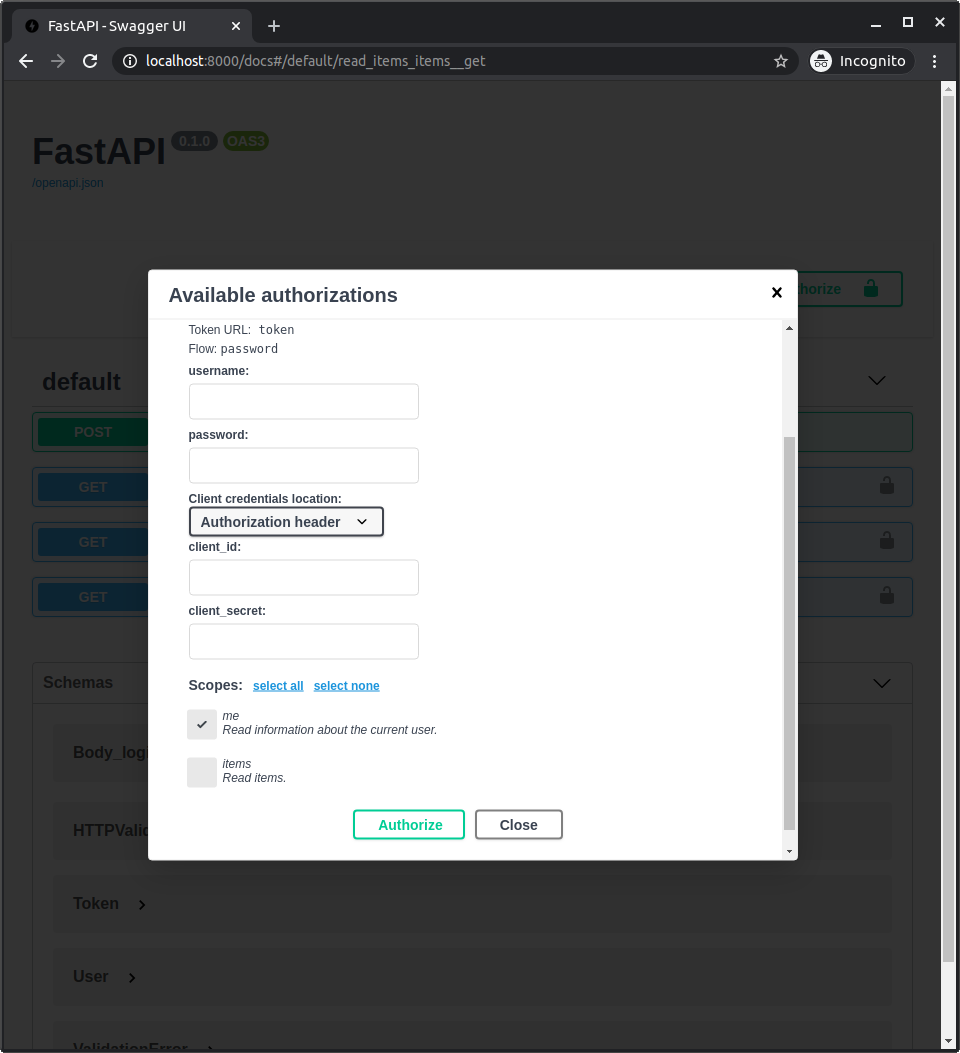
क्योंकि अब हम उन scopes को declare कर रहे हैं, वे API docs में तब दिखाई देंगे जब आप log-in/authorize करेंगे।
और आप select कर सकेंगे कि आप किन scopes को access देना चाहते हैं: me और items।
यह वही mechanism है जिसका उपयोग तब होता है जब आप Facebook, Google, GitHub, आदि के साथ log in करते समय permissions देते हैं:
Scopes के साथ JWT token
अब, token path operation को modify करें ताकि requested scopes return हों।
हम अभी भी वही OAuth2PasswordRequestForm उपयोग कर रहे हैं। इसमें scopes property शामिल है जिसमें str की list होती है, और request में received प्रत्येक scope होता है।
और हम scopes को JWT token के part के रूप में return करते हैं।
खतरा
सरलता के लिए, यहाँ हम received scopes को सीधे token में जोड़ रहे हैं।
लेकिन आपकी application में, security के लिए, आपको सुनिश्चित करना चाहिए कि आप केवल वे scopes जोड़ें जिन्हें user वास्तव में रख सकता है, या जिन्हें आपने predefine किया है।
from datetime import datetime, timedelta, timezone
from typing import Annotated

import jwt
from fastapi import Depends, FastAPI, HTTPException, Security, status
from fastapi.security import (
    OAuth2PasswordBearer,
    OAuth2PasswordRequestForm,
    SecurityScopes,
)
from jwt.exceptions import InvalidTokenError
from pwdlib import PasswordHash
from pydantic import BaseModel, ValidationError

# to get a string like this run:
# openssl rand -hex 32
SECRET_KEY = "09d25e094faa6ca2556c818166b7a9563b93f7099f6f0f4caa6cf63b88e8d3e7"
ALGORITHM = "HS256"
ACCESS_TOKEN_EXPIRE_MINUTES = 30


fake_users_db = {
    "johndoe": {
        "username": "johndoe",
        "full_name": "John Doe",
        "email": "johndoe@example.com",
        "hashed_password": "$argon2id$v=19$m=65536,t=3,p=4$wagCPXjifgvUFBzq4hqe3w$CYaIb8sB+wtD+Vu/P4uod1+Qof8h+1g7bbDlBID48Rc",
        "disabled": False,
    },
    "alice": {
        "username": "alice",
        "full_name": "Alice Chains",
        "email": "alicechains@example.com",
        "hashed_password": "$argon2id$v=19$m=65536,t=3,p=4$g2/AV1zwopqUntPKJavBFw$BwpRGDCyUHLvHICnwijyX8ROGoiUPwNKZ7915MeYfCE",
        "disabled": True,
    },
}


class Token(BaseModel):
    access_token: str
    token_type: str


class TokenData(BaseModel):
    username: str | None = None
    scopes: list[str] = []


class User(BaseModel):
    username: str
    email: str | None = None
    full_name: str | None = None
    disabled: bool | None = None


class UserInDB(User):
    hashed_password: str


password_hash = PasswordHash.recommended()

DUMMY_HASH = password_hash.hash("dummypassword")

oauth2_scheme = OAuth2PasswordBearer(
    tokenUrl="token",
    scopes={"me": "Read information about the current user.", "items": "Read items."},
)

app = FastAPI()


def verify_password(plain_password, hashed_password):
    return password_hash.verify(plain_password, hashed_password)


def get_password_hash(password):
    return password_hash.hash(password)


def get_user(db, username: str):
    if username in db:
        user_dict = db[username]
        return UserInDB(**user_dict)


def authenticate_user(fake_db, username: str, password: str):
    user = get_user(fake_db, username)
    if not user:
        verify_password(password, DUMMY_HASH)
        return False
    if not verify_password(password, user.hashed_password):
        return False
    return user


def create_access_token(data: dict, expires_delta: timedelta | None = None):
    to_encode = data.copy()
    if expires_delta:
        expire = datetime.now(timezone.utc) + expires_delta
    else:
        expire = datetime.now(timezone.utc) + timedelta(minutes=15)
    to_encode.update({"exp": expire})
    encoded_jwt = jwt.encode(to_encode, SECRET_KEY, algorithm=ALGORITHM)
    return encoded_jwt


async def get_current_user(
    security_scopes: SecurityScopes, token: Annotated[str, Depends(oauth2_scheme)]
):
    if security_scopes.scopes:
        authenticate_value = f'Bearer scope="{security_scopes.scope_str}"'
    else:
        authenticate_value = "Bearer"
    credentials_exception = HTTPException(
        status_code=status.HTTP_401_UNAUTHORIZED,
        detail="Could not validate credentials",
        headers={"WWW-Authenticate": authenticate_value},
    )
    try:
        payload = jwt.decode(token, SECRET_KEY, algorithms=[ALGORITHM])
        username = payload.get("sub")
        if username is None:
            raise credentials_exception
        scope: str = payload.get("scope", "")
        token_scopes = scope.split(" ")
        token_data = TokenData(scopes=token_scopes, username=username)
    except (InvalidTokenError, ValidationError):
        raise credentials_exception
    user = get_user(fake_users_db, username=token_data.username)
    if user is None:
        raise credentials_exception
    for scope in security_scopes.scopes:
        if scope not in token_data.scopes:
            raise HTTPException(
                status_code=status.HTTP_401_UNAUTHORIZED,
                detail="Not enough permissions",
                headers={"WWW-Authenticate": authenticate_value},
            )
    return user


async def get_current_active_user(
    current_user: Annotated[User, Security(get_current_user, scopes=["me"])],
):
    if current_user.disabled:
        raise HTTPException(status_code=400, detail="Inactive user")
    return current_user


@app.post("/token")
async def login_for_access_token(
    form_data: Annotated[OAuth2PasswordRequestForm, Depends()],
) -> Token:
    user = authenticate_user(fake_users_db, form_data.username, form_data.password)
    if not user:
        raise HTTPException(status_code=400, detail="Incorrect username or password")
    access_token_expires = timedelta(minutes=ACCESS_TOKEN_EXPIRE_MINUTES)
    access_token = create_access_token(
        data={"sub": user.username, "scope": " ".join(form_data.scopes)},
        expires_delta=access_token_expires,
    )
    return Token(access_token=access_token, token_type="bearer")


@app.get("/users/me/")
async def read_users_me(
    current_user: Annotated[User, Depends(get_current_active_user)],
) -> User:
    return current_user


@app.get("/users/me/items/")
async def read_own_items(
    current_user: Annotated[User, Security(get_current_active_user, scopes=["items"])],
):
    return [{"item_id": "Foo", "owner": current_user.username}]


@app.get("/status/")
async def read_system_status(current_user: Annotated[User, Depends(get_current_user)]):
    return {"status": "ok"}
🤓 Other versions and variants
Tip
Prefer to use the Annotated version if possible.
from datetime import datetime, timedelta, timezone

import jwt
from fastapi import Depends, FastAPI, HTTPException, Security, status
from fastapi.security import (
    OAuth2PasswordBearer,
    OAuth2PasswordRequestForm,
    SecurityScopes,
)
from jwt.exceptions import InvalidTokenError
from pwdlib import PasswordHash
from pydantic import BaseModel, ValidationError

# to get a string like this run:
# openssl rand -hex 32
SECRET_KEY = "09d25e094faa6ca2556c818166b7a9563b93f7099f6f0f4caa6cf63b88e8d3e7"
ALGORITHM = "HS256"
ACCESS_TOKEN_EXPIRE_MINUTES = 30


fake_users_db = {
    "johndoe": {
        "username": "johndoe",
        "full_name": "John Doe",
        "email": "johndoe@example.com",
        "hashed_password": "$argon2id$v=19$m=65536,t=3,p=4$wagCPXjifgvUFBzq4hqe3w$CYaIb8sB+wtD+Vu/P4uod1+Qof8h+1g7bbDlBID48Rc",
        "disabled": False,
    },
    "alice": {
        "username": "alice",
        "full_name": "Alice Chains",
        "email": "alicechains@example.com",
        "hashed_password": "$argon2id$v=19$m=65536,t=3,p=4$g2/AV1zwopqUntPKJavBFw$BwpRGDCyUHLvHICnwijyX8ROGoiUPwNKZ7915MeYfCE",
        "disabled": True,
    },
}


class Token(BaseModel):
    access_token: str
    token_type: str


class TokenData(BaseModel):
    username: str | None = None
    scopes: list[str] = []


class User(BaseModel):
    username: str
    email: str | None = None
    full_name: str | None = None
    disabled: bool | None = None


class UserInDB(User):
    hashed_password: str


password_hash = PasswordHash.recommended()

DUMMY_HASH = password_hash.hash("dummypassword")

oauth2_scheme = OAuth2PasswordBearer(
    tokenUrl="token",
    scopes={"me": "Read information about the current user.", "items": "Read items."},
)

app = FastAPI()


def verify_password(plain_password, hashed_password):
    return password_hash.verify(plain_password, hashed_password)


def get_password_hash(password):
    return password_hash.hash(password)


def get_user(db, username: str):
    if username in db:
        user_dict = db[username]
        return UserInDB(**user_dict)


def authenticate_user(fake_db, username: str, password: str):
    user = get_user(fake_db, username)
    if not user:
        verify_password(password, DUMMY_HASH)
        return False
    if not verify_password(password, user.hashed_password):
        return False
    return user


def create_access_token(data: dict, expires_delta: timedelta | None = None):
    to_encode = data.copy()
    if expires_delta:
        expire = datetime.now(timezone.utc) + expires_delta
    else:
        expire = datetime.now(timezone.utc) + timedelta(minutes=15)
    to_encode.update({"exp": expire})
    encoded_jwt = jwt.encode(to_encode, SECRET_KEY, algorithm=ALGORITHM)
    return encoded_jwt


async def get_current_user(
    security_scopes: SecurityScopes, token: str = Depends(oauth2_scheme)
):
    if security_scopes.scopes:
        authenticate_value = f'Bearer scope="{security_scopes.scope_str}"'
    else:
        authenticate_value = "Bearer"
    credentials_exception = HTTPException(
        status_code=status.HTTP_401_UNAUTHORIZED,
        detail="Could not validate credentials",
        headers={"WWW-Authenticate": authenticate_value},
    )
    try:
        payload = jwt.decode(token, SECRET_KEY, algorithms=[ALGORITHM])
        username: str = payload.get("sub")
        if username is None:
            raise credentials_exception
        scope: str = payload.get("scope", "")
        token_scopes = scope.split(" ")
        token_data = TokenData(scopes=token_scopes, username=username)
    except (InvalidTokenError, ValidationError):
        raise credentials_exception
    user = get_user(fake_users_db, username=token_data.username)
    if user is None:
        raise credentials_exception
    for scope in security_scopes.scopes:
        if scope not in token_data.scopes:
            raise HTTPException(
                status_code=status.HTTP_401_UNAUTHORIZED,
                detail="Not enough permissions",
                headers={"WWW-Authenticate": authenticate_value},
            )
    return user


async def get_current_active_user(
    current_user: User = Security(get_current_user, scopes=["me"]),
):
    if current_user.disabled:
        raise HTTPException(status_code=400, detail="Inactive user")
    return current_user


@app.post("/token")
async def login_for_access_token(
    form_data: OAuth2PasswordRequestForm = Depends(),
) -> Token:
    user = authenticate_user(fake_users_db, form_data.username, form_data.password)
    if not user:
        raise HTTPException(status_code=400, detail="Incorrect username or password")
    access_token_expires = timedelta(minutes=ACCESS_TOKEN_EXPIRE_MINUTES)
    access_token = create_access_token(
        data={"sub": user.username, "scope": " ".join(form_data.scopes)},
        expires_delta=access_token_expires,
    )
    return Token(access_token=access_token, token_type="bearer")


@app.get("/users/me/")
async def read_users_me(current_user: User = Depends(get_current_active_user)) -> User:
    return current_user


@app.get("/users/me/items/")
async def read_own_items(
    current_user: User = Security(get_current_active_user, scopes=["items"]),
):
    return [{"item_id": "Foo", "owner": current_user.username}]


@app.get("/status/")
async def read_system_status(current_user: User = Depends(get_current_user)):
    return {"status": "ok"}
path operations और dependencies में scopes declare करें
अब हम declare करते हैं कि /users/me/items/ के लिए path operation को scope items required है।
इसके लिए, हम fastapi से Security import और उपयोग करते हैं।
आप dependencies declare करने के लिए Security का उपयोग कर सकते हैं (बिल्कुल Depends की तरह), लेकिन Security एक parameter scopes भी receive करता है जिसमें scopes (strings) की list होती है।
इस case में, हम dependency function get_current_active_user को Security में pass करते हैं (उसी तरह जैसे हम Depends के साथ करते)।
लेकिन हम scopes की एक list भी pass करते हैं, इस case में केवल एक scope के साथ: items (इसमें और भी हो सकते थे)।
और dependency function get_current_active_user sub-dependencies भी declare कर सकता है, न केवल Depends के साथ बल्कि Security के साथ भी। अपना sub-dependency function (get_current_user) और अधिक scope requirements declare करते हुए।
इस case में, इसे scope me required है (इसे एक से अधिक scope required हो सकते थे)।
नोट
आपको अलग-अलग जगहों पर अलग-अलग scopes जोड़ना अनिवार्य नहीं है।
हम यहाँ यह demonstrate करने के लिए कर रहे हैं कि FastAPI अलग-अलग levels पर declared scopes को कैसे handle करता है।
from datetime import datetime, timedelta, timezone
from typing import Annotated

import jwt
from fastapi import Depends, FastAPI, HTTPException, Security, status
from fastapi.security import (
    OAuth2PasswordBearer,
    OAuth2PasswordRequestForm,
    SecurityScopes,
)
from jwt.exceptions import InvalidTokenError
from pwdlib import PasswordHash
from pydantic import BaseModel, ValidationError

# to get a string like this run:
# openssl rand -hex 32
SECRET_KEY = "09d25e094faa6ca2556c818166b7a9563b93f7099f6f0f4caa6cf63b88e8d3e7"
ALGORITHM = "HS256"
ACCESS_TOKEN_EXPIRE_MINUTES = 30


fake_users_db = {
    "johndoe": {
        "username": "johndoe",
        "full_name": "John Doe",
        "email": "johndoe@example.com",
        "hashed_password": "$argon2id$v=19$m=65536,t=3,p=4$wagCPXjifgvUFBzq4hqe3w$CYaIb8sB+wtD+Vu/P4uod1+Qof8h+1g7bbDlBID48Rc",
        "disabled": False,
    },
    "alice": {
        "username": "alice",
        "full_name": "Alice Chains",
        "email": "alicechains@example.com",
        "hashed_password": "$argon2id$v=19$m=65536,t=3,p=4$g2/AV1zwopqUntPKJavBFw$BwpRGDCyUHLvHICnwijyX8ROGoiUPwNKZ7915MeYfCE",
        "disabled": True,
    },
}


class Token(BaseModel):
    access_token: str
    token_type: str


class TokenData(BaseModel):
    username: str | None = None
    scopes: list[str] = []


class User(BaseModel):
    username: str
    email: str | None = None
    full_name: str | None = None
    disabled: bool | None = None


class UserInDB(User):
    hashed_password: str


password_hash = PasswordHash.recommended()

DUMMY_HASH = password_hash.hash("dummypassword")

oauth2_scheme = OAuth2PasswordBearer(
    tokenUrl="token",
    scopes={"me": "Read information about the current user.", "items": "Read items."},
)

app = FastAPI()


def verify_password(plain_password, hashed_password):
    return password_hash.verify(plain_password, hashed_password)


def get_password_hash(password):
    return password_hash.hash(password)


def get_user(db, username: str):
    if username in db:
        user_dict = db[username]
        return UserInDB(**user_dict)


def authenticate_user(fake_db, username: str, password: str):
    user = get_user(fake_db, username)
    if not user:
        verify_password(password, DUMMY_HASH)
        return False
    if not verify_password(password, user.hashed_password):
        return False
    return user


def create_access_token(data: dict, expires_delta: timedelta | None = None):
    to_encode = data.copy()
    if expires_delta:
        expire = datetime.now(timezone.utc) + expires_delta
    else:
        expire = datetime.now(timezone.utc) + timedelta(minutes=15)
    to_encode.update({"exp": expire})
    encoded_jwt = jwt.encode(to_encode, SECRET_KEY, algorithm=ALGORITHM)
    return encoded_jwt


async def get_current_user(
    security_scopes: SecurityScopes, token: Annotated[str, Depends(oauth2_scheme)]
):
    if security_scopes.scopes:
        authenticate_value = f'Bearer scope="{security_scopes.scope_str}"'
    else:
        authenticate_value = "Bearer"
    credentials_exception = HTTPException(
        status_code=status.HTTP_401_UNAUTHORIZED,
        detail="Could not validate credentials",
        headers={"WWW-Authenticate": authenticate_value},
    )
    try:
        payload = jwt.decode(token, SECRET_KEY, algorithms=[ALGORITHM])
        username = payload.get("sub")
        if username is None:
            raise credentials_exception
        scope: str = payload.get("scope", "")
        token_scopes = scope.split(" ")
        token_data = TokenData(scopes=token_scopes, username=username)
    except (InvalidTokenError, ValidationError):
        raise credentials_exception
    user = get_user(fake_users_db, username=token_data.username)
    if user is None:
        raise credentials_exception
    for scope in security_scopes.scopes:
        if scope not in token_data.scopes:
            raise HTTPException(
                status_code=status.HTTP_401_UNAUTHORIZED,
                detail="Not enough permissions",
                headers={"WWW-Authenticate": authenticate_value},
            )
    return user


async def get_current_active_user(
    current_user: Annotated[User, Security(get_current_user, scopes=["me"])],
):
    if current_user.disabled:
        raise HTTPException(status_code=400, detail="Inactive user")
    return current_user


@app.post("/token")
async def login_for_access_token(
    form_data: Annotated[OAuth2PasswordRequestForm, Depends()],
) -> Token:
    user = authenticate_user(fake_users_db, form_data.username, form_data.password)
    if not user:
        raise HTTPException(status_code=400, detail="Incorrect username or password")
    access_token_expires = timedelta(minutes=ACCESS_TOKEN_EXPIRE_MINUTES)
    access_token = create_access_token(
        data={"sub": user.username, "scope": " ".join(form_data.scopes)},
        expires_delta=access_token_expires,
    )
    return Token(access_token=access_token, token_type="bearer")


@app.get("/users/me/")
async def read_users_me(
    current_user: Annotated[User, Depends(get_current_active_user)],
) -> User:
    return current_user


@app.get("/users/me/items/")
async def read_own_items(
    current_user: Annotated[User, Security(get_current_active_user, scopes=["items"])],
):
    return [{"item_id": "Foo", "owner": current_user.username}]


@app.get("/status/")
async def read_system_status(current_user: Annotated[User, Depends(get_current_user)]):
    return {"status": "ok"}
🤓 Other versions and variants
Tip
Prefer to use the Annotated version if possible.
from datetime import datetime, timedelta, timezone

import jwt
from fastapi import Depends, FastAPI, HTTPException, Security, status
from fastapi.security import (
    OAuth2PasswordBearer,
    OAuth2PasswordRequestForm,
    SecurityScopes,
)
from jwt.exceptions import InvalidTokenError
from pwdlib import PasswordHash
from pydantic import BaseModel, ValidationError

# to get a string like this run:
# openssl rand -hex 32
SECRET_KEY = "09d25e094faa6ca2556c818166b7a9563b93f7099f6f0f4caa6cf63b88e8d3e7"
ALGORITHM = "HS256"
ACCESS_TOKEN_EXPIRE_MINUTES = 30


fake_users_db = {
    "johndoe": {
        "username": "johndoe",
        "full_name": "John Doe",
        "email": "johndoe@example.com",
        "hashed_password": "$argon2id$v=19$m=65536,t=3,p=4$wagCPXjifgvUFBzq4hqe3w$CYaIb8sB+wtD+Vu/P4uod1+Qof8h+1g7bbDlBID48Rc",
        "disabled": False,
    },
    "alice": {
        "username": "alice",
        "full_name": "Alice Chains",
        "email": "alicechains@example.com",
        "hashed_password": "$argon2id$v=19$m=65536,t=3,p=4$g2/AV1zwopqUntPKJavBFw$BwpRGDCyUHLvHICnwijyX8ROGoiUPwNKZ7915MeYfCE",
        "disabled": True,
    },
}


class Token(BaseModel):
    access_token: str
    token_type: str


class TokenData(BaseModel):
    username: str | None = None
    scopes: list[str] = []


class User(BaseModel):
    username: str
    email: str | None = None
    full_name: str | None = None
    disabled: bool | None = None


class UserInDB(User):
    hashed_password: str


password_hash = PasswordHash.recommended()

DUMMY_HASH = password_hash.hash("dummypassword")

oauth2_scheme = OAuth2PasswordBearer(
    tokenUrl="token",
    scopes={"me": "Read information about the current user.", "items": "Read items."},
)

app = FastAPI()


def verify_password(plain_password, hashed_password):
    return password_hash.verify(plain_password, hashed_password)


def get_password_hash(password):
    return password_hash.hash(password)


def get_user(db, username: str):
    if username in db:
        user_dict = db[username]
        return UserInDB(**user_dict)


def authenticate_user(fake_db, username: str, password: str):
    user = get_user(fake_db, username)
    if not user:
        verify_password(password, DUMMY_HASH)
        return False
    if not verify_password(password, user.hashed_password):
        return False
    return user


def create_access_token(data: dict, expires_delta: timedelta | None = None):
    to_encode = data.copy()
    if expires_delta:
        expire = datetime.now(timezone.utc) + expires_delta
    else:
        expire = datetime.now(timezone.utc) + timedelta(minutes=15)
    to_encode.update({"exp": expire})
    encoded_jwt = jwt.encode(to_encode, SECRET_KEY, algorithm=ALGORITHM)
    return encoded_jwt


async def get_current_user(
    security_scopes: SecurityScopes, token: str = Depends(oauth2_scheme)
):
    if security_scopes.scopes:
        authenticate_value = f'Bearer scope="{security_scopes.scope_str}"'
    else:
        authenticate_value = "Bearer"
    credentials_exception = HTTPException(
        status_code=status.HTTP_401_UNAUTHORIZED,
        detail="Could not validate credentials",
        headers={"WWW-Authenticate": authenticate_value},
    )
    try:
        payload = jwt.decode(token, SECRET_KEY, algorithms=[ALGORITHM])
        username: str = payload.get("sub")
        if username is None:
            raise credentials_exception
        scope: str = payload.get("scope", "")
        token_scopes = scope.split(" ")
        token_data = TokenData(scopes=token_scopes, username=username)
    except (InvalidTokenError, ValidationError):
        raise credentials_exception
    user = get_user(fake_users_db, username=token_data.username)
    if user is None:
        raise credentials_exception
    for scope in security_scopes.scopes:
        if scope not in token_data.scopes:
            raise HTTPException(
                status_code=status.HTTP_401_UNAUTHORIZED,
                detail="Not enough permissions",
                headers={"WWW-Authenticate": authenticate_value},
            )
    return user


async def get_current_active_user(
    current_user: User = Security(get_current_user, scopes=["me"]),
):
    if current_user.disabled:
        raise HTTPException(status_code=400, detail="Inactive user")
    return current_user


@app.post("/token")
async def login_for_access_token(
    form_data: OAuth2PasswordRequestForm = Depends(),
) -> Token:
    user = authenticate_user(fake_users_db, form_data.username, form_data.password)
    if not user:
        raise HTTPException(status_code=400, detail="Incorrect username or password")
    access_token_expires = timedelta(minutes=ACCESS_TOKEN_EXPIRE_MINUTES)
    access_token = create_access_token(
        data={"sub": user.username, "scope": " ".join(form_data.scopes)},
        expires_delta=access_token_expires,
    )
    return Token(access_token=access_token, token_type="bearer")


@app.get("/users/me/")
async def read_users_me(current_user: User = Depends(get_current_active_user)) -> User:
    return current_user


@app.get("/users/me/items/")
async def read_own_items(
    current_user: User = Security(get_current_active_user, scopes=["items"]),
):
    return [{"item_id": "Foo", "owner": current_user.username}]


@app.get("/status/")
async def read_system_status(current_user: User = Depends(get_current_user)):
    return {"status": "ok"}
तकनीकी विवरण
Security वास्तव में Depends का subclass है, और इसमें केवल एक extra parameter है जिसे हम बाद में देखेंगे।
लेकिन Depends के बजाय Security का उपयोग करके, FastAPI जान जाएगा कि यह security scopes declare कर सकता है, उन्हें internally उपयोग कर सकता है, और API को OpenAPI के साथ document कर सकता है।
लेकिन जब आप fastapi से Query, Path, Depends, Security और अन्य import करते हैं, तो वे वास्तव में functions हैं जो special classes return करते हैं।
SecurityScopes का उपयोग करें
अब dependency get_current_user को update करें।
यह वही है जिसका उपयोग ऊपर की dependencies द्वारा किया जाता है।
यहीं हम पहले बनाई गई उसी OAuth2 scheme का उपयोग कर रहे हैं, इसे dependency के रूप में declare करते हुए: oauth2_scheme।
क्योंकि इस dependency function की अपनी कोई scope requirements नहीं हैं, हम oauth2_scheme के साथ Depends उपयोग कर सकते हैं, जब हमें security scopes specify करने की आवश्यकता नहीं है तो हमें Security उपयोग करने की आवश्यकता नहीं है।
हम SecurityScopes type का एक special parameter भी declare करते हैं, जिसे fastapi.security से import किया गया है।
यह SecurityScopes class Request के समान है (Request का उपयोग request object को सीधे प्राप्त करने के लिए किया गया था)।
from datetime import datetime, timedelta, timezone
from typing import Annotated

import jwt
from fastapi import Depends, FastAPI, HTTPException, Security, status
from fastapi.security import (
    OAuth2PasswordBearer,
    OAuth2PasswordRequestForm,
    SecurityScopes,
)
from jwt.exceptions import InvalidTokenError
from pwdlib import PasswordHash
from pydantic import BaseModel, ValidationError

# to get a string like this run:
# openssl rand -hex 32
SECRET_KEY = "09d25e094faa6ca2556c818166b7a9563b93f7099f6f0f4caa6cf63b88e8d3e7"
ALGORITHM = "HS256"
ACCESS_TOKEN_EXPIRE_MINUTES = 30


fake_users_db = {
    "johndoe": {
        "username": "johndoe",
        "full_name": "John Doe",
        "email": "johndoe@example.com",
        "hashed_password": "$argon2id$v=19$m=65536,t=3,p=4$wagCPXjifgvUFBzq4hqe3w$CYaIb8sB+wtD+Vu/P4uod1+Qof8h+1g7bbDlBID48Rc",
        "disabled": False,
    },
    "alice": {
        "username": "alice",
        "full_name": "Alice Chains",
        "email": "alicechains@example.com",
        "hashed_password": "$argon2id$v=19$m=65536,t=3,p=4$g2/AV1zwopqUntPKJavBFw$BwpRGDCyUHLvHICnwijyX8ROGoiUPwNKZ7915MeYfCE",
        "disabled": True,
    },
}


class Token(BaseModel):
    access_token: str
    token_type: str


class TokenData(BaseModel):
    username: str | None = None
    scopes: list[str] = []


class User(BaseModel):
    username: str
    email: str | None = None
    full_name: str | None = None
    disabled: bool | None = None


class UserInDB(User):
    hashed_password: str


password_hash = PasswordHash.recommended()

DUMMY_HASH = password_hash.hash("dummypassword")

oauth2_scheme = OAuth2PasswordBearer(
    tokenUrl="token",
    scopes={"me": "Read information about the current user.", "items": "Read items."},
)

app = FastAPI()


def verify_password(plain_password, hashed_password):
    return password_hash.verify(plain_password, hashed_password)


def get_password_hash(password):
    return password_hash.hash(password)


def get_user(db, username: str):
    if username in db:
        user_dict = db[username]
        return UserInDB(**user_dict)


def authenticate_user(fake_db, username: str, password: str):
    user = get_user(fake_db, username)
    if not user:
        verify_password(password, DUMMY_HASH)
        return False
    if not verify_password(password, user.hashed_password):
        return False
    return user


def create_access_token(data: dict, expires_delta: timedelta | None = None):
    to_encode = data.copy()
    if expires_delta:
        expire = datetime.now(timezone.utc) + expires_delta
    else:
        expire = datetime.now(timezone.utc) + timedelta(minutes=15)
    to_encode.update({"exp": expire})
    encoded_jwt = jwt.encode(to_encode, SECRET_KEY, algorithm=ALGORITHM)
    return encoded_jwt


async def get_current_user(
    security_scopes: SecurityScopes, token: Annotated[str, Depends(oauth2_scheme)]
):
    if security_scopes.scopes:
        authenticate_value = f'Bearer scope="{security_scopes.scope_str}"'
    else:
        authenticate_value = "Bearer"
    credentials_exception = HTTPException(
        status_code=status.HTTP_401_UNAUTHORIZED,
        detail="Could not validate credentials",
        headers={"WWW-Authenticate": authenticate_value},
    )
    try:
        payload = jwt.decode(token, SECRET_KEY, algorithms=[ALGORITHM])
        username = payload.get("sub")
        if username is None:
            raise credentials_exception
        scope: str = payload.get("scope", "")
        token_scopes = scope.split(" ")
        token_data = TokenData(scopes=token_scopes, username=username)
    except (InvalidTokenError, ValidationError):
        raise credentials_exception
    user = get_user(fake_users_db, username=token_data.username)
    if user is None:
        raise credentials_exception
    for scope in security_scopes.scopes:
        if scope not in token_data.scopes:
            raise HTTPException(
                status_code=status.HTTP_401_UNAUTHORIZED,
                detail="Not enough permissions",
                headers={"WWW-Authenticate": authenticate_value},
            )
    return user


async def get_current_active_user(
    current_user: Annotated[User, Security(get_current_user, scopes=["me"])],
):
    if current_user.disabled:
        raise HTTPException(status_code=400, detail="Inactive user")
    return current_user


@app.post("/token")
async def login_for_access_token(
    form_data: Annotated[OAuth2PasswordRequestForm, Depends()],
) -> Token:
    user = authenticate_user(fake_users_db, form_data.username, form_data.password)
    if not user:
        raise HTTPException(status_code=400, detail="Incorrect username or password")
    access_token_expires = timedelta(minutes=ACCESS_TOKEN_EXPIRE_MINUTES)
    access_token = create_access_token(
        data={"sub": user.username, "scope": " ".join(form_data.scopes)},
        expires_delta=access_token_expires,
    )
    return Token(access_token=access_token, token_type="bearer")


@app.get("/users/me/")
async def read_users_me(
    current_user: Annotated[User, Depends(get_current_active_user)],
) -> User:
    return current_user


@app.get("/users/me/items/")
async def read_own_items(
    current_user: Annotated[User, Security(get_current_active_user, scopes=["items"])],
):
    return [{"item_id": "Foo", "owner": current_user.username}]


@app.get("/status/")
async def read_system_status(current_user: Annotated[User, Depends(get_current_user)]):
    return {"status": "ok"}
🤓 Other versions and variants
Tip
Prefer to use the Annotated version if possible.
from datetime import datetime, timedelta, timezone

import jwt
from fastapi import Depends, FastAPI, HTTPException, Security, status
from fastapi.security import (
    OAuth2PasswordBearer,
    OAuth2PasswordRequestForm,
    SecurityScopes,
)
from jwt.exceptions import InvalidTokenError
from pwdlib import PasswordHash
from pydantic import BaseModel, ValidationError

# to get a string like this run:
# openssl rand -hex 32
SECRET_KEY = "09d25e094faa6ca2556c818166b7a9563b93f7099f6f0f4caa6cf63b88e8d3e7"
ALGORITHM = "HS256"
ACCESS_TOKEN_EXPIRE_MINUTES = 30


fake_users_db = {
    "johndoe": {
        "username": "johndoe",
        "full_name": "John Doe",
        "email": "johndoe@example.com",
        "hashed_password": "$argon2id$v=19$m=65536,t=3,p=4$wagCPXjifgvUFBzq4hqe3w$CYaIb8sB+wtD+Vu/P4uod1+Qof8h+1g7bbDlBID48Rc",
        "disabled": False,
    },
    "alice": {
        "username": "alice",
        "full_name": "Alice Chains",
        "email": "alicechains@example.com",
        "hashed_password": "$argon2id$v=19$m=65536,t=3,p=4$g2/AV1zwopqUntPKJavBFw$BwpRGDCyUHLvHICnwijyX8ROGoiUPwNKZ7915MeYfCE",
        "disabled": True,
    },
}


class Token(BaseModel):
    access_token: str
    token_type: str


class TokenData(BaseModel):
    username: str | None = None
    scopes: list[str] = []


class User(BaseModel):
    username: str
    email: str | None = None
    full_name: str | None = None
    disabled: bool | None = None


class UserInDB(User):
    hashed_password: str


password_hash = PasswordHash.recommended()

DUMMY_HASH = password_hash.hash("dummypassword")

oauth2_scheme = OAuth2PasswordBearer(
    tokenUrl="token",
    scopes={"me": "Read information about the current user.", "items": "Read items."},
)

app = FastAPI()


def verify_password(plain_password, hashed_password):
    return password_hash.verify(plain_password, hashed_password)


def get_password_hash(password):
    return password_hash.hash(password)


def get_user(db, username: str):
    if username in db:
        user_dict = db[username]
        return UserInDB(**user_dict)


def authenticate_user(fake_db, username: str, password: str):
    user = get_user(fake_db, username)
    if not user:
        verify_password(password, DUMMY_HASH)
        return False
    if not verify_password(password, user.hashed_password):
        return False
    return user


def create_access_token(data: dict, expires_delta: timedelta | None = None):
    to_encode = data.copy()
    if expires_delta:
        expire = datetime.now(timezone.utc) + expires_delta
    else:
        expire = datetime.now(timezone.utc) + timedelta(minutes=15)
    to_encode.update({"exp": expire})
    encoded_jwt = jwt.encode(to_encode, SECRET_KEY, algorithm=ALGORITHM)
    return encoded_jwt


async def get_current_user(
    security_scopes: SecurityScopes, token: str = Depends(oauth2_scheme)
):
    if security_scopes.scopes:
        authenticate_value = f'Bearer scope="{security_scopes.scope_str}"'
    else:
        authenticate_value = "Bearer"
    credentials_exception = HTTPException(
        status_code=status.HTTP_401_UNAUTHORIZED,
        detail="Could not validate credentials",
        headers={"WWW-Authenticate": authenticate_value},
    )
    try:
        payload = jwt.decode(token, SECRET_KEY, algorithms=[ALGORITHM])
        username: str = payload.get("sub")
        if username is None:
            raise credentials_exception
        scope: str = payload.get("scope", "")
        token_scopes = scope.split(" ")
        token_data = TokenData(scopes=token_scopes, username=username)
    except (InvalidTokenError, ValidationError):
        raise credentials_exception
    user = get_user(fake_users_db, username=token_data.username)
    if user is None:
        raise credentials_exception
    for scope in security_scopes.scopes:
        if scope not in token_data.scopes:
            raise HTTPException(
                status_code=status.HTTP_401_UNAUTHORIZED,
                detail="Not enough permissions",
                headers={"WWW-Authenticate": authenticate_value},
            )
    return user


async def get_current_active_user(
    current_user: User = Security(get_current_user, scopes=["me"]),
):
    if current_user.disabled:
        raise HTTPException(status_code=400, detail="Inactive user")
    return current_user


@app.post("/token")
async def login_for_access_token(
    form_data: OAuth2PasswordRequestForm = Depends(),
) -> Token:
    user = authenticate_user(fake_users_db, form_data.username, form_data.password)
    if not user:
        raise HTTPException(status_code=400, detail="Incorrect username or password")
    access_token_expires = timedelta(minutes=ACCESS_TOKEN_EXPIRE_MINUTES)
    access_token = create_access_token(
        data={"sub": user.username, "scope": " ".join(form_data.scopes)},
        expires_delta=access_token_expires,
    )
    return Token(access_token=access_token, token_type="bearer")


@app.get("/users/me/")
async def read_users_me(current_user: User = Depends(get_current_active_user)) -> User:
    return current_user


@app.get("/users/me/items/")
async def read_own_items(
    current_user: User = Security(get_current_active_user, scopes=["items"]),
):
    return [{"item_id": "Foo", "owner": current_user.username}]


@app.get("/status/")
async def read_system_status(current_user: User = Depends(get_current_user)):
    return {"status": "ok"}
scopes का उपयोग करें
Parameter security_scopes का type SecurityScopes होगा।
इसमें property scopes होगी जिसमें एक list होगी, जिसमें स्वयं और इसे sub-dependency के रूप में उपयोग करने वाली सभी dependencies द्वारा required सभी scopes शामिल होंगे। इसका मतलब है, सभी "dependants"... यह confusing लग सकता है, इसे नीचे फिर से समझाया गया है।
security_scopes object (SecurityScopes class का) एक scope_str attribute भी provide करता है जिसमें एक single string होती है, जिसमें वे scopes spaces से अलग होते हैं (हम इसका उपयोग करेंगे)।
हम एक HTTPException बनाते हैं जिसे हम बाद में कई points पर reuse (raise) कर सकते हैं।
इस exception में, हम required scopes (यदि कोई हों) को spaces से अलग की गई string के रूप में शामिल करते हैं (scope_str का उपयोग करके)। हम scopes वाली उस string को WWW-Authenticate header में रखते हैं (यह spec का part है)।
from datetime import datetime, timedelta, timezone
from typing import Annotated

import jwt
from fastapi import Depends, FastAPI, HTTPException, Security, status
from fastapi.security import (
    OAuth2PasswordBearer,
    OAuth2PasswordRequestForm,
    SecurityScopes,
)
from jwt.exceptions import InvalidTokenError
from pwdlib import PasswordHash
from pydantic import BaseModel, ValidationError

# to get a string like this run:
# openssl rand -hex 32
SECRET_KEY = "09d25e094faa6ca2556c818166b7a9563b93f7099f6f0f4caa6cf63b88e8d3e7"
ALGORITHM = "HS256"
ACCESS_TOKEN_EXPIRE_MINUTES = 30


fake_users_db = {
    "johndoe": {
        "username": "johndoe",
        "full_name": "John Doe",
        "email": "johndoe@example.com",
        "hashed_password": "$argon2id$v=19$m=65536,t=3,p=4$wagCPXjifgvUFBzq4hqe3w$CYaIb8sB+wtD+Vu/P4uod1+Qof8h+1g7bbDlBID48Rc",
        "disabled": False,
    },
    "alice": {
        "username": "alice",
        "full_name": "Alice Chains",
        "email": "alicechains@example.com",
        "hashed_password": "$argon2id$v=19$m=65536,t=3,p=4$g2/AV1zwopqUntPKJavBFw$BwpRGDCyUHLvHICnwijyX8ROGoiUPwNKZ7915MeYfCE",
        "disabled": True,
    },
}


class Token(BaseModel):
    access_token: str
    token_type: str


class TokenData(BaseModel):
    username: str | None = None
    scopes: list[str] = []


class User(BaseModel):
    username: str
    email: str | None = None
    full_name: str | None = None
    disabled: bool | None = None


class UserInDB(User):
    hashed_password: str


password_hash = PasswordHash.recommended()

DUMMY_HASH = password_hash.hash("dummypassword")

oauth2_scheme = OAuth2PasswordBearer(
    tokenUrl="token",
    scopes={"me": "Read information about the current user.", "items": "Read items."},
)

app = FastAPI()


def verify_password(plain_password, hashed_password):
    return password_hash.verify(plain_password, hashed_password)


def get_password_hash(password):
    return password_hash.hash(password)


def get_user(db, username: str):
    if username in db:
        user_dict = db[username]
        return UserInDB(**user_dict)


def authenticate_user(fake_db, username: str, password: str):
    user = get_user(fake_db, username)
    if not user:
        verify_password(password, DUMMY_HASH)
        return False
    if not verify_password(password, user.hashed_password):
        return False
    return user


def create_access_token(data: dict, expires_delta: timedelta | None = None):
    to_encode = data.copy()
    if expires_delta:
        expire = datetime.now(timezone.utc) + expires_delta
    else:
        expire = datetime.now(timezone.utc) + timedelta(minutes=15)
    to_encode.update({"exp": expire})
    encoded_jwt = jwt.encode(to_encode, SECRET_KEY, algorithm=ALGORITHM)
    return encoded_jwt


async def get_current_user(
    security_scopes: SecurityScopes, token: Annotated[str, Depends(oauth2_scheme)]
):
    if security_scopes.scopes:
        authenticate_value = f'Bearer scope="{security_scopes.scope_str}"'
    else:
        authenticate_value = "Bearer"
    credentials_exception = HTTPException(
        status_code=status.HTTP_401_UNAUTHORIZED,
        detail="Could not validate credentials",
        headers={"WWW-Authenticate": authenticate_value},
    )
    try:
        payload = jwt.decode(token, SECRET_KEY, algorithms=[ALGORITHM])
        username = payload.get("sub")
        if username is None:
            raise credentials_exception
        scope: str = payload.get("scope", "")
        token_scopes = scope.split(" ")
        token_data = TokenData(scopes=token_scopes, username=username)
    except (InvalidTokenError, ValidationError):
        raise credentials_exception
    user = get_user(fake_users_db, username=token_data.username)
    if user is None:
        raise credentials_exception
    for scope in security_scopes.scopes:
        if scope not in token_data.scopes:
            raise HTTPException(
                status_code=status.HTTP_401_UNAUTHORIZED,
                detail="Not enough permissions",
                headers={"WWW-Authenticate": authenticate_value},
            )
    return user


async def get_current_active_user(
    current_user: Annotated[User, Security(get_current_user, scopes=["me"])],
):
    if current_user.disabled:
        raise HTTPException(status_code=400, detail="Inactive user")
    return current_user


@app.post("/token")
async def login_for_access_token(
    form_data: Annotated[OAuth2PasswordRequestForm, Depends()],
) -> Token:
    user = authenticate_user(fake_users_db, form_data.username, form_data.password)
    if not user:
        raise HTTPException(status_code=400, detail="Incorrect username or password")
    access_token_expires = timedelta(minutes=ACCESS_TOKEN_EXPIRE_MINUTES)
    access_token = create_access_token(
        data={"sub": user.username, "scope": " ".join(form_data.scopes)},
        expires_delta=access_token_expires,
    )
    return Token(access_token=access_token, token_type="bearer")


@app.get("/users/me/")
async def read_users_me(
    current_user: Annotated[User, Depends(get_current_active_user)],
) -> User:
    return current_user


@app.get("/users/me/items/")
async def read_own_items(
    current_user: Annotated[User, Security(get_current_active_user, scopes=["items"])],
):
    return [{"item_id": "Foo", "owner": current_user.username}]


@app.get("/status/")
async def read_system_status(current_user: Annotated[User, Depends(get_current_user)]):
    return {"status": "ok"}
🤓 Other versions and variants
Tip
Prefer to use the Annotated version if possible.
from datetime import datetime, timedelta, timezone

import jwt
from fastapi import Depends, FastAPI, HTTPException, Security, status
from fastapi.security import (
    OAuth2PasswordBearer,
    OAuth2PasswordRequestForm,
    SecurityScopes,
)
from jwt.exceptions import InvalidTokenError
from pwdlib import PasswordHash
from pydantic import BaseModel, ValidationError

# to get a string like this run:
# openssl rand -hex 32
SECRET_KEY = "09d25e094faa6ca2556c818166b7a9563b93f7099f6f0f4caa6cf63b88e8d3e7"
ALGORITHM = "HS256"
ACCESS_TOKEN_EXPIRE_MINUTES = 30


fake_users_db = {
    "johndoe": {
        "username": "johndoe",
        "full_name": "John Doe",
        "email": "johndoe@example.com",
        "hashed_password": "$argon2id$v=19$m=65536,t=3,p=4$wagCPXjifgvUFBzq4hqe3w$CYaIb8sB+wtD+Vu/P4uod1+Qof8h+1g7bbDlBID48Rc",
        "disabled": False,
    },
    "alice": {
        "username": "alice",
        "full_name": "Alice Chains",
        "email": "alicechains@example.com",
        "hashed_password": "$argon2id$v=19$m=65536,t=3,p=4$g2/AV1zwopqUntPKJavBFw$BwpRGDCyUHLvHICnwijyX8ROGoiUPwNKZ7915MeYfCE",
        "disabled": True,
    },
}


class Token(BaseModel):
    access_token: str
    token_type: str


class TokenData(BaseModel):
    username: str | None = None
    scopes: list[str] = []


class User(BaseModel):
    username: str
    email: str | None = None
    full_name: str | None = None
    disabled: bool | None = None


class UserInDB(User):
    hashed_password: str


password_hash = PasswordHash.recommended()

DUMMY_HASH = password_hash.hash("dummypassword")

oauth2_scheme = OAuth2PasswordBearer(
    tokenUrl="token",
    scopes={"me": "Read information about the current user.", "items": "Read items."},
)

app = FastAPI()


def verify_password(plain_password, hashed_password):
    return password_hash.verify(plain_password, hashed_password)


def get_password_hash(password):
    return password_hash.hash(password)


def get_user(db, username: str):
    if username in db:
        user_dict = db[username]
        return UserInDB(**user_dict)


def authenticate_user(fake_db, username: str, password: str):
    user = get_user(fake_db, username)
    if not user:
        verify_password(password, DUMMY_HASH)
        return False
    if not verify_password(password, user.hashed_password):
        return False
    return user


def create_access_token(data: dict, expires_delta: timedelta | None = None):
    to_encode = data.copy()
    if expires_delta:
        expire = datetime.now(timezone.utc) + expires_delta
    else:
        expire = datetime.now(timezone.utc) + timedelta(minutes=15)
    to_encode.update({"exp": expire})
    encoded_jwt = jwt.encode(to_encode, SECRET_KEY, algorithm=ALGORITHM)
    return encoded_jwt


async def get_current_user(
    security_scopes: SecurityScopes, token: str = Depends(oauth2_scheme)
):
    if security_scopes.scopes:
        authenticate_value = f'Bearer scope="{security_scopes.scope_str}"'
    else:
        authenticate_value = "Bearer"
    credentials_exception = HTTPException(
        status_code=status.HTTP_401_UNAUTHORIZED,
        detail="Could not validate credentials",
        headers={"WWW-Authenticate": authenticate_value},
    )
    try:
        payload = jwt.decode(token, SECRET_KEY, algorithms=[ALGORITHM])
        username: str = payload.get("sub")
        if username is None:
            raise credentials_exception
        scope: str = payload.get("scope", "")
        token_scopes = scope.split(" ")
        token_data = TokenData(scopes=token_scopes, username=username)
    except (InvalidTokenError, ValidationError):
        raise credentials_exception
    user = get_user(fake_users_db, username=token_data.username)
    if user is None:
        raise credentials_exception
    for scope in security_scopes.scopes:
        if scope not in token_data.scopes:
            raise HTTPException(
                status_code=status.HTTP_401_UNAUTHORIZED,
                detail="Not enough permissions",
                headers={"WWW-Authenticate": authenticate_value},
            )
    return user


async def get_current_active_user(
    current_user: User = Security(get_current_user, scopes=["me"]),
):
    if current_user.disabled:
        raise HTTPException(status_code=400, detail="Inactive user")
    return current_user


@app.post("/token")
async def login_for_access_token(
    form_data: OAuth2PasswordRequestForm = Depends(),
) -> Token:
    user = authenticate_user(fake_users_db, form_data.username, form_data.password)
    if not user:
        raise HTTPException(status_code=400, detail="Incorrect username or password")
    access_token_expires = timedelta(minutes=ACCESS_TOKEN_EXPIRE_MINUTES)
    access_token = create_access_token(
        data={"sub": user.username, "scope": " ".join(form_data.scopes)},
        expires_delta=access_token_expires,
    )
    return Token(access_token=access_token, token_type="bearer")


@app.get("/users/me/")
async def read_users_me(current_user: User = Depends(get_current_active_user)) -> User:
    return current_user


@app.get("/users/me/items/")
async def read_own_items(
    current_user: User = Security(get_current_active_user, scopes=["items"]),
):
    return [{"item_id": "Foo", "owner": current_user.username}]


@app.get("/status/")
async def read_system_status(current_user: User = Depends(get_current_user)):
    return {"status": "ok"}
username और data shape verify करें
हम verify करते हैं कि हमें username मिलता है, और scopes extract करते हैं।
और फिर हम उस data को Pydantic model के साथ validate करते हैं (ValidationError exception को catch करते हुए), और यदि JWT token पढ़ने या Pydantic के साथ data validate करने में error मिलता है, तो हम पहले बनाया हुआ HTTPException raise करते हैं।
इसके लिए, हम Pydantic model TokenData को नई property scopes के साथ update करते हैं।
Pydantic के साथ data validate करके हम यह सुनिश्चित कर सकते हैं कि हमारे पास, उदाहरण के लिए, scopes के साथ बिल्कुल str की list और username के साथ str है।
उदाहरण के लिए, dict, या कुछ और नहीं, क्योंकि यह बाद में किसी point पर application को break कर सकता है, जिससे यह security risk बन सकता है।
हम यह भी verify करते हैं कि हमारे पास उस username वाला user है, और यदि नहीं, तो हम वही exception raise करते हैं जो हमने पहले बनाया था।
from datetime import datetime, timedelta, timezone
from typing import Annotated

import jwt
from fastapi import Depends, FastAPI, HTTPException, Security, status
from fastapi.security import (
    OAuth2PasswordBearer,
    OAuth2PasswordRequestForm,
    SecurityScopes,
)
from jwt.exceptions import InvalidTokenError
from pwdlib import PasswordHash
from pydantic import BaseModel, ValidationError

# to get a string like this run:
# openssl rand -hex 32
SECRET_KEY = "09d25e094faa6ca2556c818166b7a9563b93f7099f6f0f4caa6cf63b88e8d3e7"
ALGORITHM = "HS256"
ACCESS_TOKEN_EXPIRE_MINUTES = 30


fake_users_db = {
    "johndoe": {
        "username": "johndoe",
        "full_name": "John Doe",
        "email": "johndoe@example.com",
        "hashed_password": "$argon2id$v=19$m=65536,t=3,p=4$wagCPXjifgvUFBzq4hqe3w$CYaIb8sB+wtD+Vu/P4uod1+Qof8h+1g7bbDlBID48Rc",
        "disabled": False,
    },
    "alice": {
        "username": "alice",
        "full_name": "Alice Chains",
        "email": "alicechains@example.com",
        "hashed_password": "$argon2id$v=19$m=65536,t=3,p=4$g2/AV1zwopqUntPKJavBFw$BwpRGDCyUHLvHICnwijyX8ROGoiUPwNKZ7915MeYfCE",
        "disabled": True,
    },
}


class Token(BaseModel):
    access_token: str
    token_type: str


class TokenData(BaseModel):
    username: str | None = None
    scopes: list[str] = []


class User(BaseModel):
    username: str
    email: str | None = None
    full_name: str | None = None
    disabled: bool | None = None


class UserInDB(User):
    hashed_password: str


password_hash = PasswordHash.recommended()

DUMMY_HASH = password_hash.hash("dummypassword")

oauth2_scheme = OAuth2PasswordBearer(
    tokenUrl="token",
    scopes={"me": "Read information about the current user.", "items": "Read items."},
)

app = FastAPI()


def verify_password(plain_password, hashed_password):
    return password_hash.verify(plain_password, hashed_password)


def get_password_hash(password):
    return password_hash.hash(password)


def get_user(db, username: str):
    if username in db:
        user_dict = db[username]
        return UserInDB(**user_dict)


def authenticate_user(fake_db, username: str, password: str):
    user = get_user(fake_db, username)
    if not user:
        verify_password(password, DUMMY_HASH)
        return False
    if not verify_password(password, user.hashed_password):
        return False
    return user


def create_access_token(data: dict, expires_delta: timedelta | None = None):
    to_encode = data.copy()
    if expires_delta:
        expire = datetime.now(timezone.utc) + expires_delta
    else:
        expire = datetime.now(timezone.utc) + timedelta(minutes=15)
    to_encode.update({"exp": expire})
    encoded_jwt = jwt.encode(to_encode, SECRET_KEY, algorithm=ALGORITHM)
    return encoded_jwt


async def get_current_user(
    security_scopes: SecurityScopes, token: Annotated[str, Depends(oauth2_scheme)]
):
    if security_scopes.scopes:
        authenticate_value = f'Bearer scope="{security_scopes.scope_str}"'
    else:
        authenticate_value = "Bearer"
    credentials_exception = HTTPException(
        status_code=status.HTTP_401_UNAUTHORIZED,
        detail="Could not validate credentials",
        headers={"WWW-Authenticate": authenticate_value},
    )
    try:
        payload = jwt.decode(token, SECRET_KEY, algorithms=[ALGORITHM])
        username = payload.get("sub")
        if username is None:
            raise credentials_exception
        scope: str = payload.get("scope", "")
        token_scopes = scope.split(" ")
        token_data = TokenData(scopes=token_scopes, username=username)
    except (InvalidTokenError, ValidationError):
        raise credentials_exception
    user = get_user(fake_users_db, username=token_data.username)
    if user is None:
        raise credentials_exception
    for scope in security_scopes.scopes:
        if scope not in token_data.scopes:
            raise HTTPException(
                status_code=status.HTTP_401_UNAUTHORIZED,
                detail="Not enough permissions",
                headers={"WWW-Authenticate": authenticate_value},
            )
    return user


async def get_current_active_user(
    current_user: Annotated[User, Security(get_current_user, scopes=["me"])],
):
    if current_user.disabled:
        raise HTTPException(status_code=400, detail="Inactive user")
    return current_user


@app.post("/token")
async def login_for_access_token(
    form_data: Annotated[OAuth2PasswordRequestForm, Depends()],
) -> Token:
    user = authenticate_user(fake_users_db, form_data.username, form_data.password)
    if not user:
        raise HTTPException(status_code=400, detail="Incorrect username or password")
    access_token_expires = timedelta(minutes=ACCESS_TOKEN_EXPIRE_MINUTES)
    access_token = create_access_token(
        data={"sub": user.username, "scope": " ".join(form_data.scopes)},
        expires_delta=access_token_expires,
    )
    return Token(access_token=access_token, token_type="bearer")


@app.get("/users/me/")
async def read_users_me(
    current_user: Annotated[User, Depends(get_current_active_user)],
) -> User:
    return current_user


@app.get("/users/me/items/")
async def read_own_items(
    current_user: Annotated[User, Security(get_current_active_user, scopes=["items"])],
):
    return [{"item_id": "Foo", "owner": current_user.username}]


@app.get("/status/")
async def read_system_status(current_user: Annotated[User, Depends(get_current_user)]):
    return {"status": "ok"}
🤓 Other versions and variants
Tip
Prefer to use the Annotated version if possible.
from datetime import datetime, timedelta, timezone

import jwt
from fastapi import Depends, FastAPI, HTTPException, Security, status
from fastapi.security import (
    OAuth2PasswordBearer,
    OAuth2PasswordRequestForm,
    SecurityScopes,
)
from jwt.exceptions import InvalidTokenError
from pwdlib import PasswordHash
from pydantic import BaseModel, ValidationError

# to get a string like this run:
# openssl rand -hex 32
SECRET_KEY = "09d25e094faa6ca2556c818166b7a9563b93f7099f6f0f4caa6cf63b88e8d3e7"
ALGORITHM = "HS256"
ACCESS_TOKEN_EXPIRE_MINUTES = 30


fake_users_db = {
    "johndoe": {
        "username": "johndoe",
        "full_name": "John Doe",
        "email": "johndoe@example.com",
        "hashed_password": "$argon2id$v=19$m=65536,t=3,p=4$wagCPXjifgvUFBzq4hqe3w$CYaIb8sB+wtD+Vu/P4uod1+Qof8h+1g7bbDlBID48Rc",
        "disabled": False,
    },
    "alice": {
        "username": "alice",
        "full_name": "Alice Chains",
        "email": "alicechains@example.com",
        "hashed_password": "$argon2id$v=19$m=65536,t=3,p=4$g2/AV1zwopqUntPKJavBFw$BwpRGDCyUHLvHICnwijyX8ROGoiUPwNKZ7915MeYfCE",
        "disabled": True,
    },
}


class Token(BaseModel):
    access_token: str
    token_type: str


class TokenData(BaseModel):
    username: str | None = None
    scopes: list[str] = []


class User(BaseModel):
    username: str
    email: str | None = None
    full_name: str | None = None
    disabled: bool | None = None


class UserInDB(User):
    hashed_password: str


password_hash = PasswordHash.recommended()

DUMMY_HASH = password_hash.hash("dummypassword")

oauth2_scheme = OAuth2PasswordBearer(
    tokenUrl="token",
    scopes={"me": "Read information about the current user.", "items": "Read items."},
)

app = FastAPI()


def verify_password(plain_password, hashed_password):
    return password_hash.verify(plain_password, hashed_password)


def get_password_hash(password):
    return password_hash.hash(password)


def get_user(db, username: str):
    if username in db:
        user_dict = db[username]
        return UserInDB(**user_dict)


def authenticate_user(fake_db, username: str, password: str):
    user = get_user(fake_db, username)
    if not user:
        verify_password(password, DUMMY_HASH)
        return False
    if not verify_password(password, user.hashed_password):
        return False
    return user


def create_access_token(data: dict, expires_delta: timedelta | None = None):
    to_encode = data.copy()
    if expires_delta:
        expire = datetime.now(timezone.utc) + expires_delta
    else:
        expire = datetime.now(timezone.utc) + timedelta(minutes=15)
    to_encode.update({"exp": expire})
    encoded_jwt = jwt.encode(to_encode, SECRET_KEY, algorithm=ALGORITHM)
    return encoded_jwt


async def get_current_user(
    security_scopes: SecurityScopes, token: str = Depends(oauth2_scheme)
):
    if security_scopes.scopes:
        authenticate_value = f'Bearer scope="{security_scopes.scope_str}"'
    else:
        authenticate_value = "Bearer"
    credentials_exception = HTTPException(
        status_code=status.HTTP_401_UNAUTHORIZED,
        detail="Could not validate credentials",
        headers={"WWW-Authenticate": authenticate_value},
    )
    try:
        payload = jwt.decode(token, SECRET_KEY, algorithms=[ALGORITHM])
        username: str = payload.get("sub")
        if username is None:
            raise credentials_exception
        scope: str = payload.get("scope", "")
        token_scopes = scope.split(" ")
        token_data = TokenData(scopes=token_scopes, username=username)
    except (InvalidTokenError, ValidationError):
        raise credentials_exception
    user = get_user(fake_users_db, username=token_data.username)
    if user is None:
        raise credentials_exception
    for scope in security_scopes.scopes:
        if scope not in token_data.scopes:
            raise HTTPException(
                status_code=status.HTTP_401_UNAUTHORIZED,
                detail="Not enough permissions",
                headers={"WWW-Authenticate": authenticate_value},
            )
    return user


async def get_current_active_user(
    current_user: User = Security(get_current_user, scopes=["me"]),
):
    if current_user.disabled:
        raise HTTPException(status_code=400, detail="Inactive user")
    return current_user


@app.post("/token")
async def login_for_access_token(
    form_data: OAuth2PasswordRequestForm = Depends(),
) -> Token:
    user = authenticate_user(fake_users_db, form_data.username, form_data.password)
    if not user:
        raise HTTPException(status_code=400, detail="Incorrect username or password")
    access_token_expires = timedelta(minutes=ACCESS_TOKEN_EXPIRE_MINUTES)
    access_token = create_access_token(
        data={"sub": user.username, "scope": " ".join(form_data.scopes)},
        expires_delta=access_token_expires,
    )
    return Token(access_token=access_token, token_type="bearer")


@app.get("/users/me/")
async def read_users_me(current_user: User = Depends(get_current_active_user)) -> User:
    return current_user


@app.get("/users/me/items/")
async def read_own_items(
    current_user: User = Security(get_current_active_user, scopes=["items"]),
):
    return [{"item_id": "Foo", "owner": current_user.username}]


@app.get("/status/")
async def read_system_status(current_user: User = Depends(get_current_user)):
    return {"status": "ok"}
scopes verify करें
अब हम verify करते हैं कि इस dependency और सभी dependants (जिसमें path operations शामिल हैं) द्वारा required सभी scopes, received token में provided scopes में शामिल हैं, अन्यथा HTTPException raise करते हैं।
इसके लिए, हम security_scopes.scopes का उपयोग करते हैं, जिसमें इन सभी scopes की list str के रूप में होती है।
from datetime import datetime, timedelta, timezone
from typing import Annotated

import jwt
from fastapi import Depends, FastAPI, HTTPException, Security, status
from fastapi.security import (
    OAuth2PasswordBearer,
    OAuth2PasswordRequestForm,
    SecurityScopes,
)
from jwt.exceptions import InvalidTokenError
from pwdlib import PasswordHash
from pydantic import BaseModel, ValidationError

# to get a string like this run:
# openssl rand -hex 32
SECRET_KEY = "09d25e094faa6ca2556c818166b7a9563b93f7099f6f0f4caa6cf63b88e8d3e7"
ALGORITHM = "HS256"
ACCESS_TOKEN_EXPIRE_MINUTES = 30


fake_users_db = {
    "johndoe": {
        "username": "johndoe",
        "full_name": "John Doe",
        "email": "johndoe@example.com",
        "hashed_password": "$argon2id$v=19$m=65536,t=3,p=4$wagCPXjifgvUFBzq4hqe3w$CYaIb8sB+wtD+Vu/P4uod1+Qof8h+1g7bbDlBID48Rc",
        "disabled": False,
    },
    "alice": {
        "username": "alice",
        "full_name": "Alice Chains",
        "email": "alicechains@example.com",
        "hashed_password": "$argon2id$v=19$m=65536,t=3,p=4$g2/AV1zwopqUntPKJavBFw$BwpRGDCyUHLvHICnwijyX8ROGoiUPwNKZ7915MeYfCE",
        "disabled": True,
    },
}


class Token(BaseModel):
    access_token: str
    token_type: str


class TokenData(BaseModel):
    username: str | None = None
    scopes: list[str] = []


class User(BaseModel):
    username: str
    email: str | None = None
    full_name: str | None = None
    disabled: bool | None = None


class UserInDB(User):
    hashed_password: str


password_hash = PasswordHash.recommended()

DUMMY_HASH = password_hash.hash("dummypassword")

oauth2_scheme = OAuth2PasswordBearer(
    tokenUrl="token",
    scopes={"me": "Read information about the current user.", "items": "Read items."},
)

app = FastAPI()


def verify_password(plain_password, hashed_password):
    return password_hash.verify(plain_password, hashed_password)


def get_password_hash(password):
    return password_hash.hash(password)


def get_user(db, username: str):
    if username in db:
        user_dict = db[username]
        return UserInDB(**user_dict)


def authenticate_user(fake_db, username: str, password: str):
    user = get_user(fake_db, username)
    if not user:
        verify_password(password, DUMMY_HASH)
        return False
    if not verify_password(password, user.hashed_password):
        return False
    return user


def create_access_token(data: dict, expires_delta: timedelta | None = None):
    to_encode = data.copy()
    if expires_delta:
        expire = datetime.now(timezone.utc) + expires_delta
    else:
        expire = datetime.now(timezone.utc) + timedelta(minutes=15)
    to_encode.update({"exp": expire})
    encoded_jwt = jwt.encode(to_encode, SECRET_KEY, algorithm=ALGORITHM)
    return encoded_jwt


async def get_current_user(
    security_scopes: SecurityScopes, token: Annotated[str, Depends(oauth2_scheme)]
):
    if security_scopes.scopes:
        authenticate_value = f'Bearer scope="{security_scopes.scope_str}"'
    else:
        authenticate_value = "Bearer"
    credentials_exception = HTTPException(
        status_code=status.HTTP_401_UNAUTHORIZED,
        detail="Could not validate credentials",
        headers={"WWW-Authenticate": authenticate_value},
    )
    try:
        payload = jwt.decode(token, SECRET_KEY, algorithms=[ALGORITHM])
        username = payload.get("sub")
        if username is None:
            raise credentials_exception
        scope: str = payload.get("scope", "")
        token_scopes = scope.split(" ")
        token_data = TokenData(scopes=token_scopes, username=username)
    except (InvalidTokenError, ValidationError):
        raise credentials_exception
    user = get_user(fake_users_db, username=token_data.username)
    if user is None:
        raise credentials_exception
    for scope in security_scopes.scopes:
        if scope not in token_data.scopes:
            raise HTTPException(
                status_code=status.HTTP_401_UNAUTHORIZED,
                detail="Not enough permissions",
                headers={"WWW-Authenticate": authenticate_value},
            )
    return user


async def get_current_active_user(
    current_user: Annotated[User, Security(get_current_user, scopes=["me"])],
):
    if current_user.disabled:
        raise HTTPException(status_code=400, detail="Inactive user")
    return current_user


@app.post("/token")
async def login_for_access_token(
    form_data: Annotated[OAuth2PasswordRequestForm, Depends()],
) -> Token:
    user = authenticate_user(fake_users_db, form_data.username, form_data.password)
    if not user:
        raise HTTPException(status_code=400, detail="Incorrect username or password")
    access_token_expires = timedelta(minutes=ACCESS_TOKEN_EXPIRE_MINUTES)
    access_token = create_access_token(
        data={"sub": user.username, "scope": " ".join(form_data.scopes)},
        expires_delta=access_token_expires,
    )
    return Token(access_token=access_token, token_type="bearer")


@app.get("/users/me/")
async def read_users_me(
    current_user: Annotated[User, Depends(get_current_active_user)],
) -> User:
    return current_user


@app.get("/users/me/items/")
async def read_own_items(
    current_user: Annotated[User, Security(get_current_active_user, scopes=["items"])],
):
    return [{"item_id": "Foo", "owner": current_user.username}]


@app.get("/status/")
async def read_system_status(current_user: Annotated[User, Depends(get_current_user)]):
    return {"status": "ok"}
🤓 Other versions and variants
Tip
Prefer to use the Annotated version if possible.
from datetime import datetime, timedelta, timezone

import jwt
from fastapi import Depends, FastAPI, HTTPException, Security, status
from fastapi.security import (
    OAuth2PasswordBearer,
    OAuth2PasswordRequestForm,
    SecurityScopes,
)
from jwt.exceptions import InvalidTokenError
from pwdlib import PasswordHash
from pydantic import BaseModel, ValidationError

# to get a string like this run:
# openssl rand -hex 32
SECRET_KEY = "09d25e094faa6ca2556c818166b7a9563b93f7099f6f0f4caa6cf63b88e8d3e7"
ALGORITHM = "HS256"
ACCESS_TOKEN_EXPIRE_MINUTES = 30


fake_users_db = {
    "johndoe": {
        "username": "johndoe",
        "full_name": "John Doe",
        "email": "johndoe@example.com",
        "hashed_password": "$argon2id$v=19$m=65536,t=3,p=4$wagCPXjifgvUFBzq4hqe3w$CYaIb8sB+wtD+Vu/P4uod1+Qof8h+1g7bbDlBID48Rc",
        "disabled": False,
    },
    "alice": {
        "username": "alice",
        "full_name": "Alice Chains",
        "email": "alicechains@example.com",
        "hashed_password": "$argon2id$v=19$m=65536,t=3,p=4$g2/AV1zwopqUntPKJavBFw$BwpRGDCyUHLvHICnwijyX8ROGoiUPwNKZ7915MeYfCE",
        "disabled": True,
    },
}


class Token(BaseModel):
    access_token: str
    token_type: str


class TokenData(BaseModel):
    username: str | None = None
    scopes: list[str] = []


class User(BaseModel):
    username: str
    email: str | None = None
    full_name: str | None = None
    disabled: bool | None = None


class UserInDB(User):
    hashed_password: str


password_hash = PasswordHash.recommended()

DUMMY_HASH = password_hash.hash("dummypassword")

oauth2_scheme = OAuth2PasswordBearer(
    tokenUrl="token",
    scopes={"me": "Read information about the current user.", "items": "Read items."},
)

app = FastAPI()


def verify_password(plain_password, hashed_password):
    return password_hash.verify(plain_password, hashed_password)


def get_password_hash(password):
    return password_hash.hash(password)


def get_user(db, username: str):
    if username in db:
        user_dict = db[username]
        return UserInDB(**user_dict)


def authenticate_user(fake_db, username: str, password: str):
    user = get_user(fake_db, username)
    if not user:
        verify_password(password, DUMMY_HASH)
        return False
    if not verify_password(password, user.hashed_password):
        return False
    return user


def create_access_token(data: dict, expires_delta: timedelta | None = None):
    to_encode = data.copy()
    if expires_delta:
        expire = datetime.now(timezone.utc) + expires_delta
    else:
        expire = datetime.now(timezone.utc) + timedelta(minutes=15)
    to_encode.update({"exp": expire})
    encoded_jwt = jwt.encode(to_encode, SECRET_KEY, algorithm=ALGORITHM)
    return encoded_jwt


async def get_current_user(
    security_scopes: SecurityScopes, token: str = Depends(oauth2_scheme)
):
    if security_scopes.scopes:
        authenticate_value = f'Bearer scope="{security_scopes.scope_str}"'
    else:
        authenticate_value = "Bearer"
    credentials_exception = HTTPException(
        status_code=status.HTTP_401_UNAUTHORIZED,
        detail="Could not validate credentials",
        headers={"WWW-Authenticate": authenticate_value},
    )
    try:
        payload = jwt.decode(token, SECRET_KEY, algorithms=[ALGORITHM])
        username: str = payload.get("sub")
        if username is None:
            raise credentials_exception
        scope: str = payload.get("scope", "")
        token_scopes = scope.split(" ")
        token_data = TokenData(scopes=token_scopes, username=username)
    except (InvalidTokenError, ValidationError):
        raise credentials_exception
    user = get_user(fake_users_db, username=token_data.username)
    if user is None:
        raise credentials_exception
    for scope in security_scopes.scopes:
        if scope not in token_data.scopes:
            raise HTTPException(
                status_code=status.HTTP_401_UNAUTHORIZED,
                detail="Not enough permissions",
                headers={"WWW-Authenticate": authenticate_value},
            )
    return user


async def get_current_active_user(
    current_user: User = Security(get_current_user, scopes=["me"]),
):
    if current_user.disabled:
        raise HTTPException(status_code=400, detail="Inactive user")
    return current_user


@app.post("/token")
async def login_for_access_token(
    form_data: OAuth2PasswordRequestForm = Depends(),
) -> Token:
    user = authenticate_user(fake_users_db, form_data.username, form_data.password)
    if not user:
        raise HTTPException(status_code=400, detail="Incorrect username or password")
    access_token_expires = timedelta(minutes=ACCESS_TOKEN_EXPIRE_MINUTES)
    access_token = create_access_token(
        data={"sub": user.username, "scope": " ".join(form_data.scopes)},
        expires_delta=access_token_expires,
    )
    return Token(access_token=access_token, token_type="bearer")


@app.get("/users/me/")
async def read_users_me(current_user: User = Depends(get_current_active_user)) -> User:
    return current_user


@app.get("/users/me/items/")
async def read_own_items(
    current_user: User = Security(get_current_active_user, scopes=["items"]),
):
    return [{"item_id": "Foo", "owner": current_user.username}]


@app.get("/status/")
async def read_system_status(current_user: User = Depends(get_current_user)):
    return {"status": "ok"}
Dependency tree और scopes
आइए इस dependency tree और scopes को फिर से review करें।
क्योंकि get_current_active_user dependency में get_current_user sub-dependency के रूप में है, get_current_active_user पर declared scope "me" required scopes की उस list में शामिल होगा जो get_current_user को pass किए गए security_scopes.scopes में होती है।
path operation स्वयं भी एक scope, "items", declare करता है, इसलिए यह भी get_current_user को pass किए गए security_scopes.scopes की list में होगा।
Dependencies और scopes की hierarchy इस तरह दिखती है:
- path operation
read_own_itemsमें है:- Dependency के साथ required scopes
["items"]: get_current_active_user:- Dependency function
get_current_active_userमें है:- Dependency के साथ required scopes
["me"]: get_current_user:- Dependency function
get_current_userमें है:- स्वयं द्वारा required कोई scopes नहीं।
oauth2_schemeका उपयोग करने वाली dependency।SecurityScopestype का एकsecurity_scopesparameter:- इस
security_scopesparameter में propertyscopesहै जिसमें ऊपर declared इन सभी scopes वालीlistहै, इसलिए:- path operation
read_own_itemsके लिएsecurity_scopes.scopesमें["me", "items"]होगा। - path operation
read_users_meके लिएsecurity_scopes.scopesमें["me"]होगा, क्योंकि यह dependencyget_current_active_userमें declared है। - path operation
read_system_statusके लिएsecurity_scopes.scopesमें[](कुछ नहीं) होगा, क्योंकि उसनेscopesके साथ कोईSecuritydeclare नहीं किया, और उसकी dependency,get_current_user, भी कोईscopesdeclare नहीं करती।
- path operation
- इस
- Dependency function
- Dependency के साथ required scopes
- Dependency function
- Dependency के साथ required scopes
सुझाव
यहाँ महत्वपूर्ण और "magic" बात यह है कि प्रत्येक path operation के लिए get_current_user के पास check करने हेतु scopes की अलग list होगी।
यह सब उस specific path operation के dependency tree में प्रत्येक path operation और प्रत्येक dependency में declared scopes पर निर्भर करता है।
SecurityScopes के बारे में अधिक details
आप SecurityScopes का उपयोग किसी भी point पर, और multiple जगहों पर कर सकते हैं, इसका "root" dependency पर होना ज़रूरी नहीं है।
इसमें हमेशा current Security dependencies और उस specific path operation तथा उस specific dependency tree के सभी dependants में declared security scopes होंगे।
क्योंकि SecurityScopes में dependants द्वारा declared सभी scopes होंगे, आप इसका उपयोग यह verify करने के लिए कर सकते हैं कि token में required scopes हैं, एक central dependency function में, और फिर अलग-अलग path operations में अलग-अलग scope requirements declare कर सकते हैं।
उन्हें प्रत्येक path operation के लिए independently check किया जाएगा।
इसे check करें
यदि आप API docs खोलते हैं, तो आप authenticate कर सकते हैं और specify कर सकते हैं कि आप किन scopes को authorize करना चाहते हैं।
यदि आप कोई scope select नहीं करते हैं, तो आप "authenticated" होंगे, लेकिन जब आप /users/me/ या /users/me/items/ access करने की कोशिश करेंगे तो आपको error मिलेगा कि आपके पास पर्याप्त permissions नहीं हैं। आप फिर भी /status/ access कर पाएंगे।
और यदि आप scope me select करते हैं लेकिन scope items नहीं, तो आप /users/me/ access कर पाएंगे लेकिन /users/me/items/ नहीं।
ऐसा ही किसी third party application के साथ होगा जो user द्वारा provided token के साथ इन path operations में से किसी एक को access करने की कोशिश करती, यह इस पर निर्भर करता है कि user ने application को कितनी permissions दीं।
Third party integrations के बारे में
इस example में हम OAuth2 "password" flow का उपयोग कर रहे हैं।
यह तब appropriate है जब हम अपनी ही application में log in कर रहे हों, शायद अपने ही frontend के साथ।
क्योंकि हम इस पर भरोसा कर सकते हैं कि यह username और password receive करे, क्योंकि हम इसे control करते हैं।
लेकिन यदि आप ऐसी OAuth2 application बना रहे हैं जिससे दूसरे connect करेंगे (अर्थात, यदि आप Facebook, Google, GitHub, आदि के बराबर authentication provider बना रहे हैं) तो आपको अन्य flows में से किसी एक का उपयोग करना चाहिए।
सबसे common implicit flow है।
सबसे secure code flow है, लेकिन इसे implement करना अधिक complex है क्योंकि इसमें अधिक steps required हैं। क्योंकि यह अधिक complex है, कई providers अंततः implicit flow suggest करते हैं।
नोट
यह common है कि प्रत्येक authentication provider अपने flows को अलग तरीके से name करता है, ताकि इसे अपने brand का part बना सके।
लेकिन अंततः, वे वही OAuth2 standard implement कर रहे होते हैं।
FastAPI में इन सभी OAuth2 authentication flows के लिए utilities fastapi.security.oauth2 में शामिल हैं।
Decorator dependencies में Security
जिस तरह आप decorator के dependencies parameter में Depends की list define कर सकते हैं (जैसा कि path operation decorators में Dependencies में समझाया गया है), आप वहाँ scopes के साथ Security भी उपयोग कर सकते हैं।