Parámetros de Query y Validaciones de String
🌐 Traducción por IA y humanos
Esta traducción fue hecha por IA guiada por humanos. 🤝
Podría tener errores al interpretar el significado original, o sonar poco natural, etc. 🤖
Puedes mejorar esta traducción ayudándonos a guiar mejor al LLM de IA.
FastAPI te permite declarar información adicional y validación para tus parámetros.
Tomemos esta aplicación como ejemplo:
from fastapi import FastAPI

app = FastAPI()


@app.get("/items/")
async def read_items(q: str | None = None):
    results = {"items": [{"item_id": "Foo"}, {"item_id": "Bar"}]}
    if q:
        results.update({"q": q})
    return results
El parámetro de query q es de tipo str | None, lo que significa que es de tipo str pero también podría ser None, y de hecho, el valor por defecto es None, así que FastAPI sabrá que no es requerido.
Nota
FastAPI sabrá que el valor de q no es requerido por el valor por defecto = None.
Tener str | None permitirá que tu editor te dé un mejor soporte y detecte errores.
Validaciones adicionales
Vamos a hacer que, aunque q sea opcional, siempre que se proporcione, su longitud no exceda los 50 caracteres.
Importar Query y Annotated
Para lograr eso, primero importa:
QuerydesdefastapiAnnotateddesdetyping
from typing import Annotated

from fastapi import FastAPI, Query

app = FastAPI()


@app.get("/items/")
async def read_items(q: Annotated[str | None, Query(max_length=50)] = None):
    results = {"items": [{"item_id": "Foo"}, {"item_id": "Bar"}]}
    if q:
        results.update({"q": q})
    return results
🤓 Other versions and variants
Tip
Prefer to use the Annotated version if possible.
from fastapi import FastAPI, Query

app = FastAPI()


@app.get("/items/")
async def read_items(q: str | None = Query(default=None, max_length=50)):
    results = {"items": [{"item_id": "Foo"}, {"item_id": "Bar"}]}
    if q:
        results.update({"q": q})
    return results
Nota
FastAPI añadió soporte para Annotated (y empezó a recomendarlo) en la versión 0.95.0.
Si tienes una versión más antigua, obtendrás errores al intentar usar Annotated.
Asegúrate de Actualizar la versión de FastAPI a al menos 0.95.1 antes de usar Annotated.
Usar Annotated en el tipo del parámetro q
¿Recuerdas que te dije antes que Annotated puede usarse para agregar metadatos a tus parámetros en la Introducción a Tipos de Python?
Ahora es el momento de usarlo con FastAPI. 🚀
Teníamos esta anotación de tipo:
q: str | None = None
Lo que haremos es envolver eso con Annotated, para que se convierta en:
q: Annotated[str | None] = None
Ambas versiones significan lo mismo, q es un parámetro que puede ser un str o None, y por defecto, es None.
Ahora vamos a lo divertido. 🎉
Agregar Query a Annotated en el parámetro q
Ahora que tenemos este Annotated donde podemos poner más información (en este caso algunas validaciones adicionales), agrega Query dentro de Annotated, y establece el parámetro max_length a 50:
from typing import Annotated

from fastapi import FastAPI, Query

app = FastAPI()


@app.get("/items/")
async def read_items(q: Annotated[str | None, Query(max_length=50)] = None):
    results = {"items": [{"item_id": "Foo"}, {"item_id": "Bar"}]}
    if q:
        results.update({"q": q})
    return results
🤓 Other versions and variants
Tip
Prefer to use the Annotated version if possible.
from fastapi import FastAPI, Query

app = FastAPI()


@app.get("/items/")
async def read_items(q: str | None = Query(default=None, max_length=50)):
    results = {"items": [{"item_id": "Foo"}, {"item_id": "Bar"}]}
    if q:
        results.update({"q": q})
    return results
Nota que el valor por defecto sigue siendo None, por lo que el parámetro sigue siendo opcional.
Pero ahora, al tener Query(max_length=50) dentro de Annotated, le estamos diciendo a FastAPI que queremos que tenga validación adicional para este valor, queremos que tenga un máximo de 50 caracteres. 😎
Consejo
Aquí estamos usando Query() porque este es un parámetro de query. Más adelante veremos otros como Path(), Body(), Header(), y Cookie(), que también aceptan los mismos argumentos que Query().
FastAPI ahora:
- Validará los datos asegurándose de que la longitud máxima sea de 50 caracteres
- Mostrará un error claro para el cliente cuando los datos no sean válidos
- Documentará el parámetro en el esquema de OpenAPI path operation (así aparecerá en la UI de documentación automática)
Alternativa (antigua): Query como valor por defecto
Versiones anteriores de FastAPI (antes de 0.95.0) requerían que usaras Query como el valor por defecto de tu parámetro, en lugar de ponerlo en Annotated, hay una alta probabilidad de que veas código usándolo alrededor, así que te lo explicaré.
Consejo
Para nuevo código y siempre que sea posible, usa Annotated como se explicó arriba. Hay múltiples ventajas (explicadas a continuación) y no hay desventajas. 🍰
Así es como usarías Query() como el valor por defecto de tu parámetro de función, estableciendo el parámetro max_length a 50:
from fastapi import FastAPI, Query

app = FastAPI()


@app.get("/items/")
async def read_items(q: str | None = Query(default=None, max_length=50)):
    results = {"items": [{"item_id": "Foo"}, {"item_id": "Bar"}]}
    if q:
        results.update({"q": q})
    return results
🤓 Other versions and variants
from typing import Annotated

from fastapi import FastAPI, Query

app = FastAPI()


@app.get("/items/")
async def read_items(q: Annotated[str | None, Query(max_length=50)] = None):
    results = {"items": [{"item_id": "Foo"}, {"item_id": "Bar"}]}
    if q:
        results.update({"q": q})
    return results
Como en este caso (sin usar Annotated) debemos reemplazar el valor por defecto None en la función con Query(), ahora necesitamos establecer el valor por defecto con el parámetro Query(default=None), esto sirve al mismo propósito de definir ese valor por defecto (al menos para FastAPI).
Entonces:
q: str | None = Query(default=None)
...hace que el parámetro sea opcional, con un valor por defecto de None, lo mismo que:
q: str | None = None
Pero la versión con Query lo declara explícitamente como un parámetro de query.
Luego, podemos pasar más parámetros a Query. En este caso, el parámetro max_length que se aplica a los strings:
q: str | None = Query(default=None, max_length=50)
Esto validará los datos, mostrará un error claro cuando los datos no sean válidos, y documentará el parámetro en el esquema de OpenAPI path operation.
Query como valor por defecto o en Annotated
Ten en cuenta que cuando uses Query dentro de Annotated no puedes usar el parámetro default para Query.
En su lugar utiliza el valor por defecto real del parámetro de la función. De lo contrario, sería inconsistente.
Por ejemplo, esto no está permitido:
q: Annotated[str, Query(default="rick")] = "morty"
...porque no está claro si el valor por defecto debería ser "rick" o "morty".
Así que utilizarías (preferentemente):
q: Annotated[str, Query()] = "rick"
...o en code bases más antiguas encontrarás:
q: str = Query(default="rick")
Ventajas de Annotated
Usar Annotated es recomendado en lugar del valor por defecto en los parámetros de función, es mejor por múltiples razones. 🤓
El valor por defecto del parámetro de función es el valor real por defecto, eso es más intuitivo con Python en general. 😌
Podrías llamar a esa misma función en otros lugares sin FastAPI, y funcionaría como se espera. Si hay un parámetro requerido (sin un valor por defecto), tu editor te avisará con un error, Python también se quejará si lo ejecutas sin pasar el parámetro requerido.
Cuando no usas Annotated y en su lugar usas el estilo de valor por defecto (antiguo), si llamas a esa función sin FastAPI en otros lugares, tienes que recordar pasar los argumentos a la función para que funcione correctamente, de lo contrario, los valores serán diferentes de lo que esperas (por ejemplo, QueryInfo o algo similar en lugar de str). Y tu editor no se quejará, y Python no se quejará al ejecutar esa función, solo cuando las operaciones internas generen errores.
Dado que Annotated puede tener más de una anotación de metadato, ahora podrías incluso usar la misma función con otras herramientas, como Typer. 🚀
Agregar más validaciones
También puedes agregar un parámetro min_length:
from typing import Annotated

from fastapi import FastAPI, Query

app = FastAPI()


@app.get("/items/")
async def read_items(
    q: Annotated[str | None, Query(min_length=3, max_length=50)] = None,
):
    results = {"items": [{"item_id": "Foo"}, {"item_id": "Bar"}]}
    if q:
        results.update({"q": q})
    return results
🤓 Other versions and variants
Tip
Prefer to use the Annotated version if possible.
from fastapi import FastAPI, Query

app = FastAPI()


@app.get("/items/")
async def read_items(q: str | None = Query(default=None, min_length=3, max_length=50)):
    results = {"items": [{"item_id": "Foo"}, {"item_id": "Bar"}]}
    if q:
        results.update({"q": q})
    return results
Agregar expresiones regulares
Puedes definir una expresión regular pattern que el parámetro debe coincidir:
from typing import Annotated

from fastapi import FastAPI, Query

app = FastAPI()


@app.get("/items/")
async def read_items(
    q: Annotated[
        str | None, Query(min_length=3, max_length=50, pattern="^fixedquery$")
    ] = None,
):
    results = {"items": [{"item_id": "Foo"}, {"item_id": "Bar"}]}
    if q:
        results.update({"q": q})
    return results
🤓 Other versions and variants
Tip
Prefer to use the Annotated version if possible.
from fastapi import FastAPI, Query

app = FastAPI()


@app.get("/items/")
async def read_items(
    q: str | None = Query(
        default=None, min_length=3, max_length=50, pattern="^fixedquery$"
    ),
):
    results = {"items": [{"item_id": "Foo"}, {"item_id": "Bar"}]}
    if q:
        results.update({"q": q})
    return results
Este patrón específico de expresión regular revisa que el valor recibido del parámetro:
^: comienza con los siguientes caracteres, no tiene caracteres antes.fixedquery: tiene el valor exactofixedquery.$: termina allí, no tiene más caracteres después defixedquery.
Si te sientes perdido con todas estas ideas de "expresión regular", no te preocupes. Son un tema difícil para muchas personas. Aún puedes hacer muchas cosas sin necesitar expresiones regulares todavía.
Ahora sabes que cuando las necesites puedes usarlas en FastAPI.
Valores por defecto
Puedes, por supuesto, usar valores por defecto diferentes de None.
Digamos que quieres declarar el parámetro de query q para que tenga un min_length de 3, y para que tenga un valor por defecto de "fixedquery":
from typing import Annotated

from fastapi import FastAPI, Query

app = FastAPI()


@app.get("/items/")
async def read_items(q: Annotated[str, Query(min_length=3)] = "fixedquery"):
    results = {"items": [{"item_id": "Foo"}, {"item_id": "Bar"}]}
    if q:
        results.update({"q": q})
    return results
🤓 Other versions and variants
Tip
Prefer to use the Annotated version if possible.
from fastapi import FastAPI, Query

app = FastAPI()


@app.get("/items/")
async def read_items(q: str = Query(default="fixedquery", min_length=3)):
    results = {"items": [{"item_id": "Foo"}, {"item_id": "Bar"}]}
    if q:
        results.update({"q": q})
    return results
Nota
Tener un valor por defecto de cualquier tipo, incluyendo None, hace que el parámetro sea opcional (no requerido).
Parámetros requeridos
Cuando no necesitamos declarar más validaciones o metadatos, podemos hacer que el parámetro de query q sea requerido simplemente no declarando un valor por defecto, como:
q: str
en lugar de:
q: str | None = None
Pero ahora lo estamos declarando con Query, por ejemplo, como:
q: Annotated[str | None, Query(min_length=3)] = None
Así que, cuando necesites declarar un valor como requerido mientras usas Query, simplemente puedes no declarar un valor por defecto:
from typing import Annotated

from fastapi import FastAPI, Query

app = FastAPI()


@app.get("/items/")
async def read_items(q: Annotated[str, Query(min_length=3)]):
    results = {"items": [{"item_id": "Foo"}, {"item_id": "Bar"}]}
    if q:
        results.update({"q": q})
    return results
🤓 Other versions and variants
Tip
Prefer to use the Annotated version if possible.
from fastapi import FastAPI, Query

app = FastAPI()


@app.get("/items/")
async def read_items(q: str = Query(min_length=3)):
    results = {"items": [{"item_id": "Foo"}, {"item_id": "Bar"}]}
    if q:
        results.update({"q": q})
    return results
Requerido, puede ser None
Puedes declarar que un parámetro puede aceptar None, pero que aún así es requerido. Esto obligaría a los clientes a enviar un valor, incluso si el valor es None.
Para hacer eso, puedes declarar que None es un tipo válido pero simplemente no declarar un valor por defecto:
from typing import Annotated

from fastapi import FastAPI, Query

app = FastAPI()


@app.get("/items/")
async def read_items(q: Annotated[str | None, Query(min_length=3)]):
    results = {"items": [{"item_id": "Foo"}, {"item_id": "Bar"}]}
    if q:
        results.update({"q": q})
    return results
🤓 Other versions and variants
Tip
Prefer to use the Annotated version if possible.
from fastapi import FastAPI, Query

app = FastAPI()


@app.get("/items/")
async def read_items(q: str | None = Query(min_length=3)):
    results = {"items": [{"item_id": "Foo"}, {"item_id": "Bar"}]}
    if q:
        results.update({"q": q})
    return results
Lista de parámetros de Query / múltiples valores
Cuando defines un parámetro de query explícitamente con Query también puedes declararlo para recibir una lista de valores, o dicho de otra manera, para recibir múltiples valores.
Por ejemplo, para declarar un parámetro de query q que puede aparecer varias veces en la URL, puedes escribir:
from typing import Annotated

from fastapi import FastAPI, Query

app = FastAPI()


@app.get("/items/")
async def read_items(q: Annotated[list[str] | None, Query()] = None):
    query_items = {"q": q}
    return query_items
🤓 Other versions and variants
Tip
Prefer to use the Annotated version if possible.
from fastapi import FastAPI, Query

app = FastAPI()


@app.get("/items/")
async def read_items(q: list[str] | None = Query(default=None)):
    query_items = {"q": q}
    return query_items
Entonces, con una URL como:
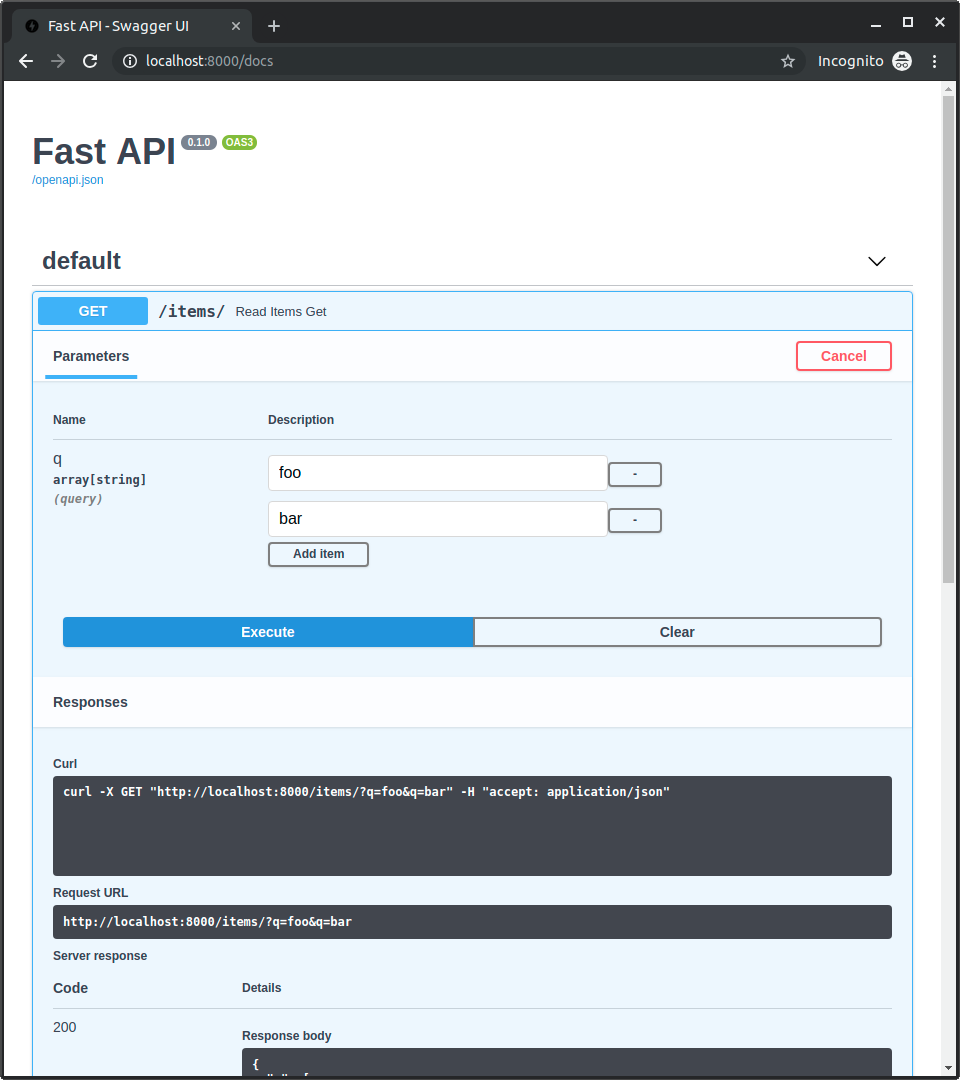
http://localhost:8000/items/?q=foo&q=bar
recibirías los múltiples valores de los query parameters q (foo y bar) en una list de Python dentro de tu path operation function, en el parámetro de función q.
Entonces, el response a esa URL sería:
{
  "q": [
    "foo",
    "bar"
  ]
}
Consejo
Para declarar un parámetro de query con un tipo de list, como en el ejemplo anterior, necesitas usar explícitamente Query, de lo contrario sería interpretado como un request body.
La documentación interactiva de API se actualizará en consecuencia, para permitir múltiples valores:
Lista de parámetros de Query / múltiples valores con valores por defecto
También puedes definir un valor por defecto list de valores si no se proporciona ninguno:
from typing import Annotated

from fastapi import FastAPI, Query

app = FastAPI()


@app.get("/items/")
async def read_items(q: Annotated[list[str], Query()] = ["foo", "bar"]):
    query_items = {"q": q}
    return query_items
🤓 Other versions and variants
Tip
Prefer to use the Annotated version if possible.
from fastapi import FastAPI, Query

app = FastAPI()


@app.get("/items/")
async def read_items(q: list[str] = Query(default=["foo", "bar"])):
    query_items = {"q": q}
    return query_items
Si vas a:
http://localhost:8000/items/
el valor por defecto de q será: ["foo", "bar"] y tu response será:
{
  "q": [
    "foo",
    "bar"
  ]
}
Usando solo list
También puedes usar list directamente en lugar de list[str]:
from typing import Annotated

from fastapi import FastAPI, Query

app = FastAPI()


@app.get("/items/")
async def read_items(q: Annotated[list, Query()] = []):
    query_items = {"q": q}
    return query_items
🤓 Other versions and variants
Tip
Prefer to use the Annotated version if possible.
from fastapi import FastAPI, Query

app = FastAPI()


@app.get("/items/")
async def read_items(q: list = Query(default=[])):
    query_items = {"q": q}
    return query_items
Nota
Ten en cuenta que en este caso, FastAPI no revisará el contenido de la list.
Por ejemplo, list[int] revisaría (y documentaría) que el contenido de la list son enteros. Pero list sola no lo haría.
Declarar más metadatos
Puedes agregar más información sobre el parámetro.
Esa información se incluirá en el OpenAPI generado y será utilizada por las interfaces de usuario de documentación y herramientas externas.
Nota
Ten en cuenta que diferentes herramientas podrían tener diferentes niveles de soporte de OpenAPI.
Algunas de ellas podrían no mostrar toda la información extra declarada todavía, aunque en la mayoría de los casos, la funcionalidad faltante ya está planificada para desarrollo.
Puedes agregar un title:
from typing import Annotated

from fastapi import FastAPI, Query

app = FastAPI()


@app.get("/items/")
async def read_items(
    q: Annotated[str | None, Query(title="Query string", min_length=3)] = None,
):
    results = {"items": [{"item_id": "Foo"}, {"item_id": "Bar"}]}
    if q:
        results.update({"q": q})
    return results
🤓 Other versions and variants
Tip
Prefer to use the Annotated version if possible.
from fastapi import FastAPI, Query

app = FastAPI()


@app.get("/items/")
async def read_items(
    q: str | None = Query(default=None, title="Query string", min_length=3),
):
    results = {"items": [{"item_id": "Foo"}, {"item_id": "Bar"}]}
    if q:
        results.update({"q": q})
    return results
Y una description:
from typing import Annotated

from fastapi import FastAPI, Query

app = FastAPI()


@app.get("/items/")
async def read_items(
    q: Annotated[
        str | None,
        Query(
            title="Query string",
            description="Query string for the items to search in the database that have a good match",
            min_length=3,
        ),
    ] = None,
):
    results = {"items": [{"item_id": "Foo"}, {"item_id": "Bar"}]}
    if q:
        results.update({"q": q})
    return results
🤓 Other versions and variants
Tip
Prefer to use the Annotated version if possible.
from fastapi import FastAPI, Query

app = FastAPI()


@app.get("/items/")
async def read_items(
    q: str | None = Query(
        default=None,
        title="Query string",
        description="Query string for the items to search in the database that have a good match",
        min_length=3,
    ),
):
    results = {"items": [{"item_id": "Foo"}, {"item_id": "Bar"}]}
    if q:
        results.update({"q": q})
    return results
Alias para parámetros
Imagina que quieres que el parámetro sea item-query.
Como en:
http://127.0.0.1:8000/items/?item-query=foobaritems
Pero item-query no es un nombre de variable válido en Python.
Lo más cercano sería item_query.
Pero aún necesitas que sea exactamente item-query...
Entonces puedes declarar un alias, y ese alias será usado para encontrar el valor del parámetro:
from typing import Annotated

from fastapi import FastAPI, Query

app = FastAPI()


@app.get("/items/")
async def read_items(q: Annotated[str | None, Query(alias="item-query")] = None):
    results = {"items": [{"item_id": "Foo"}, {"item_id": "Bar"}]}
    if q:
        results.update({"q": q})
    return results
🤓 Other versions and variants
Tip
Prefer to use the Annotated version if possible.
from fastapi import FastAPI, Query

app = FastAPI()


@app.get("/items/")
async def read_items(q: str | None = Query(default=None, alias="item-query")):
    results = {"items": [{"item_id": "Foo"}, {"item_id": "Bar"}]}
    if q:
        results.update({"q": q})
    return results
Declarar parámetros obsoletos
Ahora digamos que ya no te gusta este parámetro.
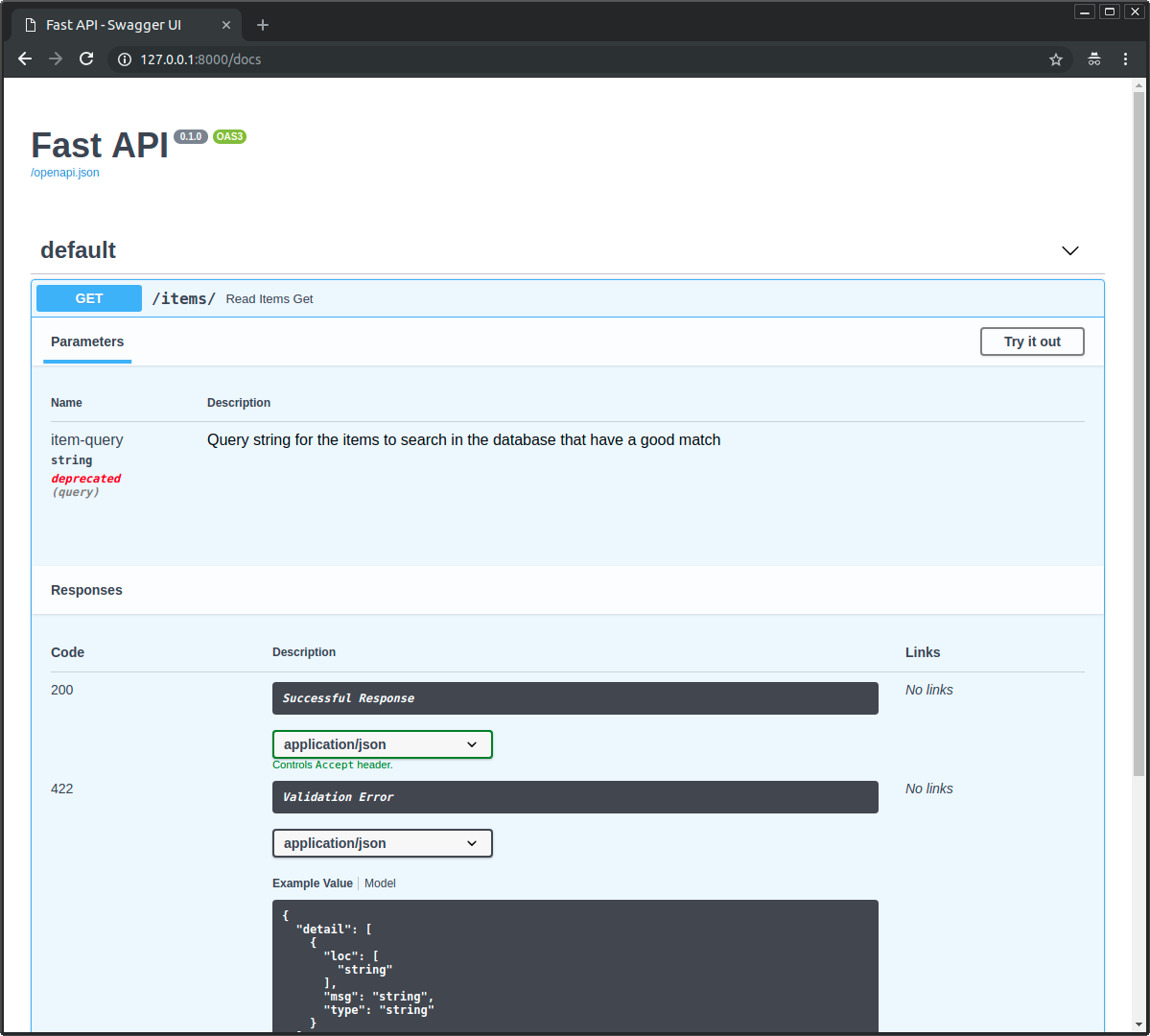
Tienes que dejarlo allí por un tiempo porque hay clientes usándolo, pero quieres que la documentación lo muestre claramente como obsoleto.
Luego pasa el parámetro deprecated=True a Query:
from typing import Annotated

from fastapi import FastAPI, Query

app = FastAPI()


@app.get("/items/")
async def read_items(
    q: Annotated[
        str | None,
        Query(
            alias="item-query",
            title="Query string",
            description="Query string for the items to search in the database that have a good match",
            min_length=3,
            max_length=50,
            pattern="^fixedquery$",
            deprecated=True,
        ),
    ] = None,
):
    results = {"items": [{"item_id": "Foo"}, {"item_id": "Bar"}]}
    if q:
        results.update({"q": q})
    return results
🤓 Other versions and variants
Tip
Prefer to use the Annotated version if possible.
from fastapi import FastAPI, Query

app = FastAPI()


@app.get("/items/")
async def read_items(
    q: str | None = Query(
        default=None,
        alias="item-query",
        title="Query string",
        description="Query string for the items to search in the database that have a good match",
        min_length=3,
        max_length=50,
        pattern="^fixedquery$",
        deprecated=True,
    ),
):
    results = {"items": [{"item_id": "Foo"}, {"item_id": "Bar"}]}
    if q:
        results.update({"q": q})
    return results
La documentación lo mostrará así:
Excluir parámetros de OpenAPI
Para excluir un parámetro de query del esquema de OpenAPI generado (y por lo tanto, de los sistemas de documentación automática), establece el parámetro include_in_schema de Query a False:
from typing import Annotated

from fastapi import FastAPI, Query

app = FastAPI()


@app.get("/items/")
async def read_items(
    hidden_query: Annotated[str | None, Query(include_in_schema=False)] = None,
):
    if hidden_query:
        return {"hidden_query": hidden_query}
    else:
        return {"hidden_query": "Not found"}
🤓 Other versions and variants
Tip
Prefer to use the Annotated version if possible.
from fastapi import FastAPI, Query

app = FastAPI()


@app.get("/items/")
async def read_items(
    hidden_query: str | None = Query(default=None, include_in_schema=False),
):
    if hidden_query:
        return {"hidden_query": hidden_query}
    else:
        return {"hidden_query": "Not found"}
Validación personalizada
Podría haber casos donde necesites hacer alguna validación personalizada que no puede hacerse con los parámetros mostrados arriba.
En esos casos, puedes usar una función validadora personalizada que se aplique después de la validación normal (por ejemplo, después de validar que el valor es un str).
Puedes lograr eso usando AfterValidator de Pydantic dentro de Annotated.
Consejo
Pydantic también tiene BeforeValidator y otros. 🤓
Por ejemplo, este validador personalizado revisa que el ID del ítem empiece con isbn- para un número de libro ISBN o con imdb- para un ID de URL de película de IMDB:
import random
from typing import Annotated

from fastapi import FastAPI
from pydantic import AfterValidator

app = FastAPI()

data = {
    "isbn-9781529046137": "The Hitchhiker's Guide to the Galaxy",
    "imdb-tt0371724": "The Hitchhiker's Guide to the Galaxy",
    "isbn-9781439512982": "Isaac Asimov: The Complete Stories, Vol. 2",
}


def check_valid_id(id: str):
    if not id.startswith(("isbn-", "imdb-")):
        raise ValueError('Invalid ID format, it must start with "isbn-" or "imdb-"')
    return id


@app.get("/items/")
async def read_items(
    id: Annotated[str | None, AfterValidator(check_valid_id)] = None,
):
    if id:
        item = data.get(id)
    else:
        id, item = random.choice(list(data.items()))
    return {"id": id, "name": item}
Nota
Esto está disponible con Pydantic versión 2 o superior. 😎
Consejo
Si necesitas hacer cualquier tipo de validación que requiera comunicarte con algún componente externo, como una base de datos u otra API, deberías usar Dependencias de FastAPI, las aprenderás más adelante.
Estos validadores personalizados son para cosas que pueden revisarse solo con los mismos datos provistos en el request.
Entiende ese código
El punto importante es solo usar AfterValidator con una función dentro de Annotated. Si quieres, sáltate esta parte. 🤸
Pero si te da curiosidad este ejemplo de código específico y sigues entretenido, aquí tienes algunos detalles extra.
String con value.startswith()
¿Lo notaste? Un string usando value.startswith() puede recibir una tupla, y revisará cada valor en la tupla:
# Code above omitted 👆

def check_valid_id(id: str):
    if not id.startswith(("isbn-", "imdb-")):
        raise ValueError('Invalid ID format, it must start with "isbn-" or "imdb-"')
    return id

# Code below omitted 👇
👀 Full file preview
import random
from typing import Annotated

from fastapi import FastAPI
from pydantic import AfterValidator

app = FastAPI()

data = {
    "isbn-9781529046137": "The Hitchhiker's Guide to the Galaxy",
    "imdb-tt0371724": "The Hitchhiker's Guide to the Galaxy",
    "isbn-9781439512982": "Isaac Asimov: The Complete Stories, Vol. 2",
}


def check_valid_id(id: str):
    if not id.startswith(("isbn-", "imdb-")):
        raise ValueError('Invalid ID format, it must start with "isbn-" or "imdb-"')
    return id


@app.get("/items/")
async def read_items(
    id: Annotated[str | None, AfterValidator(check_valid_id)] = None,
):
    if id:
        item = data.get(id)
    else:
        id, item = random.choice(list(data.items()))
    return {"id": id, "name": item}
Un ítem aleatorio
Con data.items() obtenemos un objeto iterable con tuplas que contienen la clave y el valor para cada elemento del diccionario.
Convertimos este objeto iterable en una list propiamente dicha con list(data.items()).
Luego con random.choice() podemos obtener un valor aleatorio de la list, así que obtenemos una tupla con (id, name). Será algo como ("imdb-tt0371724", "The Hitchhiker's Guide to the Galaxy").
Luego asignamos esos dos valores de la tupla a las variables id y name.
Así, si el usuario no proporcionó un ID de ítem, aún recibirá una sugerencia aleatoria.
...hacemos todo esto en una sola línea simple. 🤯 ¿No te encanta Python? 🐍
# Code above omitted 👆

@app.get("/items/")
async def read_items(
    id: Annotated[str | None, AfterValidator(check_valid_id)] = None,
):
    if id:
        item = data.get(id)
    else:
        id, item = random.choice(list(data.items()))
    return {"id": id, "name": item}
👀 Full file preview
import random
from typing import Annotated

from fastapi import FastAPI
from pydantic import AfterValidator

app = FastAPI()

data = {
    "isbn-9781529046137": "The Hitchhiker's Guide to the Galaxy",
    "imdb-tt0371724": "The Hitchhiker's Guide to the Galaxy",
    "isbn-9781439512982": "Isaac Asimov: The Complete Stories, Vol. 2",
}


def check_valid_id(id: str):
    if not id.startswith(("isbn-", "imdb-")):
        raise ValueError('Invalid ID format, it must start with "isbn-" or "imdb-"')
    return id


@app.get("/items/")
async def read_items(
    id: Annotated[str | None, AfterValidator(check_valid_id)] = None,
):
    if id:
        item = data.get(id)
    else:
        id, item = random.choice(list(data.items()))
    return {"id": id, "name": item}
Recapitulación
Puedes declarar validaciones y metadatos adicionales para tus parámetros.
Validaciones genéricas y metadatos:
aliastitledescriptiondeprecated
Validaciones específicas para strings:
min_lengthmax_lengthpattern
Validaciones personalizadas usando AfterValidator.
En estos ejemplos viste cómo declarar validaciones para valores de tipo str.
Mira los siguientes capítulos para aprender cómo declarar validaciones para otros tipos, como números.