의존성으로서의 클래스
🌐 AI와 사람이 함께한 번역
이 번역은 사람의 안내를 받아 AI가 만들었습니다. 🤝
원문의 의미를 오해하거나 부자연스러워 보이는 등 오류가 있을 수 있습니다. 🤖
의존성 주입 시스템에 대해 더 깊이 살펴보기 전에, 이전 예제를 업그레이드해 보겠습니다.
이전 예제의 dict
이전 예제에서는 의존성("dependable")에서 dict를 반환하고 있었습니다:
from typing import Annotated

from fastapi import Depends, FastAPI

app = FastAPI()


async def common_parameters(q: str | None = None, skip: int = 0, limit: int = 100):
    return {"q": q, "skip": skip, "limit": limit}


@app.get("/items/")
async def read_items(commons: Annotated[dict, Depends(common_parameters)]):
    return commons


@app.get("/users/")
async def read_users(commons: Annotated[dict, Depends(common_parameters)]):
    return commons
🤓 Other versions and variants
Tip
Prefer to use the Annotated version if possible.
from fastapi import Depends, FastAPI

app = FastAPI()


async def common_parameters(q: str | None = None, skip: int = 0, limit: int = 100):
    return {"q": q, "skip": skip, "limit": limit}


@app.get("/items/")
async def read_items(commons: dict = Depends(common_parameters)):
    return commons


@app.get("/users/")
async def read_users(commons: dict = Depends(common_parameters)):
    return commons
하지만 그러면 경로 처리 함수의 매개변수 commons에서 dict를 받게 됩니다.
그리고 에디터는 dict의 키와 값 타입을 알 수 없기 때문에 dict에 대해서는 (완성 기능 같은) 많은 지원을 제공할 수 없다는 것을 알고 있습니다.
더 나은 방법이 있습니다...
의존성이 되기 위한 조건
지금까지는 함수로 선언된 의존성을 봤습니다.
하지만 그것만이 의존성을 선언하는 유일한 방법은 아닙니다(아마도 더 일반적이긴 하겠지만요).
핵심 요소는 의존성이 "호출 가능(callable)"해야 한다는 것입니다.
파이썬에서 "호출 가능(callable)"이란 파이썬이 함수처럼 "호출"할 수 있는 모든 것입니다.
따라서 something(함수가 아닐 수도 있습니다)이라는 객체가 있고, 다음처럼 "호출"(실행)할 수 있다면:
something()
또는
something(some_argument, some_keyword_argument="foo")
그것은 "호출 가능(callable)"입니다.
의존성으로서의 클래스
파이썬 클래스의 인스턴스를 만들 때도 같은 문법을 사용한다는 것을 알 수 있을 겁니다.
예를 들어:
class Cat:
    def __init__(self, name: str):
        self.name = name


fluffy = Cat(name="Mr Fluffy")
이 경우 fluffy는 클래스 Cat의 인스턴스입니다.
그리고 fluffy를 만들기 위해 Cat을 "호출"하고 있습니다.
따라서 파이썬 클래스도 호출 가능(callable)합니다.
그러면 FastAPI에서는 파이썬 클래스를 의존성으로 사용할 수 있습니다.
FastAPI가 실제로 확인하는 것은 그것이 "호출 가능(callable)"(함수, 클래스, 또는 다른 무엇이든)한지와 정의된 매개변수들입니다.
FastAPI에서 "호출 가능(callable)"한 것을 의존성으로 넘기면, 그 "호출 가능(callable)"한 것의 매개변수들을 분석하고 경로 처리 함수의 매개변수와 동일한 방식으로 처리합니다. 하위 의존성도 포함해서요.
이것은 매개변수가 전혀 없는 callable에도 적용됩니다. 매개변수가 없는 경로 처리 함수에 적용되는 것과 동일합니다.
그러면 위의 의존성("dependable") common_parameters를 클래스 CommonQueryParams로 바꿀 수 있습니다:
from typing import Annotated

from fastapi import Depends, FastAPI

app = FastAPI()


fake_items_db = [{"item_name": "Foo"}, {"item_name": "Bar"}, {"item_name": "Baz"}]


class CommonQueryParams:
    def __init__(self, q: str | None = None, skip: int = 0, limit: int = 100):
        self.q = q
        self.skip = skip
        self.limit = limit


@app.get("/items/")
async def read_items(commons: Annotated[CommonQueryParams, Depends(CommonQueryParams)]):
    response = {}
    if commons.q:
        response.update({"q": commons.q})
    items = fake_items_db[commons.skip : commons.skip + commons.limit]
    response.update({"items": items})
    return response
🤓 Other versions and variants
Tip
Prefer to use the Annotated version if possible.
from fastapi import Depends, FastAPI

app = FastAPI()


fake_items_db = [{"item_name": "Foo"}, {"item_name": "Bar"}, {"item_name": "Baz"}]


class CommonQueryParams:
    def __init__(self, q: str | None = None, skip: int = 0, limit: int = 100):
        self.q = q
        self.skip = skip
        self.limit = limit


@app.get("/items/")
async def read_items(commons: CommonQueryParams = Depends(CommonQueryParams)):
    response = {}
    if commons.q:
        response.update({"q": commons.q})
    items = fake_items_db[commons.skip : commons.skip + commons.limit]
    response.update({"items": items})
    return response
클래스의 인스턴스를 만들 때 사용하는 __init__ 메서드에 주목하세요:
from typing import Annotated

from fastapi import Depends, FastAPI

app = FastAPI()


fake_items_db = [{"item_name": "Foo"}, {"item_name": "Bar"}, {"item_name": "Baz"}]


class CommonQueryParams:
    def __init__(self, q: str | None = None, skip: int = 0, limit: int = 100):
        self.q = q
        self.skip = skip
        self.limit = limit


@app.get("/items/")
async def read_items(commons: Annotated[CommonQueryParams, Depends(CommonQueryParams)]):
    response = {}
    if commons.q:
        response.update({"q": commons.q})
    items = fake_items_db[commons.skip : commons.skip + commons.limit]
    response.update({"items": items})
    return response
🤓 Other versions and variants
Tip
Prefer to use the Annotated version if possible.
from fastapi import Depends, FastAPI

app = FastAPI()


fake_items_db = [{"item_name": "Foo"}, {"item_name": "Bar"}, {"item_name": "Baz"}]


class CommonQueryParams:
    def __init__(self, q: str | None = None, skip: int = 0, limit: int = 100):
        self.q = q
        self.skip = skip
        self.limit = limit


@app.get("/items/")
async def read_items(commons: CommonQueryParams = Depends(CommonQueryParams)):
    response = {}
    if commons.q:
        response.update({"q": commons.q})
    items = fake_items_db[commons.skip : commons.skip + commons.limit]
    response.update({"items": items})
    return response
...이전의 common_parameters와 동일한 매개변수를 가지고 있습니다:
from typing import Annotated

from fastapi import Depends, FastAPI

app = FastAPI()


async def common_parameters(q: str | None = None, skip: int = 0, limit: int = 100):
    return {"q": q, "skip": skip, "limit": limit}


@app.get("/items/")
async def read_items(commons: Annotated[dict, Depends(common_parameters)]):
    return commons


@app.get("/users/")
async def read_users(commons: Annotated[dict, Depends(common_parameters)]):
    return commons
🤓 Other versions and variants
Tip
Prefer to use the Annotated version if possible.
from fastapi import Depends, FastAPI

app = FastAPI()


async def common_parameters(q: str | None = None, skip: int = 0, limit: int = 100):
    return {"q": q, "skip": skip, "limit": limit}


@app.get("/items/")
async def read_items(commons: dict = Depends(common_parameters)):
    return commons


@app.get("/users/")
async def read_users(commons: dict = Depends(common_parameters)):
    return commons
이 매개변수들이 FastAPI가 의존성을 "해결"하는 데 사용할 것들입니다.
두 경우 모두 다음을 갖게 됩니다:
str인 선택적 쿼리 매개변수q.- 기본값이
0인int쿼리 매개변수skip. - 기본값이
100인int쿼리 매개변수limit.
두 경우 모두 데이터는 변환되고, 검증되며, OpenAPI 스키마에 문서화되는 등 여러 처리가 적용됩니다.
사용하기
이제 이 클래스를 사용해 의존성을 선언할 수 있습니다.
from typing import Annotated

from fastapi import Depends, FastAPI

app = FastAPI()


fake_items_db = [{"item_name": "Foo"}, {"item_name": "Bar"}, {"item_name": "Baz"}]


class CommonQueryParams:
    def __init__(self, q: str | None = None, skip: int = 0, limit: int = 100):
        self.q = q
        self.skip = skip
        self.limit = limit


@app.get("/items/")
async def read_items(commons: Annotated[CommonQueryParams, Depends(CommonQueryParams)]):
    response = {}
    if commons.q:
        response.update({"q": commons.q})
    items = fake_items_db[commons.skip : commons.skip + commons.limit]
    response.update({"items": items})
    return response
🤓 Other versions and variants
Tip
Prefer to use the Annotated version if possible.
from fastapi import Depends, FastAPI

app = FastAPI()


fake_items_db = [{"item_name": "Foo"}, {"item_name": "Bar"}, {"item_name": "Baz"}]


class CommonQueryParams:
    def __init__(self, q: str | None = None, skip: int = 0, limit: int = 100):
        self.q = q
        self.skip = skip
        self.limit = limit


@app.get("/items/")
async def read_items(commons: CommonQueryParams = Depends(CommonQueryParams)):
    response = {}
    if commons.q:
        response.update({"q": commons.q})
    items = fake_items_db[commons.skip : commons.skip + commons.limit]
    response.update({"items": items})
    return response
FastAPI는 CommonQueryParams 클래스를 호출합니다. 그러면 해당 클래스의 "인스턴스"가 생성되고, 그 인스턴스가 함수의 매개변수 commons로 전달됩니다.
타입 어노테이션 vs Depends
위 코드에서 CommonQueryParams를 두 번 작성하는 방식에 주목하세요:
commons: Annotated[CommonQueryParams, Depends(CommonQueryParams)]
팁
가능하다면 Annotated 버전을 사용하는 것을 권장합니다.
commons: CommonQueryParams = Depends(CommonQueryParams)
마지막 CommonQueryParams는, 다음에서:
... Depends(CommonQueryParams)
...FastAPI가 실제로 무엇이 의존성인지 알기 위해 사용하는 것입니다.
FastAPI는 여기에서 선언된 매개변수들을 추출하고, 실제로 이것을 호출합니다.
이 경우 첫 번째 CommonQueryParams는 다음에서:
commons: Annotated[CommonQueryParams, ...
팁
가능하다면 Annotated 버전을 사용하는 것을 권장합니다.
commons: CommonQueryParams ...
...FastAPI에 특별한 의미가 없습니다. FastAPI는 이를 데이터 변환, 검증 등에 사용하지 않습니다(그런 용도로는 Depends(CommonQueryParams)를 사용하고 있기 때문입니다).
실제로는 이렇게만 작성해도 됩니다:
commons: Annotated[Any, Depends(CommonQueryParams)]
팁
가능하다면 Annotated 버전을 사용하는 것을 권장합니다.
commons = Depends(CommonQueryParams)
...다음과 같이요:
from typing import Annotated, Any

from fastapi import Depends, FastAPI

app = FastAPI()


fake_items_db = [{"item_name": "Foo"}, {"item_name": "Bar"}, {"item_name": "Baz"}]


class CommonQueryParams:
    def __init__(self, q: str | None = None, skip: int = 0, limit: int = 100):
        self.q = q
        self.skip = skip
        self.limit = limit


@app.get("/items/")
async def read_items(commons: Annotated[Any, Depends(CommonQueryParams)]):
    response = {}
    if commons.q:
        response.update({"q": commons.q})
    items = fake_items_db[commons.skip : commons.skip + commons.limit]
    response.update({"items": items})
    return response
🤓 Other versions and variants
Tip
Prefer to use the Annotated version if possible.
from fastapi import Depends, FastAPI

app = FastAPI()


fake_items_db = [{"item_name": "Foo"}, {"item_name": "Bar"}, {"item_name": "Baz"}]


class CommonQueryParams:
    def __init__(self, q: str | None = None, skip: int = 0, limit: int = 100):
        self.q = q
        self.skip = skip
        self.limit = limit


@app.get("/items/")
async def read_items(commons=Depends(CommonQueryParams)):
    response = {}
    if commons.q:
        response.update({"q": commons.q})
    items = fake_items_db[commons.skip : commons.skip + commons.limit]
    response.update({"items": items})
    return response
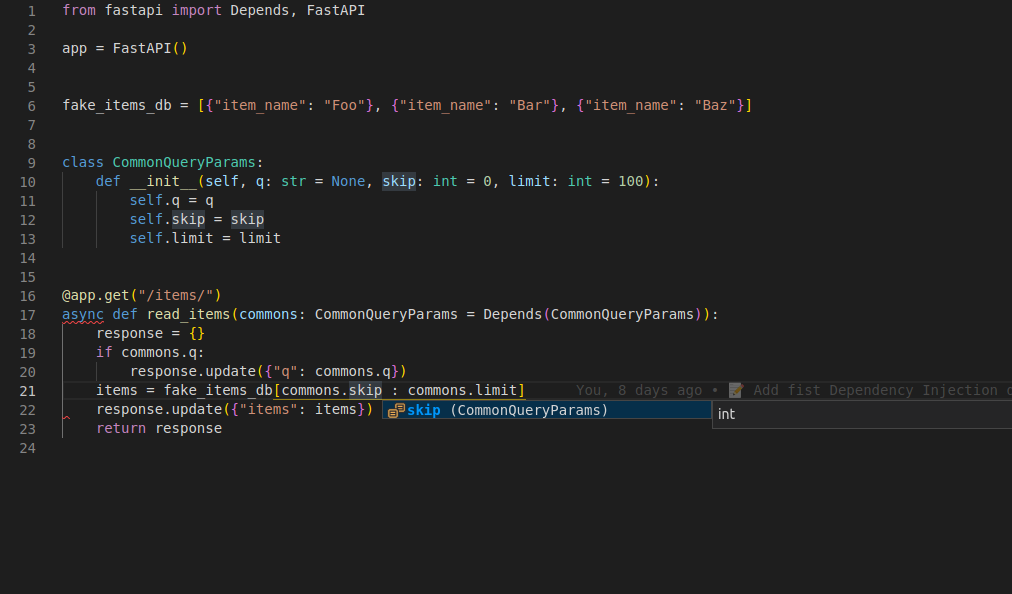
하지만 타입을 선언하는 것을 권장합니다. 그러면 에디터가 매개변수 commons에 무엇이 전달되는지 알 수 있고, 코드 완성, 타입 체크 등에서 도움을 받을 수 있습니다:
단축
하지만 CommonQueryParams를 두 번 작성하는 코드 반복이 있다는 것을 볼 수 있습니다:
commons: Annotated[CommonQueryParams, Depends(CommonQueryParams)]
팁
가능하다면 Annotated 버전을 사용하는 것을 권장합니다.
commons: CommonQueryParams = Depends(CommonQueryParams)
FastAPI는 이런 경우를 위한 단축 방법을 제공합니다. 이때 의존성은 특히 FastAPI가 "호출"해서 클래스 자체의 인스턴스를 만들도록 하는 클래스입니다.
이 특정한 경우에는 다음과 같이 할 수 있습니다:
다음처럼 작성하는 대신:
commons: Annotated[CommonQueryParams, Depends(CommonQueryParams)]
팁
가능하다면 Annotated 버전을 사용하는 것을 권장합니다.
commons: CommonQueryParams = Depends(CommonQueryParams)
...이렇게 작성합니다:
commons: Annotated[CommonQueryParams, Depends()]
팁
가능하다면 Annotated 버전을 사용하는 것을 권장합니다.
commons: CommonQueryParams = Depends()
의존성을 매개변수의 타입으로 선언하고, Depends(CommonQueryParams) 안에 클래스 전체를 다시 작성하는 대신 매개변수 없이 Depends()를 사용합니다.
그러면 같은 예제는 다음처럼 보일 겁니다:
from typing import Annotated

from fastapi import Depends, FastAPI

app = FastAPI()


fake_items_db = [{"item_name": "Foo"}, {"item_name": "Bar"}, {"item_name": "Baz"}]


class CommonQueryParams:
    def __init__(self, q: str | None = None, skip: int = 0, limit: int = 100):
        self.q = q
        self.skip = skip
        self.limit = limit


@app.get("/items/")
async def read_items(commons: Annotated[CommonQueryParams, Depends()]):
    response = {}
    if commons.q:
        response.update({"q": commons.q})
    items = fake_items_db[commons.skip : commons.skip + commons.limit]
    response.update({"items": items})
    return response
🤓 Other versions and variants
Tip
Prefer to use the Annotated version if possible.
from fastapi import Depends, FastAPI

app = FastAPI()


fake_items_db = [{"item_name": "Foo"}, {"item_name": "Bar"}, {"item_name": "Baz"}]


class CommonQueryParams:
    def __init__(self, q: str | None = None, skip: int = 0, limit: int = 100):
        self.q = q
        self.skip = skip
        self.limit = limit


@app.get("/items/")
async def read_items(commons: CommonQueryParams = Depends()):
    response = {}
    if commons.q:
        response.update({"q": commons.q})
    items = fake_items_db[commons.skip : commons.skip + commons.limit]
    response.update({"items": items})
    return response
...그리고 FastAPI는 무엇을 해야 하는지 알게 됩니다.
팁
도움이 되기보다 더 헷갈린다면, 무시하세요. 이건 필수가 아닙니다.
그저 단축 방법일 뿐입니다. FastAPI는 코드 반복을 최소화하도록 도와주는 것을 중요하게 생각하기 때문입니다.